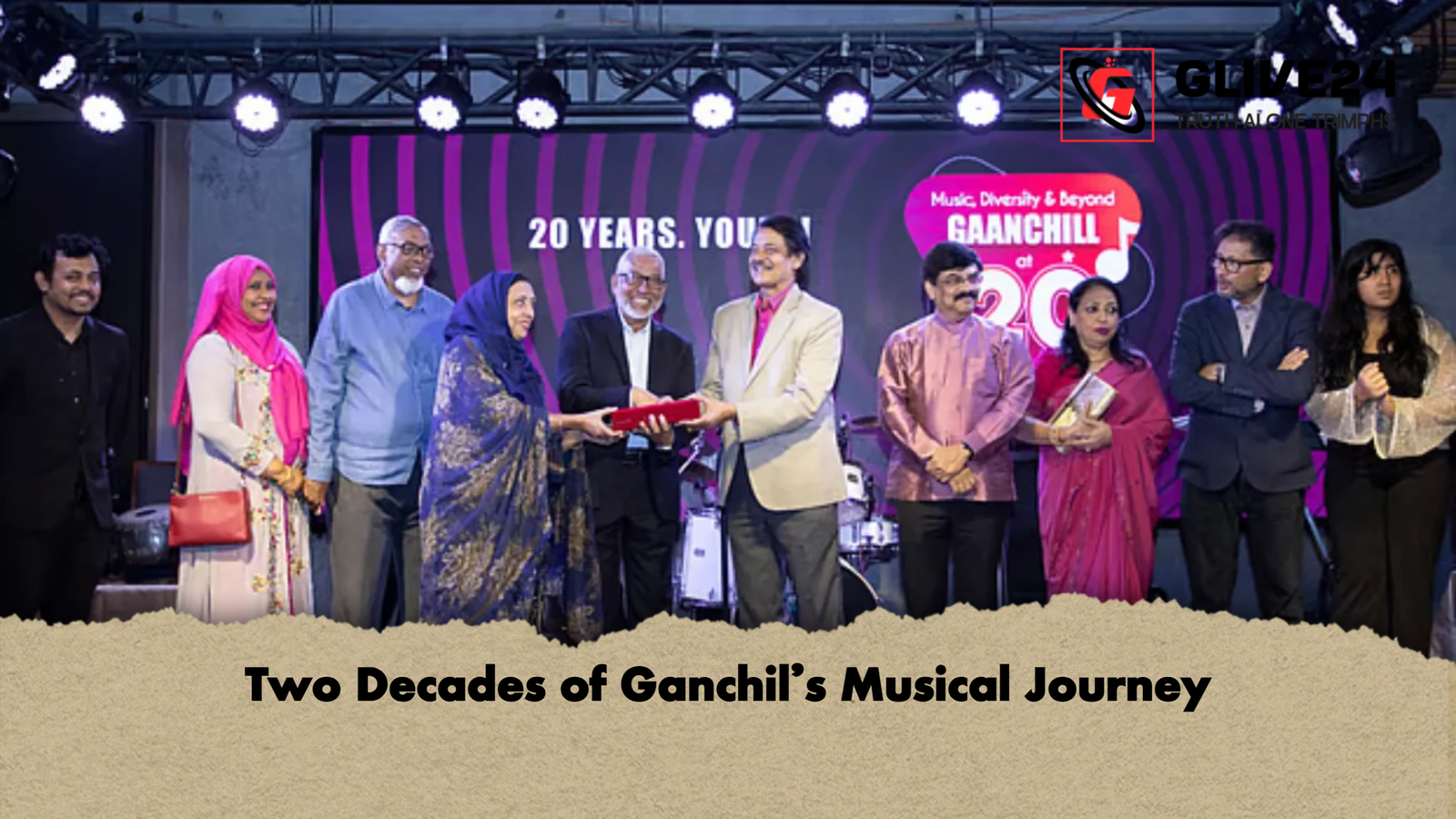
Spanning the cassette-and-CD era of the 1990s to the album culture of the 2000s, and finally arriving at today’s digital age, Bangladesh’s musical landscape has witnessed profound transformations. On the evening marking the twentieth anniversary of Ganchil, one of the country’s foremost music production houses, the atmosphere brimmed with nostalgia, melody, and heartfelt emotion. Musicians, composers, lyricists, and behind-the-scenes artisans gathered to celebrate not only two decades of music but also the enduring spirit behind it.
The anniversary was more than a mere remembrance of the past; it was a declaration of Ganchil’s continued commitment to the future of music. Honouring tradition while embracing change, the institution unveiled a new logo, announced expanded projects, and formally articulated its renewed ethos: “Legacy never retires; it reinvents itself.”
Founded in late 2005 by Nakeeb Khan, Kumar Bishwajit, Asif Iqbal, and Reza Rahman, Ganchil has grown steadily into a mature music enterprise. Today, Asif Iqbal serves as the sole custodian of the institution. During the anniversary celebrations, he personally oversaw the presentation of commemorative plaques to the three founding members. Although Kumar Bishwajit was attending from Canada via video call, he expressed his gratitude and shared his reflections with the audience. The founders’ words echoed the trials, memories, and affection entwined with Ganchil’s journey, coupled with hopes for the institution’s continued expansion.
Following the formal honours, the main cultural programme commenced. Performances by Konal, Salma, Kishore, Mahadi, Dola, Niloy, Nahid Hasan, and Tarik Mridha, among others, brought to life popular tracks penned by Asif Iqbal under the Ganchil banner. From the early days, the production house had prioritised high-quality music, releasing Mehrob and Rumi’s acclaimed albums Adda and Beauty’s Charandasi. However, the market faced challenges during 2008–09 due to piracy and the rise of FM radio culture, leading to a temporary suspension of album releases in 2012. By 2015, Ganchil had reemerged with renewed energy, adapting to the digital landscape and continuing to nurture music culture.
Looking ahead, Asif Iqbal shared ambitious plans for Ganchil, including theatre projects, the Ganchil Originals music series, and Pather Golpo, a production highlighting unseen aspects of Bangladesh to provide audiences with fresh experiences.
The evening concluded with the premiere of the new music video O Jan, performed by Konal and Niloy, lyrics by Asif Iqbal, and co-composed by Avral Sahir and Lincoln from West Bengal. Filmed amidst the breathtaking landscapes of Mustang, Nepal, the video also features performances by Sunerah Binte Kamal and Farrokh Ahmed Rehan. The screening elicited thunderous applause, and the performers shared that meticulous care and passion had shaped the project, with the unique location adding a distinct visual dimension.
The event was hosted with flair by Mousumi Mou and Abu Hena Roni, and attended by luminaries including Shahid Mahmud Jangi, Rafikul Alam, Samina Chowdhury, Manam Ahmed, Shawkat Ali Emon, Chayanika Chowdhury, and many others.
| Year | Key Milestone | Significance |
|---|---|---|
| 2005 | Ganchil founded | Launch of album-focused music production |
| 2006–07 | Popular albums released | Gained early audience acclaim |
| 2008–09 | Market slump due to piracy | Album sales decline |
| 2012 | Album releases paused | Strategic reassessment |
| 2015–Present | Digital resurgence | New content, Ganchil Originals, audience expansion |
Ultimately, the celebrations reaffirmed that Ganchil is far more than a music production house; it is a living bridge of time, memory, and legacy—ever capable of reinvention while honouring its past.