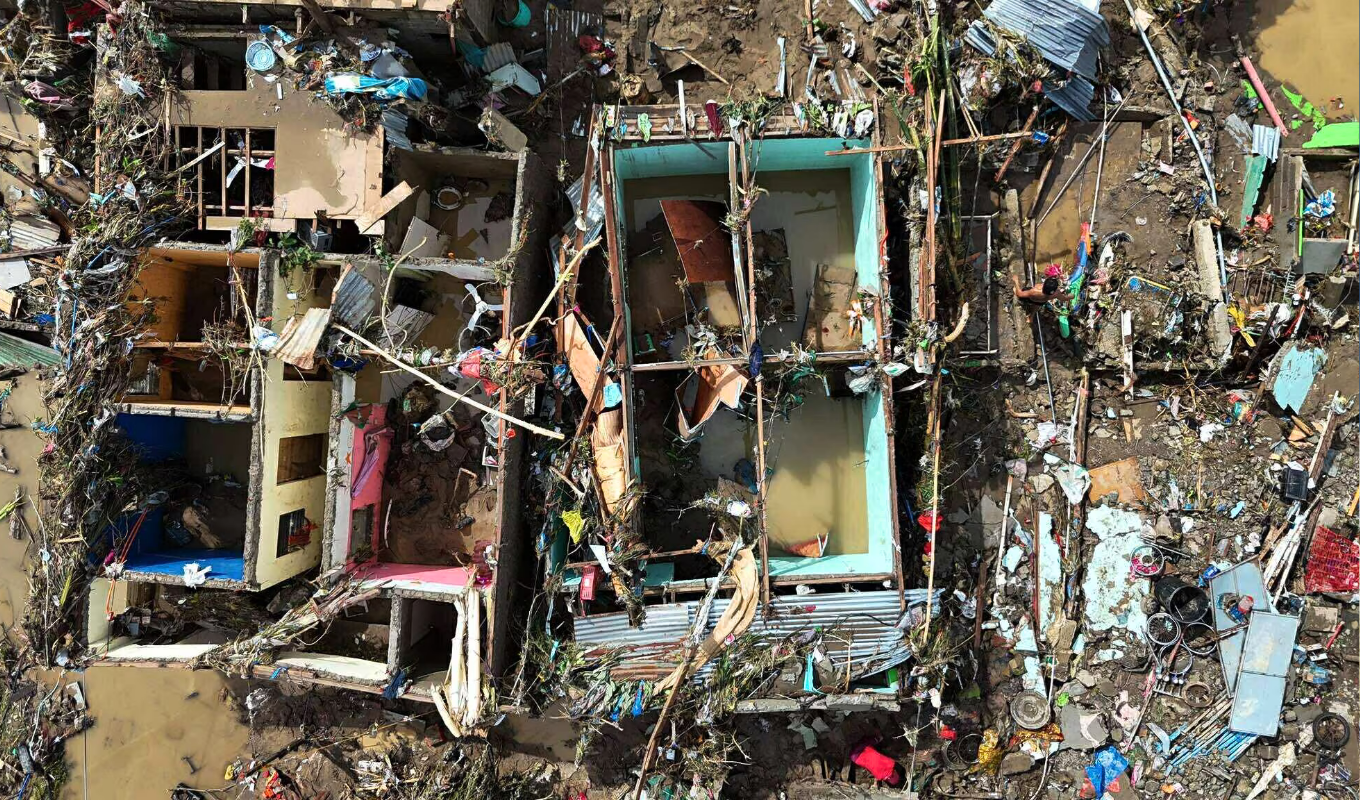
Typhoon Kalmaegi tore across Vietnam early on Friday, killing five people after wreaking havoc in the Philippines, where the death toll has surged to 188. The storm brought record rainfall, widespread flooding, and destructive winds that flattened homes and paralysed entire communities across both nations.
Earlier this week, Kalmaegi unleashed torrential rains over the central Philippines, sweeping away vehicles, containers, and entire buildings before slamming into Vietnam late on Thursday.
“The roof of my house’s second floor was just blown away,” said Nguyen Van Tam, a 42-year-old fisherman in Vietnam’s Gia Lai province, where the storm made landfall with sustained winds reaching 149 kilometres (92 miles) per hour, according to the Environment Ministry. “We were all safe, but the typhoon was really terrible—so many trees have fallen,” he added, relieved that his fishing boat had survived the tempest.
Vietnamese officials continued assessing the damage on Friday morning. Preliminary reports confirmed five fatalities and 57 houses completely destroyed in Gia Lai and neighbouring Dak Lak, while nearly 3,000 more homes suffered roof or structural damage. Eleven boats and ships were reported sunk.
Along the coastline of Quy Nhon beach, AFP correspondents observed rescue teams and soldiers assisting residents in clearing debris, cutting fallen trees, and retrieving metal roofs scattered by the storm.
“This was a very big typhoon that hit us,” said Tran Ngo An, 64. “It’s only the second time in my life I’ve seen a storm like this. The last one was about ten years ago, but this was much stronger.”
Vietnam’s state electricity provider reported that 1.6 million customers lost power when the typhoon battered the central coast. Electricity was partially restored by Friday morning, though thousands remain without supply.
While the storm weakened as it moved inland, forecasters warned that heavy rains would persist along the central coastline throughout the day.
Vietnam, one of the world’s most cyclone-prone nations, experiences around ten tropical storms or typhoons each year. However, Kalmaegi marked the thirteenth of 2025, underscoring a worrying escalation in storm frequency and intensity. Climate scientists warn that human-induced global warming is fuelling stronger storms, as warmer seas and air amplify both wind speed and rainfall.
Relentless Rains Batter the Philippines
Before making landfall in Vietnam, Kalmaegi devastated the Philippine islands of Cebu and Negros, submerging towns and cities under floodwaters described as “unprecedented.” Search operations continue for the 135 people still missing, according to Philippine authorities, who confirmed the death toll had risen to 188 on Thursday.
The typhoon struck Vietnam while the country was still recovering from more than a week of flooding and record-breaking rainfall that had already claimed at least 47 lives and inundated thousands of homes.
The ancient cities of Hue and Hoi An, both UNESCO World Heritage Sites, were among the worst affected. Streets in these historic areas turned into canals after torrential rains dumped up to 1.7 metres (5 feet 6 inches) of water in just 24 hours — breaking national precipitation records.
With over 3,200 kilometres of coastline and 2,300 rivers, Vietnam remains acutely vulnerable to flooding. According to the national statistics office, natural disasters had already killed or left 279 people missing in 2025 and caused over $2 billion in damages — even before Typhoon Kalmaegi’s arrival.