
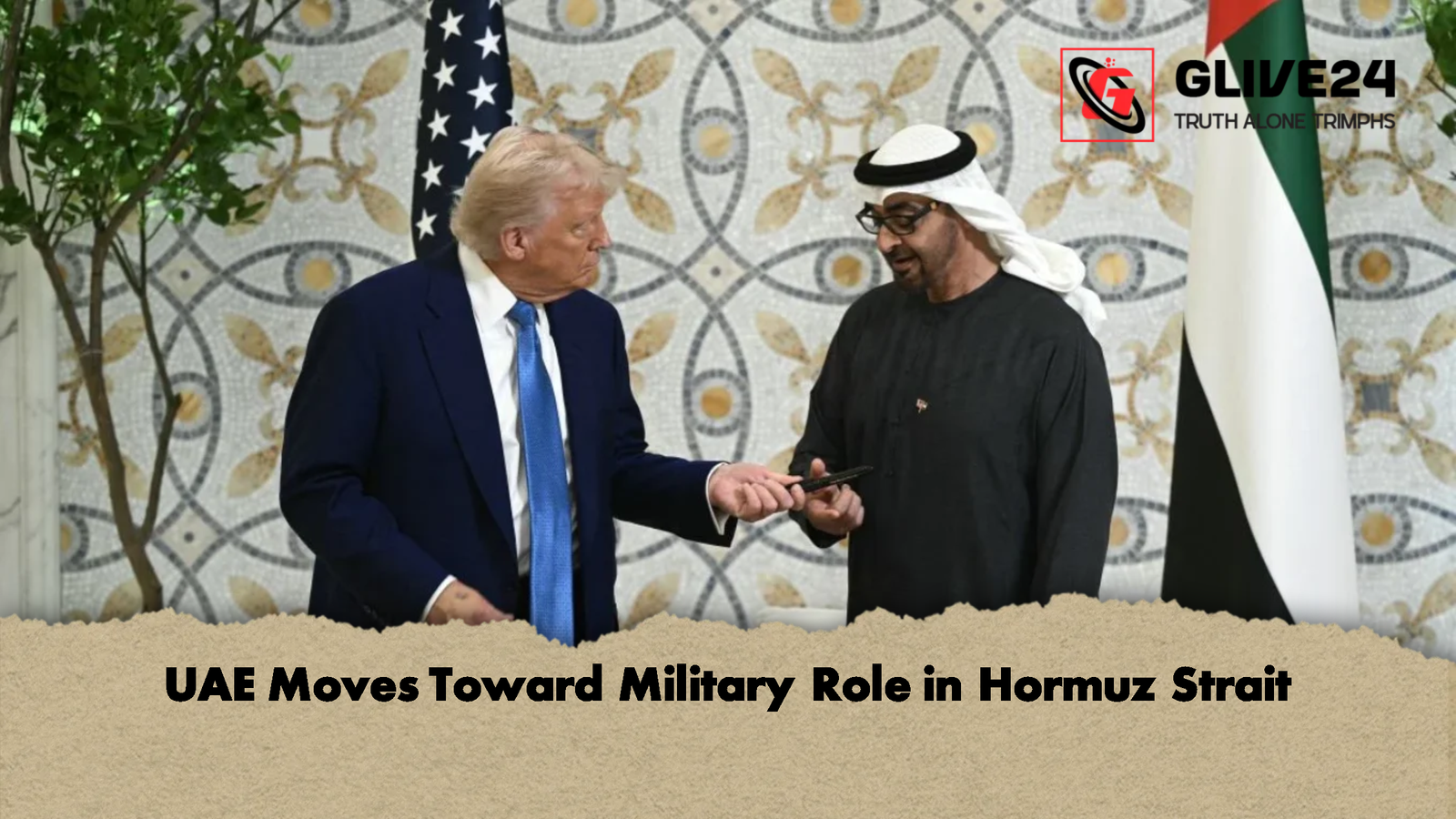
The United Arab Emirates (UAE) is reportedly undergoing a notable strategic realignment amid rising tensions with Iran, with indications that it is preparing to participate in a potential United States-led military initiative aimed at securing the Strait of Hormuz, a vital global shipping corridor. According to reporting attributed to The Wall Street Journal, the Gulf state is edging closer to a position that could see it directly involved in any future confrontation with Tehran.
If realised, this would represent a significant escalation in regional dynamics, marking the first time a Gulf Arab nation has been closely associated with a direct military campaign targeting Iran.
Table of Contents
Diplomatic and Operational Coordination
Sources familiar with the discussions suggest that the UAE is working on drafting a proposal for submission to the United Nations Security Council, seeking international legal backing for operations intended to guarantee the continued openness of the Strait of Hormuz. Alongside this initiative, Abu Dhabi is reportedly engaging in diplomatic outreach to Western and Asian partners in an effort to build a broader multinational coalition.
Emirati officials are said to argue that Iran, under mounting domestic and international pressure, may attempt to weaponise its geographic position by disrupting maritime traffic through the strait. In such a scenario, they contend that military intervention could become necessary if diplomatic and economic measures fail to prevent escalation.
Early operational considerations are understood to include limited but critical support roles, such as mine-clearance operations within the strait, as well as intelligence sharing and logistical assistance for allied forces.
Territorial Disputes and Strategic Positions
The report also highlights renewed Emirati emphasis on disputed islands within the Strait of Hormuz, particularly Abu Musa, which has been under Iranian control for decades but remains claimed by the UAE. Emirati officials are believed to have argued that control or secure access to such strategic points could be essential for safeguarding maritime security in the region.
Regional Alignment and International Involvement
Saudi Arabia and other Gulf Cooperation Council members are understood to support continued pressure on Iran aimed at curbing its military capabilities, although none have formally committed to deploying ground forces.
Bahrain, a close United States ally and host to the US Navy’s Fifth Fleet, is expected to introduce a related resolution at the United Nations Security Council, signalling increasing alignment between Gulf states and Washington’s strategic objectives.
Key Strategic Overview
| Category | Details |
|---|---|
| Potential Mission | Security and stability of Strait of Hormuz |
| Proposed UAE Role | Mine clearance, logistics, intelligence, air support |
| Diplomatic Initiative | Draft UN Security Council resolution under preparation |
| Military Assets | F-16 fighter jets, surveillance drones |
| Strategic Infrastructure | Jebel Ali Port (logistical staging hub) |
| Key Partners | United States, Bahrain, Saudi Arabia (political alignment) |
| Principal Adversary | Iran |
| Territorial Dispute | Abu Musa Island |
Escalating Military Pressure
Iran has reportedly intensified its military posture in response to the UAE’s shifting alignment. Regional accounts suggest that Tehran has launched multiple ballistic and cruise missile strikes, alongside drone attacks, targeting Emirati territory. Iranian officials have warned that any state assisting efforts perceived as undermining Iranian sovereignty or strategic interests would face retaliatory strikes against civilian infrastructure.
Since the escalation of hostilities, Iran is believed to have launched approximately 2,500 missiles and drones in total, with the UAE reportedly absorbing a greater share of attacks than Israel, according to the same regional assessments.
Expert Warnings and Strategic Risks
Security analysts have cautioned that any direct involvement in securing the Strait of Hormuz could expose Gulf states to sustained asymmetric warfare. Elizabeth Dent of the Washington Institute has suggested that a premature US withdrawal following a declaration of success could leave allies such as the UAE vulnerable to prolonged Iranian retaliation.
Meanwhile, US lawmaker Adam Smith has warned that maintaining maritime security in the strait would be highly complex, noting that even small-scale drone or fast-boat attacks could significantly disrupt shipping lanes.
Bilal Saab of Chatham House has highlighted the UAE’s strategic value in any potential coalition effort, pointing to facilities such as Jebel Ali Port as key logistical hubs. He also noted that the country’s advanced F-16 fleet, surveillance drones, and precision-guided munitions supplied by the United States could enhance the operational capabilities of a Western-led coalition.
A Volatile Regional Calculus
While the UAE’s emerging stance aligns it more closely with Western strategic priorities, it also raises the risk of widening the regional conflict. The Strait of Hormuz remains one of the world’s most critical energy transit routes, and any sustained disruption could have immediate global economic consequences.
As tensions continue to rise, Gulf states face an increasingly complex balancing act between strategic alignment, economic stability, and the growing possibility of direct military confrontation with Iran.