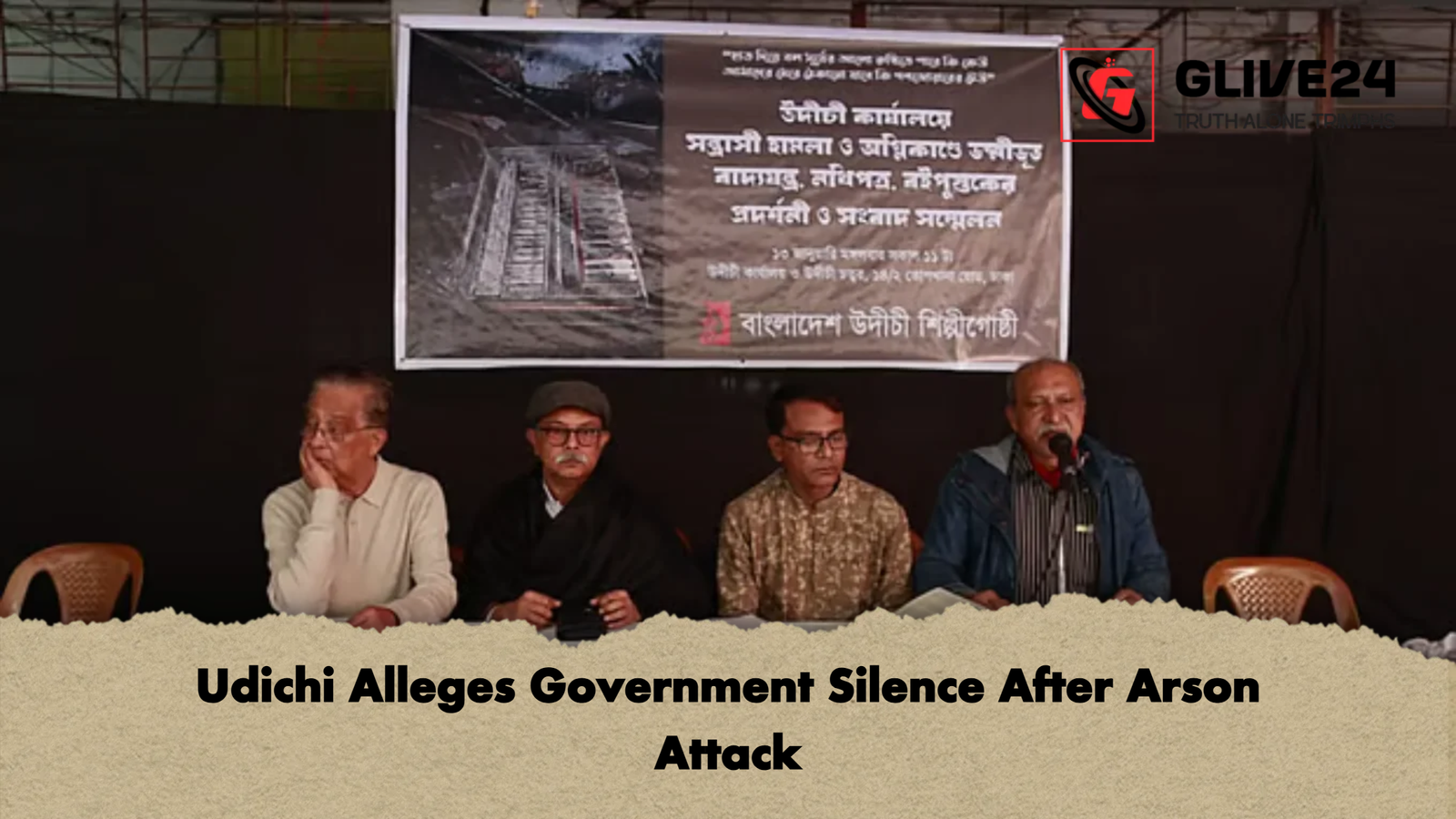
Twenty-four days after a violent attack and arson reduced large parts of its central office to ashes, Bangladesh’s renowned cultural organisation Udichi Shilpigosthi says it has received no visit, inquiry, or even a gesture of sympathy from any responsible member of the interim government. The allegation was made during a public exhibition and press conference held on Tuesday in front of Udichi’s central office in Dhaka.
The exhibition displayed the charred remains of cultural materials accumulated over Udichi’s 57-year history. Burnt musical instruments, theatre costumes, stage props, archival documents, photographs, and organisational records were laid out to demonstrate both the material loss and the symbolic assault on Bangladesh’s progressive cultural movement. Organisers said the exhibition was intended not only to document destruction but also to remind the public of Udichi’s long-standing role in promoting secularism, cultural resistance, and democratic values.
Speaking at the press conference, Acting President Habibul Alam and General Secretary Jamsed Anwar expressed deep disappointment at what they described as the “complete indifference” of the authorities. Anwar, reading a written statement, said the cultural adviser’s silence following such a serious attack on one of the country’s largest and most influential cultural organisations had raised serious questions about the state’s commitment to protecting cultural institutions.
Anwar described the attack as premeditated, alleging the involvement of anti-liberation, extremist, and fascist forces. He pointed to a pattern of violence, noting that attacks on Chhayanaut, Prothom Alo, and The Daily Star took place on 18 December, followed by the assault on Udichi the next day. This sequence, he argued, demonstrated that the incident was not isolated but part of a coordinated campaign against progressive voices.
He further claimed that threats made publicly by leaders of Islami Chhatra Shibir were widely known in advance, yet no effective preventive measures were taken. On the day of the attack, Udichi leaders said they contacted law enforcement agencies regarding security concerns but received no police assistance. Members of the organisation had remained at the office throughout the day and only learned of the attack while returning from a protest programme near the Chhayanaut building.
Udichi also criticised the interim government for excluding the organisation from this year’s annual state grants for cultural groups, calling the decision discriminatory and unacceptable. Leaders insisted that intimidation would not silence Udichi’s activities.
According to Habibul Alam, a case has been filed and police and fire service officials have completed preliminary investigations and evidence collection. However, no suspects have yet been identified or arrested. Udichi has demanded immediate arrests, warning that failure to ensure justice would prompt broader movements involving cultural workers and the general public.
A brief overview of the losses presented at the exhibition is outlined below:
| Category of Loss | Description |
|---|---|
| Archival Materials | 57 years of documents, photographs, and records |
| Musical Instruments | Drums, harmoniums, tablas, and others |
| Theatre Assets | Costumes, props, stage equipment |
| Organisational Impact | Severe disruption, office rendered unusable |
Veteran politician Mujahidul Islam Selim, former president of the Communist Party of Bangladesh, visited the site and said the smell and devastation reminded him of atrocities committed in November 1971 during the Liberation War. He remarked that those who attack cultural centres cannot be supporters of Bangladesh’s independence.
The event was attended by leaders from various political and cultural organisations. The programme concluded with Udichi members performing the organisation’s anthem in unison, symbolising resilience and collective resistance in the face of destruction.