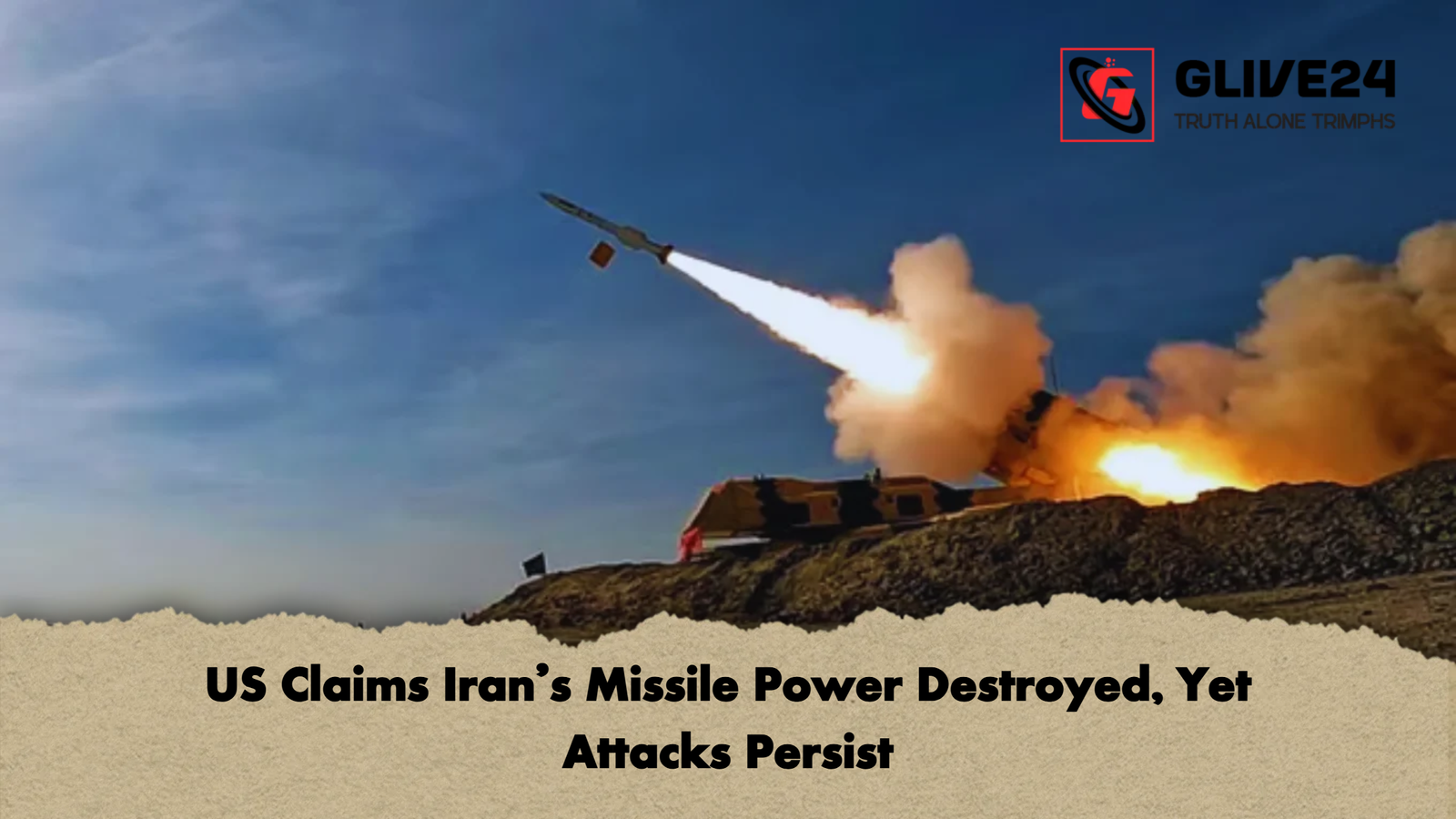
Experts suggest that while the joint United States–Israel offensive has significantly reduced Iran’s missile and drone capabilities, Tehran still retains enough military assets to inflict considerable damage.
The White House stated last Saturday, “Iran’s ballistic missile capabilities have been virtually destroyed. Their navy is not in a position to conduct warfare. We maintain complete air dominance over Iran.”
On 28 February, the United States launched the joint offensive with Israel, dubbed Operation Epic Fury. Officials claim that the operation is yielding substantial results. A key aspect of the US–Israeli strategy is identifying Iranian missile launchers. Every missile launch generates a detectable signature through explosions, which can be tracked via satellite and radar systems. Former President Donald Trump also noted that US forces have almost destroyed Iran’s drone manufacturing capacity.
Despite these claims, incidents continue. On Monday, Qatar announced it had intercepted another missile fired from Iran. Meanwhile, Saudi Arabia, the United Arab Emirates, and Bahrain have issued missile-related alerts. In Abu Dhabi, one person was killed when a missile struck a vehicle.
Iran’s Reduced Missile Activity
Data indicates that Iran’s missile and drone launches have significantly decreased since the conflict began, particularly against Gulf countries and Israel.
| Date / Period | Target | Missiles Launched | Drones Launched | Source |
|---|---|---|---|---|
| First 24 hours | UAE | 167 (ballistic & cruise) | 541 | UAE Ministry of Defence |
| Day 15 | UAE | 4 | 6 | Al Jazeera |
| First 2 days | Israel | ~100 | – | Institute for National Security Studies |
| Recent days | Israel | Single-digit | – | Institute for National Security Studies |
According to the Pentagon, missile attacks have declined by 90% and drone attacks by 86% compared with the first day of conflict. Intelligence reports estimate that Iran possesses approximately 3,000 missiles, down from 2,500 following a 12-day conflict with Israel last June.
Strategic Adaptation
Despite the reduction, Iran has adapted by decentralising its missile operations and relying more on mobile launchers, making them harder to detect and target. David Des Roches, Associate Professor at the National Defense University, noted that completely neutralising Iran’s missile capability without a ground invasion is virtually impossible, even with near-total air control.
Iran’s current tactics involve launching one or two drones or missiles at a time, focusing on civilian and commercial infrastructure rather than major military targets. Des Roches describes this as “harassment attacks” aimed at forcing repeated activation of defence systems and instilling fear.
Experts, including Hamidreza Azizi of the German Institute for International and Security Affairs, note that Iran seeks to outlast its adversaries, relying on persistent, low-volume missile launches. Tehran has honed the production of cost-effective yet highly effective drones like the Shahed-136, which can be deployed in multiple waves to overwhelm defence systems.
Recent attacks include drone strikes near Dubai International Airport and Fujairah industrial zones, as well as missile alerts in central Israel. Maritime traffic in the Strait of Hormuz, which carries 20% of the world’s oil, has slowed due to threats, though actual attacks on ships remain limited.
Economic Implications
Iran’s unconventional tactics are designed to cause economic disruption. The country has influenced oil prices to exceed $100 per barrel, disrupted Qatar’s gas production, halted Bahrain’s state oil shipments, and reduced production at southern Iraqi oilfields by 70%. Professor Vali Nasr of Johns Hopkins University warns that sustained oil price increases could inflict damage on the US economy comparable to or exceeding direct bombings in Iran.
In conclusion, while Iran’s missile capabilities have been materially degraded, its adaptive strategies and ongoing attacks demonstrate a continued capacity to project military and economic influence across the region.