
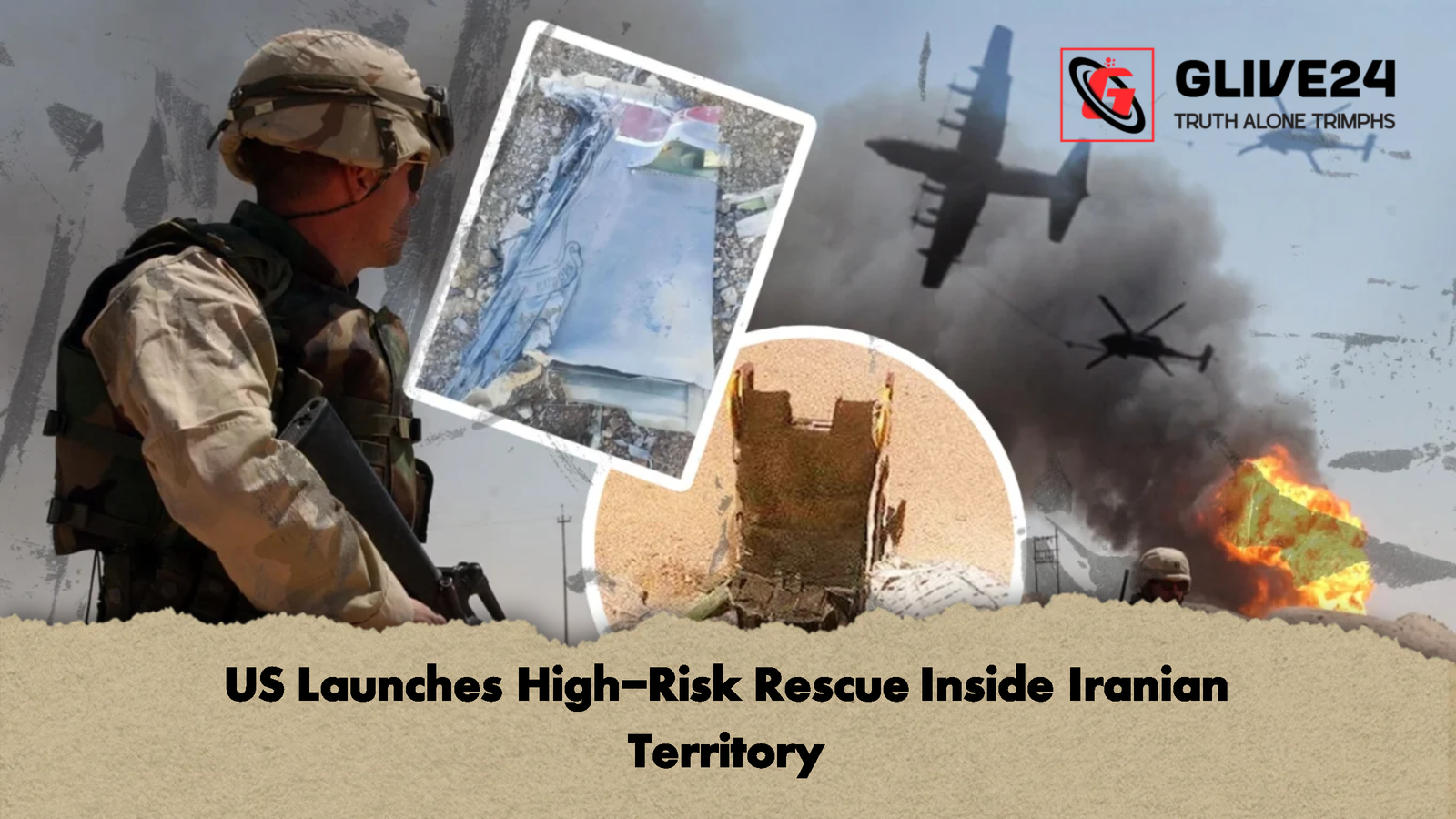
A highly complex and exceptionally dangerous military operation by the United States reportedly led to the successful recovery of two aircrew members after their F-15E Strike Eagle fighter jet was shot down over Iranian territory, triggering a chain of events that military analysts have described as one of the most intricate rescue missions in modern warfare history.
According to details published by international media, including The Daily Mail, the mission came at a significant cost, involving the loss of two advanced military aircraft and a helicopter, alongside the mobilisation of hundreds of elite special forces personnel in an operation spanning roughly 24 hours inside hostile territory.
Table of Contents
Crash and immediate aftermath
The incident began when an F-15E Strike Eagle, flying at extreme speed over south-western Iran, was struck by enemy fire and brought down—marking the first confirmed loss of a US combat aircraft since the 2003 Iraq conflict. The two crew members ejected moments before impact, but were separated during their descent into the mountainous terrain of Kohgiluyeh and Boyer-Ahmad province, roughly 30 miles from the Persian Gulf.
The pilot landed closer to relatively open ground and was located and extracted within hours by a US military helicopter. The second airman, a senior weapons systems officer, was not as fortunate. He landed in a remote, rugged area and sustained significant injuries during ejection, a process known to frequently cause fractures and spinal trauma even under optimal conditions.
Despite his injuries, he was able to move and immediately initiated survival procedures under the SERE doctrine—Survival, Evasion, Resistance and Escape—standard training for personnel operating behind enemy lines.
Survival and evasion in hostile terrain
Equipped with a survival vest containing medical supplies, food rations, a compass, navigation tools, a SIG Sauer M18 pistol, and water purification tablets, the injured airman began treating himself before moving away from the crash site to avoid detection.
Central to his survival was a Combat Survivor Evader Locator (CSEL) device manufactured by Boeing, which allows encrypted communication with command authorities. His first transmission was received hours after the crash, prompting an immediate escalation in US military response planning.
To avoid capture, the airman reportedly moved into extremely difficult mountainous terrain, including climbs of up to 7,000 feet, seeking concealment in isolated, snow-covered elevations. His movements were guided by survival protocols designed to minimise detection risk, while periodically transmitting encrypted location updates.
Massive US military response
Following confirmation that the airman was alive, US Central Command initiated a large-scale recovery operation. Intelligence assessments reportedly led to the deployment of several hundred elite personnel, including Navy SEALs, Delta Force operators, and para-rescue specialists from the 24th Special Tactics Squadron.
The forces were transported using C-130J aircraft, supported by MH-6 Little Bird helicopters from the 160th Special Operations Aviation Regiment—known as the “Night Stalkers”, previously involved in the 2011 Osama bin Laden raid.
Simultaneously, armed drones and A-10 Warthog aircraft were deployed to secure the operational area. Reports suggest that hostile movements within a three-mile radius of the airman’s position were actively suppressed, with infrastructure such as roads, communication towers, and vehicles targeted to prevent interference.
Iranian sources later claimed casualties occurred during these strikes, although independent verification remains limited.
Deception tactics and battlefield confusion
As the operation intensified, US intelligence agencies reportedly considered diversionary tactics to mislead Iranian forces. These included circulating misleading intelligence about the airman’s location to draw attention away from the actual extraction zone.
At the same time, Iranian state media broadcast images of armed mobilisation in mountainous regions, with claims that civilians had joined search efforts after a reward of $60,000 was announced for the airman’s capture.
Despite these developments, the stranded officer had already established a concealed position in extremely rugged terrain, making visual detection difficult even during daylight.
Final extraction and complications
Once the airman’s location was confirmed, special operations forces converged on the area. As helicopters approached, the survivor activated his locator device again, enabling precise identification by rescuers.
However, the extraction phase did not proceed smoothly. Forces initially landed at a makeshift airfield in eastern Iran that had been hastily converted into a temporary US operational base. The site was intended for evacuation logistics but quickly became compromised when two large C-130 Hercules transport aircraft became stuck in soft ground.
With the aircraft immobilised, additional evacuation planes were urgently dispatched, causing several hours of delay and heightened operational risk.
Withdrawal under pressure
Once reinforcement aircraft arrived, all personnel, including the rescued airman, were successfully evacuated. To prevent sensitive equipment from being captured, the stranded aircraft were destroyed on site using explosives, alongside a disabled helicopter that had suffered engine failure.
By the end of the operation, all US forces had withdrawn, concluding a mission that spanned approximately 36 hours and involved direct engagement, deception operations, aerial suppression, and deep insertion of special forces into hostile territory.
Military analysts continue to describe the operation as one of the most daring and logistically complex rescue missions ever conducted, highlighting both the scale of resources deployed and the extreme risks undertaken to recover a single stranded airman.