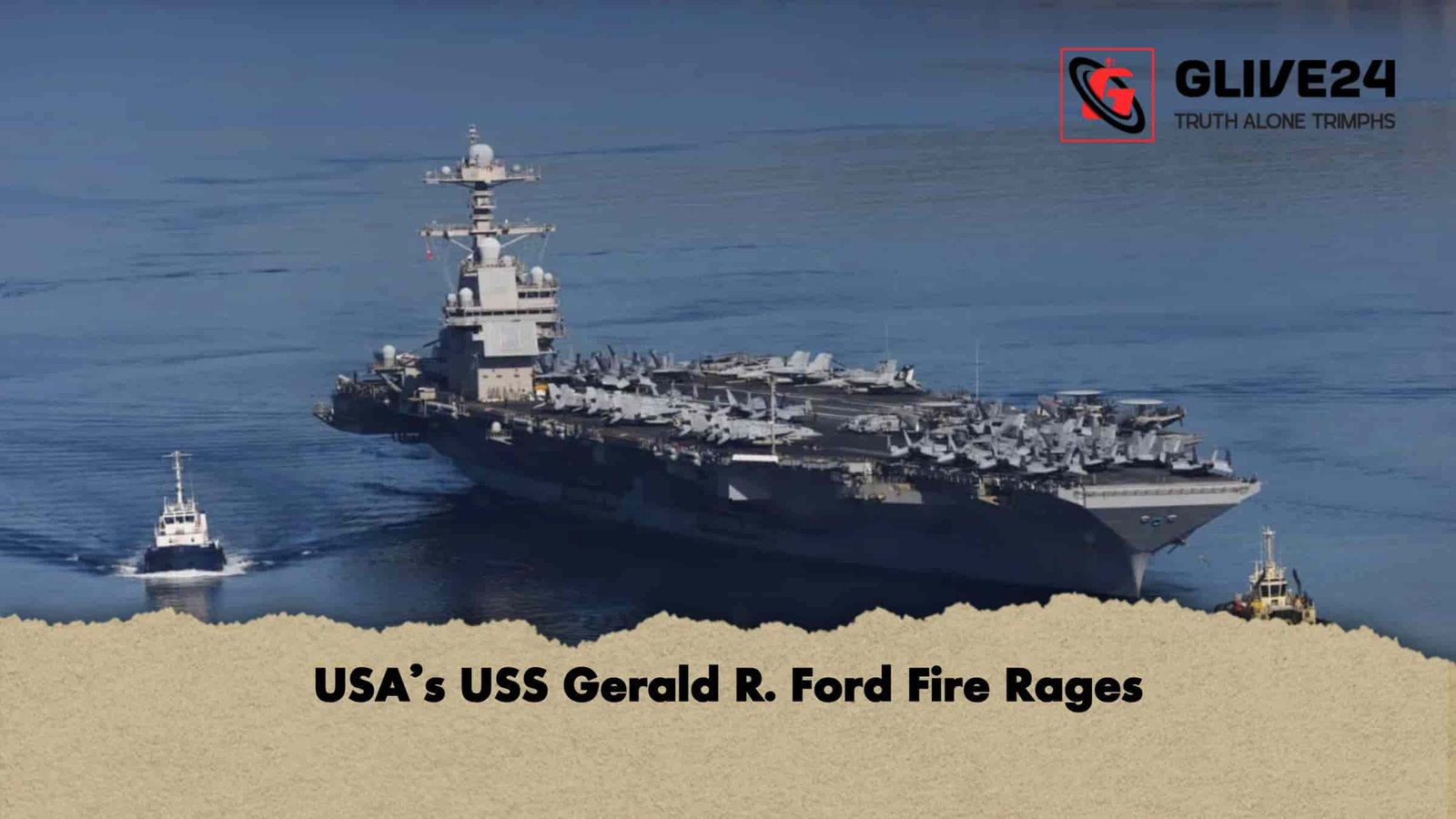
A major fire aboard the United States Navy’s most advanced aircraft carrier, USS Gerald R. Ford, burned for more than 30 hours last week, forcing hundreds of sailors from their quarters and severely disrupting onboard operations, according to reports from The New York Times and military officials.
The fire reportedly broke out on 12 March 2026 in the ship’s primary laundry area, possibly originating within a dryer vent, before spreading into nearby berthing compartments. Despite continuous efforts by the crew, the blaze was not fully extinguished until more than a day later — an unusually prolonged duration for an onboard fire.
U.S. Naval Forces Central Command has confirmed that the incident was non-combat related and emphasised that the carrier remains operational. Nevertheless, the human toll has been significant. Two sailors were treated for non-life-threatening injuries, and dozens suffered from smoke inhalation during the extended blaze.
Disruption to Crew Life
The fire has rendered the sleeping quarters of roughly 600 crew members — out of a complement of about 4,500 — unusable. Many are now forced to sleep on tables, deck spaces, and temporary sleeping areas throughout the ship. Crew morale and comfort have been further undermined by the loss of the ship’s main laundry facility, leaving sailors unable to perform basic hygiene during an extended deployment.
The known effects of the fire are summarised in the table below:
| Aspect | Details |
|---|---|
| Incident date | 12 March 2026 |
| Fire duration | Over 30 hours |
| Cause | Laundry facility fire (non-combat) |
| Injuries | 2 treated for non-life-threatening injuries |
| Smoke inhalation | Dozens affected |
| Displaced personnel | ~600 unable to use berths |
| Operational status | Fully operational |
Operational Context and Ongoing Challenges
The fire occurred during an unusually long deployment. Gerald R. Ford has been at sea for approximately 10 months, traversing the Mediterranean, Caribbean, Red Sea, and Persian Gulf in support of U.S. military operations across the Middle East. If the carrier remains deployed through mid-April, this mission will mark the longest U.S. carrier deployment since the Vietnam War.
The ship has also faced recurring technical issues, including frequent plumbing and sewage system malfunctions, which have required repeated external support. The Navy has not indicated when Gerald R. Ford will return to port for extensive repairs. In the meantime, the crew continues to manage difficult living conditions and operational pressures amid sustained maritime operations.