
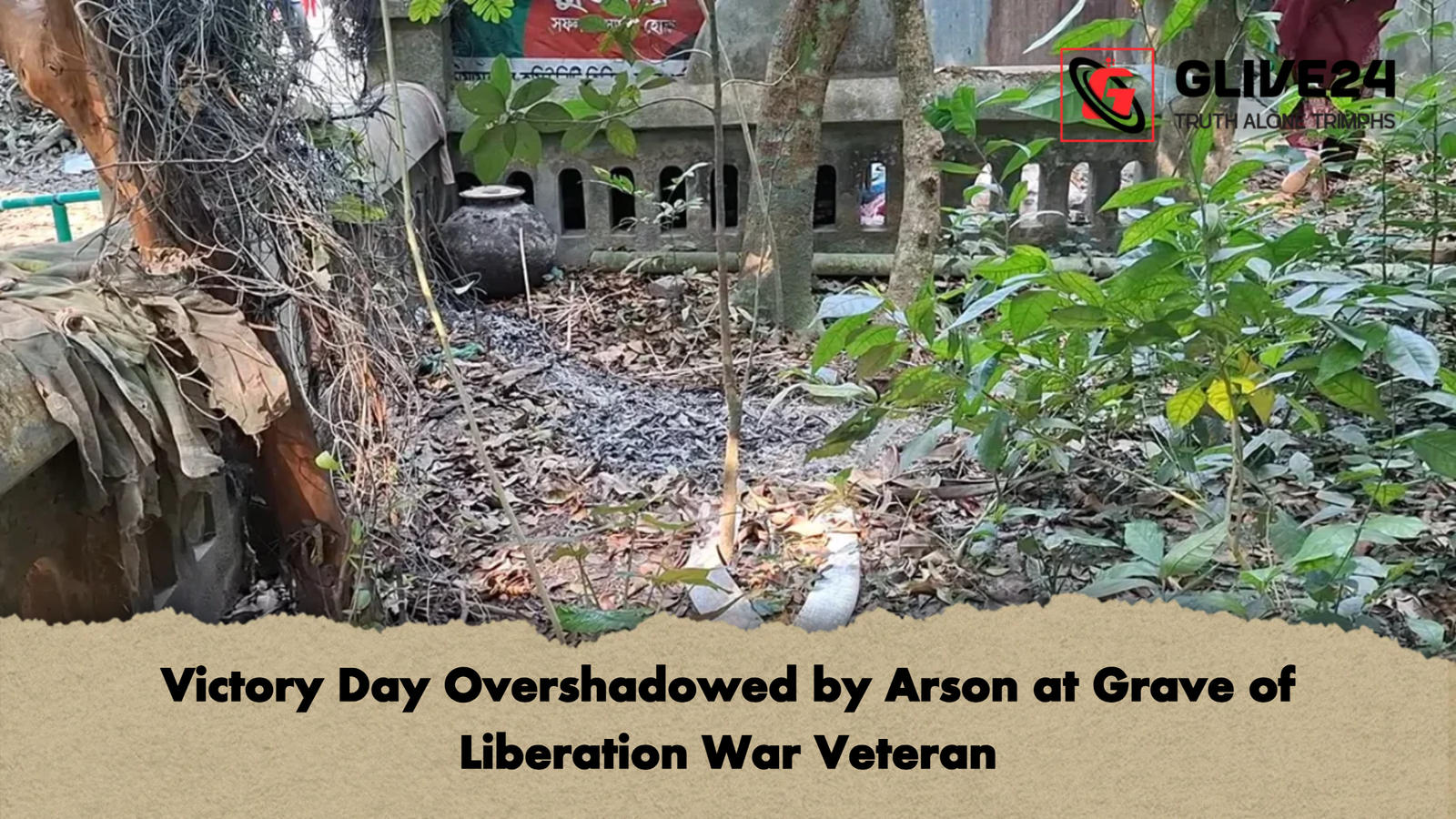
The deliberate burning of a freedom fighter’s grave in Shariatpur has cast a dark shadow over Victory Day commemorations, triggering outrage and concern across the local community. The incident, which occurred late on Monday night in Niamatpur village, has been described as a serious moral and social transgression with implications far beyond a single family.
The victim of the act, Abdul Mannan Khan, was a recognised participant in the 1971 Liberation War. During the conflict, he fought against the Pakistani occupation forces, risking his life for the country’s independence. After the war, he returned to a quiet civilian life and remained a respected figure in his village until his death in 2010.
His grave, located beside the family home, was targeted under the cover of night. According to relatives, miscreants placed wooden materials on the grave and set them alight before fleeing the scene. No witnesses have yet come forward, and the perpetrators remain unidentified.
The discovery of the crime was made by Khan’s widow, Mahfuza Begum, who visits her husband’s grave every morning. On this occasion, she found ash scattered across the grave, with visible signs of recent burning. Her cries brought the rest of the family rushing to the site, where they found evidence of a fire that had only just been extinguished.
The family’s daughter, Afroza Akter, said the incident left them traumatised and fearful. She reported the matter to local officials and freedom fighter representatives, stressing that the family could not understand who would commit such an act against someone who had already passed away and posed no threat to anyone.
Villagers who gathered at the site expressed similar confusion and anger. Many pointed out that Abdul Mannan Khan had no known disputes and was widely respected. As such, speculation has arisen about whether the act was intended as a broader provocation or message, rather than a personal vendetta.
The emotional impact on the family was particularly severe. Mahfuza Begum questioned whether her husband was being targeted even in death because of his identity as a freedom fighter. She lamented that while the nation was meant to celebrate victory and independence, her family was instead engulfed in grief and uncertainty.
Freedom fighter leaders have labelled the incident deeply concerning. Abdul Aziz Sikder, convenor of the local Freedom Fighters Command Council, said such acts threaten the dignity of all freedom fighters and undermine the collective memory of the Liberation War. He confirmed that discussions were underway regarding a response.
Local administrators have promised to look into the matter. The Upazila Nirbahi Officer acknowledged receiving the complaint, while district authorities indicated that coordination with police officials would follow.
Analysts and residents alike argue that the incident highlights the need for stronger protection of historically significant sites and renewed efforts to reinforce respect for the nation’s liberation heritage. Without swift investigation and accountability, they warn, such acts risk becoming precedents rather than exceptions.