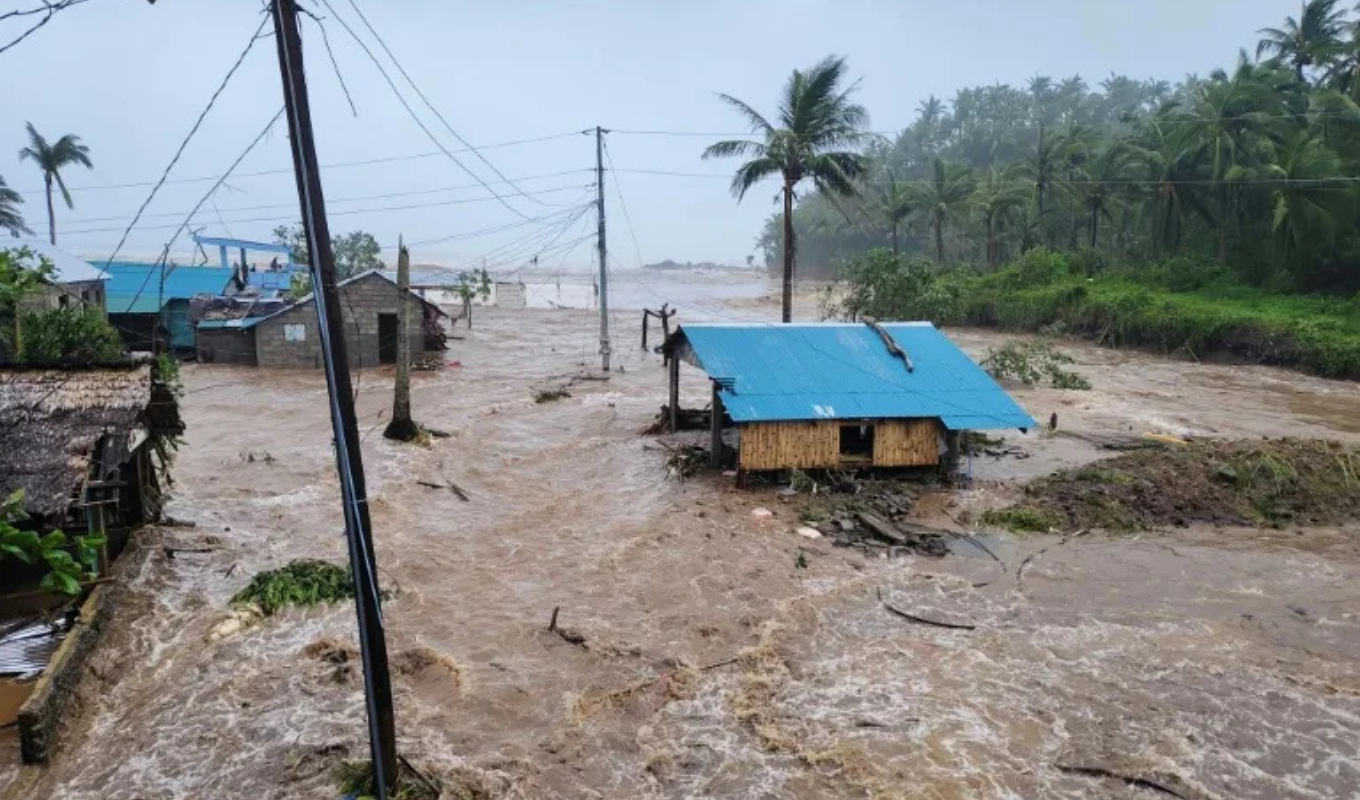
A weakening Typhoon Fung-wong exited the Philippines on Monday morning, moving over the South China Sea after its powerful winds and torrential rains caused widespread destruction. At least two people were reported dead, and over 1.4 million individuals were forced to evacuate as the storm battered the country.
Fung-wong, which spanned almost the entire archipelago, made landfall on the eastern seaboard of the Philippines on Sunday evening as a “super typhoon,” uprooting trees and flooding towns, particularly in the southern regions. The storm arrived just days after Typhoon Kalmaegi had passed through the central islands, claiming at least 224 lives.
On Monday, schools and government offices across large parts of Luzon, including the capital, Manila, were closed, although the heavy rains initially forecast had not yet arrived.
In Aurora province, where Fung-wong made landfall the night before, rescue worker Geofry Parrocha told AFP that officials were only now able to assess the damage.
“We’re seeing many damaged houses, and some of our main roads are not passable due to landslides,” he said from Dipaculao town, where power had yet to be restored. “We couldn’t mobilise last night because the rain was heavy and the volume of water was high.”
Aurora Taay, mayor of Dingalan town in Aurora, told a Facebook Live audience that several houses and boats along the coastline had been destroyed by massive waves.
Turning Toward Taiwan
The Philippines’ state weather service confirmed that the typhoon, which had forced 1.4 million people to evacuate, was now expected to veer towards Taiwan, continuing to weaken as it moved northward.
Samar province, one of the hardest-hit areas by Typhoon Kalmaegi last week, recorded the first known fatality from Fung-wong on Sunday. Juniel Tagarino, a rescuer in Catbalogan City, reported that a 64-year-old woman, attempting to evacuate, was found dead beneath debris and fallen trees.
“The wind was so strong and the rain was heavy… According to her family, she might have gone back into her house to retrieve something,” Tagarino explained.
The civil defence office later confirmed a second death, a person who drowned in a flash flood on Catanduanes island.
Further north, in Cagayan province, evacuees at a shelter spoke of their fears of flooding. Loretta Salquina, a local resident, told AFP: “We often suffer flooding in our home, so when we were told to evacuate, we left because we would have been trapped.”
Climate Change and Intensifying Storms
Scientists have warned that storms are becoming increasingly powerful due to human-driven climate change. Warmer ocean temperatures fuel rapid intensification of typhoons, while a warmer atmosphere holds more moisture, leading to heavier rainfall.
‘The Ground Was Shaking’
In Catanduanes, the storm battered the region with heavy winds and rain on Sunday morning, while storm surges sent waves crashing over streets, inundating homes in some areas.
“The waves started roaring around 7:00 am. When the waves hit the seawall, it felt like the ground was shaking,” recalled Edson Casarino, 33, a resident of Virac town in Catanduanes.
AFP verified video footage showing a church in Virac surrounded by floodwaters, which reached halfway up the building’s entrance.
Major flooding was also reported in southern Luzon’s Bicol region. In Guinobatan, a town of about 80,000 people in Albay province, video footage confirmed streets had been transformed into raging torrents of water.
Just days earlier, Typhoon Kalmaegi had caused similar destruction in the cities and towns of Cebu and Negros islands, sweeping away cars, riverside shanties, and large shipping containers.
Search and rescue efforts in Cebu had been suspended on Saturday due to safety concerns about the approaching super typhoon.