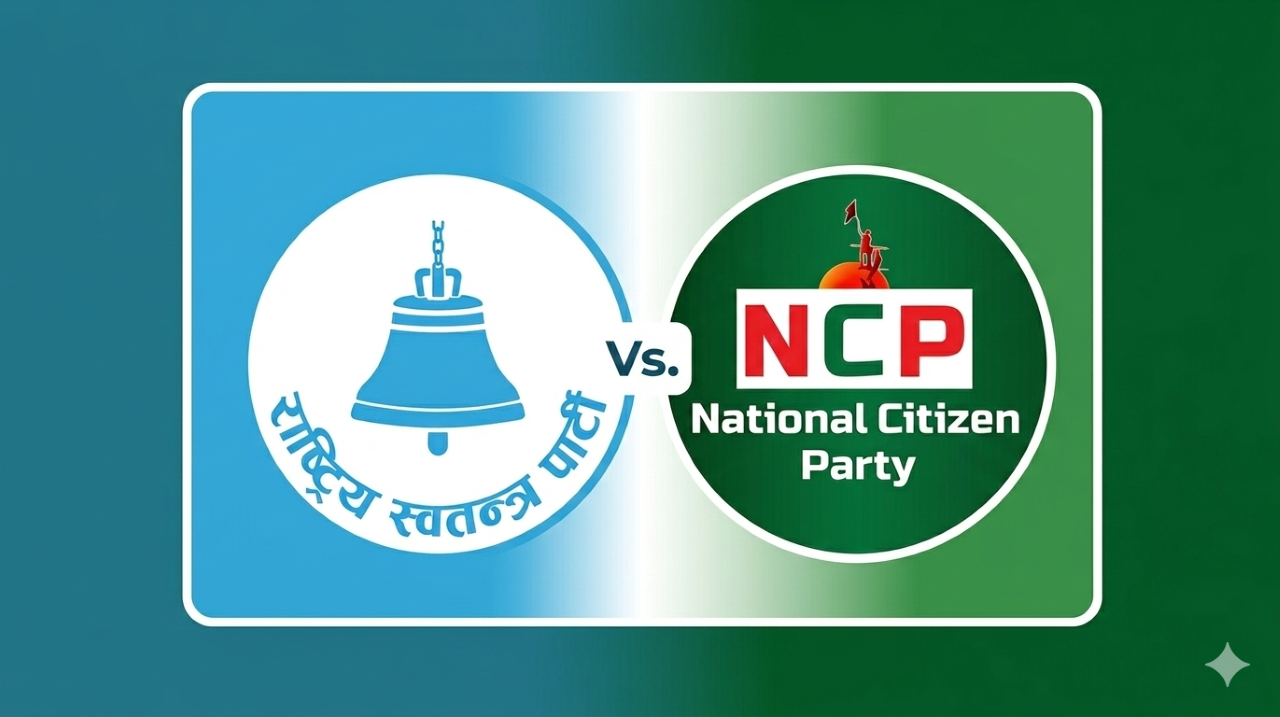
In recent decades, young people have emerged as a powerful driving force in the political landscape of South Asia. In both Nepal and Bangladesh, youth-led street movements have shaken the foundations of established political forces and reignited debate over the nature of state governance. Although certain surface-level similarities can be observed between the movements in the two countries, closer examination reveals fundamental differences in their ideological foundations, the character of their leadership, their political objectives, and the nature of their post-movement transformations.
These differences become most evident when comparing Nepal’s Rastriya Swatantra Party (RSP) and Bangladesh’s National Citizen Party (NCP). Many observers attempt to place the two parties in the same category, describing them as youth-driven, reform-oriented political forces. However, such a comparison is misleading and analytically weak, as the political contexts from which they emerged, their relationships with protest movements, and their respective attitudes towards state power differ in essential and substantive ways.
Political Ideology: Genuine Neutrality vs Strategic Disguise
One of the most significant differences between the movements in Nepal and Bangladesh lay in the degree of consistency between their declared political positions and their actual conduct.
Nepal’s youth movement was genuinely spontaneous and non-partisan. Civic platforms such as Hami Nepal operated independently and did not function under the patronage or influence of any political party. Their objectives centred on ensuring accountability within state institutions, taking a firm stance against corruption, and establishing a visible space for youth voices in public discourse.
The organisers of the movement consciously distanced themselves from power politics. They believed that forming a political party or engaging in electoral competition could weaken the moral standing of the movement. As a result, the protests were widely perceived by ordinary citizens as a form of moral and social pressure aimed at institutional reform rather than the pursuit of political power.
This principled position allowed the movement to establish itself as a civic awakening rather than a partisan campaign, with its moral credibility serving as its greatest strength.
In Bangladesh, however, the narrative of neutrality followed a markedly different trajectory. Although the movement initially claimed to be non-partisan, subsequent developments indicated the presence of organised political backing. Evidence increasingly suggested that certain political forces behind the protests were actively preparing to participate in state power.
When key coordinators and spokespersons of the movement moved directly towards forming a political party and seeking a share of state authority, a section of the public began to feel deceived. Matters became even more apparent when Jamaat-e-Islami began asserting visible influence across administrative structures. Many citizens consequently came to believe that the proclaimed neutrality of the movement had been largely strategic — a method of mobilising public support rather than a genuine commitment to non-partisanship.
As a result, the movement in Bangladesh gradually came to be viewed not as a civic awakening but as a project driven by political ambition.
The perception hardened further when, ahead of the elections, the movement leaders entered into an alliance with Jamaat-e-Islami. This development dispelled lingering public doubts regarding their political roots. Many citizens concluded that the movement represented a rebranded political front aligned with Jamaat-e-Islami, the party historically associated with the perpetrators of the 1971 war crimes.
Participation in Power and Moral Erosion
The conduct of movement leaders after the protests proved decisive in shaping public trust. It is precisely at this stage that a clear contrast emerges between the experiences of Nepal and Bangladesh.
In Nepal, youth leaders chose to remain outside the structures of state power following the success of their movement. They declined administrative positions within the government and refrained from becoming part of the formal policy-making apparatus. Instead, they sought to position themselves as watchdogs of public interest, maintaining pressure on the state from outside the corridors of power.
This stance significantly strengthened their moral legitimacy. By avoiding the privileges associated with office, they eliminated the risk of being accused of abusing authority or engaging in administrative corruption. Consequently, their integrity remained largely unquestioned, and the moral foundation of the movement stayed intact in the eyes of the public.
In Bangladesh, the trajectory unfolded in the opposite direction. Youth leaders of the movement became directly integrated into the state structure. By accepting advisory posts, intervening in administrative decisions, and participating actively in policy-making processes, they entered the sphere of political power itself.
This rapid transition inevitably cast doubt on the moral standing of the movement. For many citizens, the transformation from street-level protest leaders into stakeholders within state authority appeared unsettling. The shift suggested a move away from principled civic activism towards formal political engagement.
Among the younger generation in particular, a critical question began to surface: was the movement genuinely driven by public interest, or had it served as a strategic pathway to political power?
Such doubts gradually weakened the foundations of public trust and reshaped perceptions of the movement’s original purpose.
Relief Funds and the Stigma of Corruption
In the aftermath of any mass movement, one of the most important measures of leadership integrity lies in social accountability and the transparent management of humanitarian initiatives. This becomes especially critical during natural disasters, when relief and assistance funds are collected from the public in moments of deep collective sympathy. The handling of such funds often becomes a litmus test of public trust. It is precisely in this domain that a marked contrast can be observed between the youth leadership of Nepal and that of Bangladesh.
Nepal’s youth activists, having deliberately remained outside the formal structures of state power and refrained from assuming responsibility for large-scale financial operations, did not encounter situations that could expose them to allegations of financial impropriety. Their activism remained largely centred on civic awareness, human rights advocacy, and demands for institutional accountability. The social initiatives they undertook were relatively limited in scale, transparent in execution, and free from major funding-related controversies. As a result, public confidence in their integrity remained intact, and the moral standing of the movement was preserved.
The context in Bangladesh unfolded differently. There, youth leaders became directly involved in relief and humanitarian activities in the post-movement period. In particular, the management of relief funds raised after devastating floods drew significant scrutiny. Questions began to surface regarding the transparent utilisation of the substantial sums donated by citizens out of empathy and solidarity.
As ambiguities emerged over financial reporting, expenditure transparency, and the fair distribution of aid, public suspicion gradually intensified. Many citizens felt that the trust underpinning their donations had been compromised. The absence of clear disclosures regarding how funds were allocated, along with inconsistent communication, placed the leadership under increasing public criticism.
The situation grew more complicated when controversies surrounding relief funds were followed by further allegations of corruption, extortion, and abuse of authority in various sectors. This succession of negative reports created deep discomfort among those who had previously supported the movement.
Leaders who had once been viewed as symbols of moral credibility now faced accusations of financial misconduct, provoking strong public reactions. The consequence was political estrangement: many ordinary citizens slowly distanced themselves from these figures and questioned their ethical legitimacy.
Therefore, the failure to ensure transparency in matters of social responsibility significantly weakened the moral position of Bangladesh’s youth leadership, adversely affecting their post-movement political credibility and public acceptance.
Foreign Influence and Intelligence Activity
The credibility of any mass movement largely depends on its spontaneity, its organic social foundations, and its perceived independence from foreign influence. When suspicions arise regarding external encouragement, diplomatic pressure, or covert intelligence involvement, the moral strength of a movement inevitably comes under scrutiny. Public doubt begins to surface as to whether the movement genuinely reflects popular aspirations or serves as a component of broader geopolitical manoeuvring.
In the case of Nepal, such allegations gained little substantive ground. In the aftermath of the protests, no clear evidence emerged in the public domain demonstrating direct involvement by foreign governments or intelligence agencies. International observers largely viewed the movement as an internally driven civic awakening rather than an externally orchestrated campaign. Claims of foreign sponsorship, strategic direction, or financial backing were neither convincingly substantiated nor widely accepted. Consequently, the general public perceived the protests as a spontaneous response arising from Nepal’s own social and political realities.
The situation in Bangladesh, however, became comparatively more contentious and politically sensitive. From the early stages of the movement, various discussions circulated regarding the possible involvement of foreign states, diplomatic engagement, and the activities of intelligence agencies. Persistent speculation and politically charged narratives contributed to growing public uncertainty.
Particular controversy surrounded the episodes of violence and loss of life during the protests, where questions were raised about both motive and operational methods. In some instances, media discussions referred to the possible presence of “external snipers” or unidentified professional attackers, further complicating public perceptions. Such narratives cast doubt on the spontaneity of the movement and shifted the discourse beyond that of routine political unrest.
Moreover, the post-movement international engagements of certain leaders also attracted criticism. Figures associated with the movement, along with representatives linked to the administrative structures they supported, undertook overseas visits and participated in activities that, in the eyes of many observers, suggested a visible degree of foreign influence.
As a result, debates surrounding foreign involvement and intelligence-related activity placed the moral credibility of Bangladesh’s movement under complex scrutiny. Whereas Nepal’s protests were broadly regarded as an expression of domestic civic consciousness, the atmosphere of geopolitical suspicion in Bangladesh weakened public trust in the movement’s post-protest trajectory.
Law and Order and Delays in the Electoral Process
In the post-movement period, a clear and profound contrast emerged between Nepal and Bangladesh in the manner in which the state was administered. This divergence became particularly visible in terms of leadership responsibility, administrative capacity, and commitment to democratic norms.
Following the conclusion of the protests in Nepal, responsible state authorities acted swiftly to stabilise the law-and-order situation. They moved decisively to curb violence, reorganise administrative structures, and ensure public safety. At the same time, they announced elections within a defined timeframe in order to prevent prolonged political uncertainty. Judicial processes were formally initiated to investigate the killings and acts of violence that had occurred during the protests. Citizens therefore gained confidence that the state remained committed to guaranteeing security and ensuring justice. As a result of these prompt and institutional measures, normalcy returned to Nepal relatively quickly.
In Bangladesh, however, the post-movement environment unfolded in a markedly different manner. Protest leaders effectively dismantled significant portions of the administrative structure of the state. They did not assume an effective role in restoring law and order. Instead, under their direct leadership or tacit approval, prolonged episodes of mob violence, public beatings, vandalism, and arson continued. Such unrest severely compromised the safety and security of ordinary citizens.
Obstacles were also created in the way of impartial investigations into the killings that took place during the protests. Efforts were made to influence judicial proceedings for political ends, and in many instances effective action against those responsible was delayed.
The most serious erosion of public trust arose over the issue of elections. While citizens expected a swift return to a legitimate political order through timely polls, the post-movement authorities failed to provide clear assurances. They did not present a credible electoral roadmap within a specified timeframe. Instead, elections were postponed on the grounds of various reforms and administrative justifications.
These delays generated widespread suspicion among the public that the authorities were reluctant to transfer power through democratic means. Consequently, the proclaimed objective of restoring democracy itself came under question.
The overall outcome was striking: whereas Nepal restored law and order and reactivated democratic processes within a relatively short period, Bangladesh remained mired in extended political uncertainty, administrative fragility, and a deep crisis of public confidence.
The Stigma of Indemnity and Legal Immunity
In matters of justice and the rule of law, the granting of indemnity or legal immunity directly calls into question the moral standing of a state. When a movement emerges in the name of justice and accountability, yet its own leaders seek exemption from legal responsibility, its ethical foundation inevitably collapses. A similar dynamic became evident in the context of Bangladesh.
In Nepal, protest leaders did not demand any special legal protections for themselves. Nor did the state grant them immunity. Law-enforcement authorities maintained a clear position that the law applies equally to all citizens and that no individual stands above it. Incidents of violence that occurred during the protests were therefore addressed through regular judicial procedures. This approach reflected both the moral firmness of Nepal’s state institutions and their commitment to upholding the rule of law.
A markedly different picture emerged in Bangladesh. Rather than ensuring accountability for serious offences committed during the protests—including the killing of police officers, homicide, arson, vandalism, destruction of public property, and instances of mob justice—legal protection was extended to those implicated. The post-movement power structure implemented this immunity as a political decision, thereby directly undermining the principle of equality before the law.
In Bangladesh’s political history, the term “indemnity” carries deeply negative and painful connotations. In the past, indemnity laws were used to obstruct the prosecution of major political assassinations, leaving profound scars on the national conscience. The reappearance of similar practices therefore triggered strong public reactions, as many perceived it as a troubling repetition of historical injustices.
The most serious moral crisis arises when a movement that claims to fight against impunity simultaneously seeks to shield its own leadership from legal accountability. Citizens then begin to question the true purpose of the movement: was it genuinely aimed at establishing justice, or was it ultimately a strategy to secure power and protect its own actors?
For families who lost loved ones during the violence, such legal immunity appears as a grave injustice. They witnessed a movement that demanded justice for bloodshed eventually fostering a culture of evading responsibility for that very bloodshed.
This reality strongly suggests that the leadership failed to uphold the principles of justice it had publicly championed. Instead, securing political advantage after assuming power appeared to take precedence. As a result, the proclaimed moral position of the movement weakened considerably, and the foundation of public trust suffered lasting damage.
Position towards the Foundations of the State and Historical Consciousness
Protesters in Nepal demonstrated explicit respect for the founding principles of the state and its constitutional framework. Rather than attempting to undermine or reject the existing constitution, they sought reforms and improvements in governance within its established legal structure. Their position was clear: to correct flaws in the governing system while preserving the institutional foundations of the state. As a result, a large segment of the public viewed the movement not as destructive, but as a responsible initiative aimed at institutional reform and democratic accountability.
In contrast, sections of the protest leadership in Bangladesh adopted a more contentious stance towards the state’s foundational ideals and historical legacy after coming into proximity with power. Questioning constitutional principles rooted in the sacrifices of the Liberation War, vandalising memorials and monuments associated with the war, and making disparaging remarks about the country’s struggle for independence were perceived by many citizens as actions that conflicted with national sentiment and identity. Incidents involving damage to memorial sites linked to Sheikh Mujibur Rahman, the founding leader of Bangladesh, also provoked widespread public reaction. Such actions contributed to growing public distrust towards post-movement political actors and led many citizens to feel that core elements of national history and identity were being undermined.
Formation of Political Parties: Preparation versus Sudden Emergence
A political party is not merely an organisation; it is the outcome of long-term ideological preparation, policy development, organisational maturity, and sustained public trust. A party’s social base becomes strong only when citizens believe it stands not on temporary emotion, but on a coherent philosophy and consistent political programmes. Judged by these standards, a fundamental distinction becomes evident between the youth-led political forces of Nepal and Bangladesh.
In Nepal, the youth-oriented political party, the Rastriya Swatantra Party (RSP), had been established long before the protest movement emerged. The party did not arise suddenly by exploiting a political vacuum; rather, it developed gradually as an alternative political force over an extended period. By advocating anti-corruption measures, administrative transparency, accountable governance, and meaningful youth participation, it cultivated public confidence through clearly articulated programmes. Consequently, its popularity was not the result of momentary excitement or emotional momentum, but a natural outcome of sustained political engagement and long-term organisational work.
Because the RSP was already organised prior to the protests, it did not attempt to use the movement as a means to legitimise itself. Instead, it positioned itself as an alternative political force operating within the existing political framework. This process reflected both its political maturity and its strategic stability.
The situation in Bangladesh was markedly different. The popularity generated on the streets during the protest movement encouraged sections of the youth leadership to convert emotional public support into political capital. Without establishing a solid ideological foundation, long-term organisational planning, or a clearly defined political vision, they moved swiftly to form a political party. As a result, many citizens began to view this step not as a continuation of the spontaneous civic spirit of the movement, but as an opportunistic attempt to capitalise on a temporary wave of support.
The most controversial aspect was the formation of the party with the direct assistance and patronage of the administrative structure that emerged after the movement. Efforts to build a political organisation by leveraging proximity to state power, administrative influence, and institutional advantages generated deep public suspicion. In the eyes of many citizens, this appeared to be a “power-dependent party formation”, where the machinery of the state—rather than the moral force of the mass movement—served as the principal foundation.
Political history demonstrates that parties built upon long-term public trust and ideological cohesion tend to develop durable foundations, whereas parties born from temporary emotion and reliance on power structures often face questions regarding their sustainability. In Bangladesh’s case, the abrupt formation of a party after the movement and its perceived reliance on state-backed support rendered the new political force controversial from the outset.
Thus, the contrast between Nepal’s prepared political alternative and Bangladesh’s sudden political transformation is not merely organisational; it also reflects deeper differences in moral credibility, political maturity, and the foundations of public trust.
RSP versus NCP: Why the Comparison Is Misleading
Many analysts attempt to assess Nepal’s Rastriya Swatantra Party (RSP) and Bangladesh’s National Citizen Party (NCP) within the same analytical framework. At a superficial level, both parties appear similar: each claims strong youth support and presents itself as an alternative to the conventional political order. It is from this apparent similarity that comparisons often arise. However, a closer examination of their political origins, ethical positions, strategic objectives, and relationships with state power reveals that such comparisons oversimplify reality and obscure essential differences.
The Rastriya Swatantra Party was not a direct product of a mass protest movement. It emerged from within the existing political structure as an alternative force and gradually strengthened its position through organisational development, principled political positions, and sustained public engagement. By articulating clear political programmes centred on anti-corruption measures, administrative transparency, and accountable governance, the party earned public credibility over time. Its rise, therefore, represented a planned process of political evolution rather than an emotional response to immediate post-protest sentiment.
During periods of mass mobilisation, the RSP deliberately avoided direct involvement. Party leaders recognised that the moral authority of a civic movement could be weakened if it became entangled with partisan political interests. While the party expressed principled sympathy with the aspirations of the protesters, it preserved its organisational independence. This decision to maintain distance reflected political maturity and reinforced its ethical stance against exploiting civic unrest for party advantage.
In contrast, the emergence of Bangladesh’s National Citizen Party followed a markedly different trajectory. The NCP is directly rooted in the protest movement itself. Coordinators, spokespersons, and leading organisers of the demonstrations became actively involved in forming a political party even before the movement had fully subsided. In effect, the organisational leadership of the protest rapidly transformed into a partisan political structure. Consequently, no meaningful separation developed between the movement as a civic force and the party as a political entity.
The NCP’s political doctrine also followed a different path. Its leadership openly embraced the strategy of entering the system and becoming stakeholders in state power as a means of bringing change. Prominent movement figures assumed direct administrative roles within the state apparatus and organised the party from positions of governmental influence. Leaders such as Nahid Islam argued that structural reform would be impossible without participating in state authority. Yet this position conflicted with the earlier claims of political neutrality made during the protests. The decision to become part of the ruling structure placed the moral posture of non-partisanship under immediate scrutiny.
As a result, while the RSP maintained a distinct identity as an alternative political force, the NCP found itself caught between the ethical legacy of the movement and its partisan political ambitions. On the one hand, it claimed to represent the spirit of the protests; on the other, it transformed that momentum directly into institutional power. This dual posture created confusion among the public regarding the party’s true character and intentions.
Considering these fundamental differences, it becomes clear that evaluating the RSP and the NCP by the same standards is analytically flawed. One party developed as an alternative political force through long-term preparation and structural consolidation; the other entered the political arena through a rapid post-movement transformation. One preserved the ethical autonomy of civic mobilisation by maintaining distance from protest politics; the other converted protest energy directly into political authority.
Placing these two parties in the same category therefore ignores their divergent origins, strategies, and political philosophies. The comparison is not merely imprecise—it reduces complex political realities to an oversimplified and misleading narrative.
Principled Resistance versus Strategic Pursuit of Power
In conclusion, the youth movement in Nepal represented a genuine civic awakening whose principal strength lay in moral resolve, organisational restraint, and a deliberate distance from state power. Although the movement exerted significant pressure for institutional reform, its leadership consciously refrained from seeking a share in governmental authority. This stance preserved both their ethical credibility and public trust. They remained on the streets as a moral force, holding the state accountable, yet avoided becoming stakeholders in the power structure in ways that might have compromised their integrity.
By contrast, the movement in Bangladesh advanced rapidly towards political transformation, where the declared stance of ‘non-partisanship’ gradually evolved into a strategic posture. The leadership shifted its position by forming a political party, participating directly in state power, and assuming active roles within administrative structures. Consequently, a visible gap emerged between the movement’s initial moral authority and the political realities that followed, creating confusion and scepticism among the public.
Several key factors explain why the moral force of Nepal’s movement remains largely intact. Its leaders did not seek legal immunity for themselves, were not credibly linked to allegations of direct foreign patronage, and were not implicated in financial irregularities involving public funds or state resources. As a result, the movement has been widely regarded as a transparent expression of civic consciousness.
The situation in Bangladesh unfolded differently. Post-movement administrative fragility, the spread of violence and mob justice, and the failure to present a clear electoral roadmap while appearing to prolong tenure in power gradually eroded public support. Citizens expected stability, accountability, and justice; when political developments failed to meet those expectations, the youth leadership increasingly became detached from public confidence.
In this context, equating the political success of Nepal’s RSP with the rise of Bangladesh’s NCP does not withstand rigorous analysis. The political origins, ethical positioning, organisational trajectories, and respective relationships with state power differ fundamentally. Such comparisons therefore represent not merely analytical weakness but also a misleading simplification of complex political realities.
Author
ABM Zakirul Haque Titon
Editor, Glive24.com