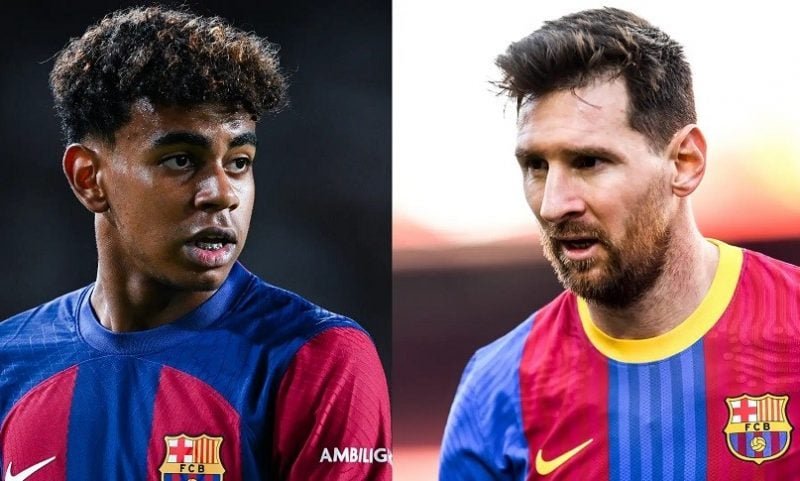
In football, comparisons are a double-edged sword. They elevate, yet they suffocate. They inspire, yet they confine. And when the comparison is with Lionel Messi, the blade becomes sharper still. Lamine Yamal, the prodigy who has emerged from Barcelona’s famed La Masia academy, finds himself ensnared in this familiar narrative — yet he is fighting back with unusual clarity.
His statement — “Messi knows I do not want to be like him” — is not merely a personal preference. It is a bold rejection of a system that insists on crafting heirs to footballing thrones that may never again be filled. Yamal’s refusal is an assertion of identity, a declaration that he will not be shaped by nostalgia.
The football world has been desperate to replace Messi ever since his emotional departure from Barcelona in 2021. Anyone with a magical left foot and the audacity to dribble is immediately thrust into the conversation. But the truth is that Messi is irreplaceable; he is a singular phenomenon. Yamal seems to understand this more clearly than the commentators who compare him.
Consider the superficial similarities. Both play off the right flank. Both use the left foot as if it were a brush painting masterpieces. Both exhibit impressive composure at a tender age. And both have enjoyed rapid success: Yamal with Barcelona and Spain, Messi with Barcelona and Argentina. But similarities, however striking, do not define a career.
Yamal’s insistence on distancing himself from the Messi narrative stems from a deeper respect. He believes that comparing a teenager with a man who has conquered every frontier in football — from Champions League titles to the World Cup — risks diminishing the enormity of Messi’s legacy.
During his interview on “60 Minutes”, Yamal spoke the language of humility and realism: “I respect him for what he is and what he represents in football. For me, he is the greatest ever.” In those words lies an understanding that Messi’s greatness is not a benchmark to chase but a summit unattainable by imitation.
Yet despite this, Yamal cannot escape the parallels. He wears Barcelona’s number 10 shirt — the very number Messi transformed into a global emblem. On the pitch, he often acts as the focal point of Barcelona’s attack, orchestrating play and shouldering responsibility in a way that mirrors his predecessor. His seven goals in fourteen matches this season underline his rising influence.
But his personal philosophy sets him apart. “Joy,” he said, is what defines him. Not ambition, not records, not headlines—joy. In an era where football increasingly resembles an industry, Yamal’s emphasis on joy feels almost radical. His desire to inspire younger players, rather than simply outperform rivals, signals a different kind of greatness.
Even his views off the field reflect this grounded mindset. Despite the wealth that surrounds him, he remains without a driving licence. When asked about future car choices, he replied with modesty: “Something simple, something my friends can enjoy. Not a Lamborghini.”
And at a time when the media speculates endlessly about his personal relationships, he cuts through the noise with a simple declaration: “Football was my first love. It will always be.”
Yamal’s resistance to the Messi comparison is not defiance; it is wisdom. It is a recognition that football does not need another Messi. It needs new stories, new identities, new forms of brilliance. Messi’s era is immortal. Yamal’s era is only beginning.
And if he is allowed to grow without the burden of imitation, his story may well become one of football’s most compelling new chapters.