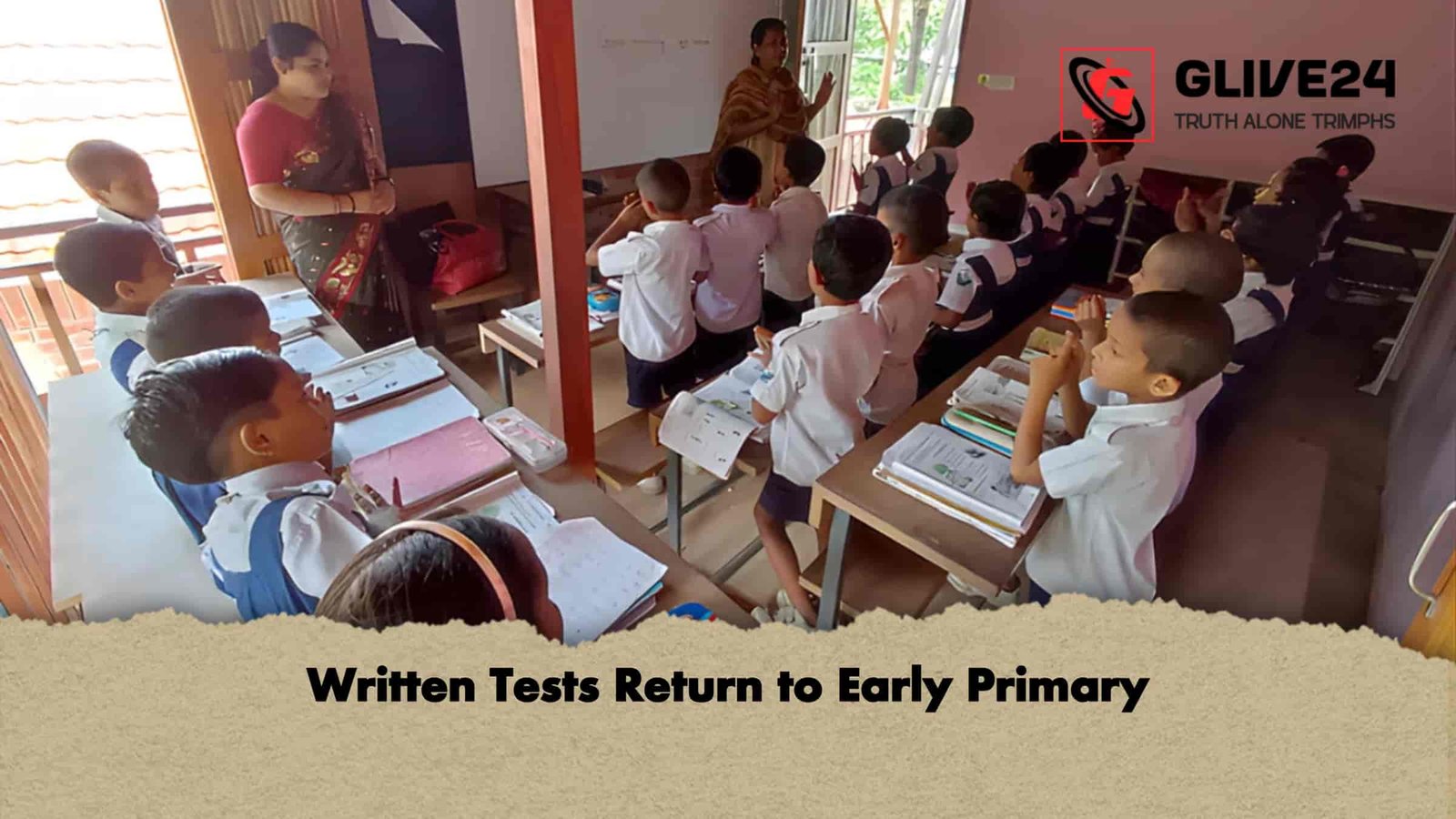
The government has decided to reintroduce written examinations in Classes One and Two of government primary schools, marking a significant shift in Bangladesh’s primary assessment policy. The move partially reverses a reform introduced in 2023 under the revised National Curriculum, which had eliminated formal examinations at these levels in favour of a fully continuous assessment system. Just two years later, the policy rethink has triggered renewed debate among education officials, teachers, parents and academics.
When the new curriculum was first rolled out, its core rationale was to reduce academic pressure on six- and seven-year-old children, promote joyful and activity-based learning, and support their mental, social and emotional development. Assessment was redesigned to rely on classroom observation, participation, behaviour and regular classwork rather than formal tests. However, recent internal reviews by the education authorities have concluded that an exclusively continuous assessment approach has made it difficult to accurately measure students’ actual learning progress and attainment. In response, the government has opted for a “blended assessment” model combining continuous and written evaluations.
According to sources at the Ministry of Primary and Mass Education, the revised assessment guidelines were approved at a meeting held on 26 January and will come into effect from the 2026 academic year. On 1 February, the Directorate of Primary Education and the National Curriculum and Textbook Board were instructed to begin necessary preparations. The decision was formally confirmed by Shahina Sultana, Additional Secretary (Schools) at the ministry.
Under the new framework, subjects with prescribed textbooks and teacher guides in Classes One and Two will be assessed through a balanced mix of methods. Half of the total marks will come from continuous assessment and the remaining half from written, end-of-term examinations. As a result, core subjects such as Bangla, English and Mathematics will once again include written tests. In contrast, subjects like Art and Craft, Physical Education and co-curricular activities—where no formal textbooks exist—will remain entirely under continuous assessment.
For Classes Three to Five, the weight of written examinations has been increased further. Textbook-based subjects will now be assessed with 70 per cent of marks derived from written exams and 30 per cent from continuous assessment, while co-curricular activities will continue to be evaluated exclusively through non-examination methods.
Overview of the revised assessment structure
| Grade level | Subject type | Continuous assessment | Written assessment |
|---|---|---|---|
| Classes One–Two | Textbook-based subjects | 50% | 50% |
| Classes One–Two | Co-curricular activities | 100% | None |
| Classes Three–Five | Textbook-based subjects | 30% | 70% |
| Classes Three–Five | Co-curricular activities | 100% | None |
Government primary schools conduct three assessment periods each year—in April, August and December. While individual schools are responsible for setting question papers, neighbouring schools may collaborate if needed. The new guidelines also require that at least 30 per cent of questions be drawn directly from textbook exercises to ensure alignment between teaching and assessment.
The decision has not been without criticism. Muhammad Mahbub Morshed, a member of the government’s advisory committee on primary and non-formal education and an associate professor at the Institute of Education and Research, University of Dhaka, has warned that formal examinations may place unnecessary pressure on very young learners. He argues that reintroducing tests without first strengthening classroom teaching and continuous assessment practices risks missing the core objective of the reform—ensuring learning tailored to each child’s ability.
With more than 100,000 primary schools and over 20 million students nationwide, stakeholders agree that this shift in assessment policy is likely to have far-reaching implications for teaching practices, learning outcomes and the overall quality of primary education in Bangladesh.