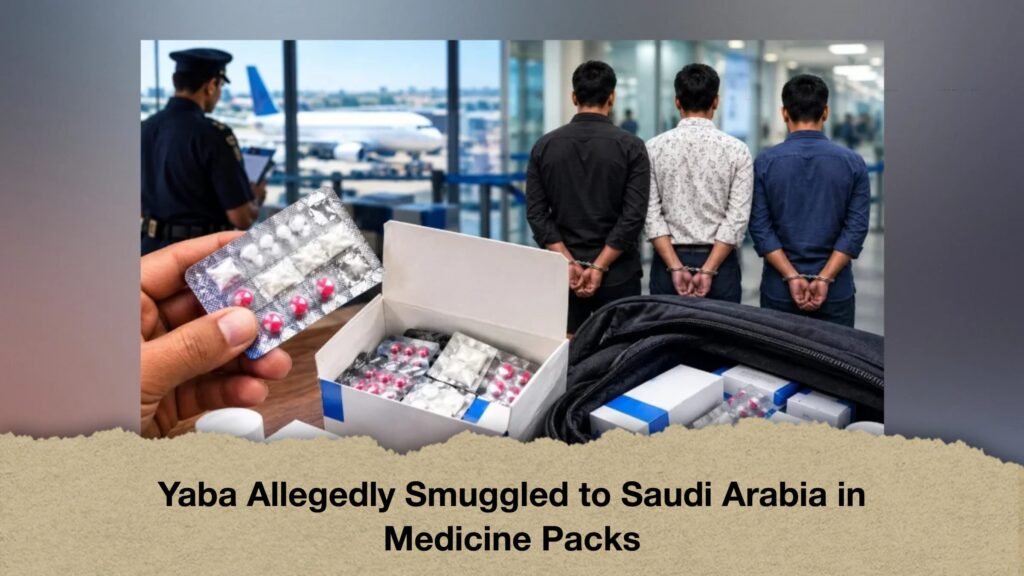
A suspected drug-trafficking network in Chandpur is allegedly exploiting Bangladeshi passengers travelling to Saudi Arabia by concealing yaba tablets inside medicine packets, with unsuspecting expatriates being used as couriers.
The alleged scheme came to light following two separate drug seizures in Shahrasti, where police recovered a total of 520 yaba tablets. Investigators have identified local residents Arif Hossain, Mahmudul Hasan and Mohin Uddin as alleged key figures in the network. Arif is currently in Bangladesh, while Mahmudul and Mohin are believed to be in Saudi Arabia.
According to police information, case documents and audio conversations examined as part of the investigation, members of the suspected network allegedly contact people preparing to travel to Saudi Arabia and ask them to carry packets described as medicines. The travellers are reportedly told that certain medicines are more expensive or difficult to obtain in Saudi Arabia.
The alleged drug consignments are then concealed inside medicine packets before being handed to the passengers. The travellers may be unaware of the contents, while an intended recipient allegedly collects the package after the passenger reaches Saudi Arabia.
160 yaba tablets recovered
In one of the cases, police recovered 160 yaba tablets allegedly concealed inside packets of Phoenix-20 and gastric medicine.
The packet was reportedly intended for expatriate Sujon Mia, a resident of Shahrasti who was preparing to travel to Saudi Arabia. Police arrested Abdur Razzak, also known as Anik, while he was allegedly taking the package to Sujon. Another suspect, Arif, reportedly fled when police intervened.
According to the case documents, police had received information about the suspected movement of yaba and conducted a raid in an area west of Munsi Gazi Patowari Bari. Anik was subsequently arrested and the tablets were seized.
Police said during preliminary questioning that Anik indicated the yaba had been concealed inside medicine packaging for transportation abroad. The exact involvement of other individuals remains under investigation.
Shahrasti police said Arif and Mahmudul were being investigated over their alleged roles. Investigators have also sought further questioning of suspects in an effort to establish how the alleged network operated and whether additional people were involved.
Earlier seizure uncovered 360 tablets
The second incident took place on 1 August at Bholdighi Bazar in Shahrasti.
Local traders reportedly became suspicious after receiving a package that was supposed to contain medicine for Rashed, a Saudi-bound passenger. The package had allegedly been delivered by Runa Akter, the wife of Saudi-based Arif Hossain, to Enayet Hossain, director of Hakkani Traders, for onward delivery.
Enayet reportedly noticed that the size and weight of the package appeared unusual. He called other traders and opened it in their presence while recording the process.
Inside were 12 packets labelled Phoenix-20 and Rabeprazole Sodium. After the medicines were removed, the traders allegedly found yaba tablets concealed beneath the medicine packaging. Each packet reportedly contained 30 tablets, bringing the total to 360.
Police subsequently seized the tablets and arrested Belal Hossain. Runa reportedly went into hiding following the incident.
Rashed, the intended traveller, said Arif had earlier contacted him and asked him to carry medicines to Saudi Arabia. Arif’s wife later brought the package to his home. Rashed said he had asked her to leave it at a market shop rather than keeping it at his residence.
He later said that had the package not been intercepted, he might have travelled to Saudi Arabia without knowing that he was allegedly carrying yaba. Such a situation could have exposed him to serious legal consequences at the airport and created difficulties for his family.
Travellers allegedly targeted through personal contacts
The investigation indicates that the suspected network may have relied heavily on personal and local connections to identify people travelling to Saudi Arabia.
According to allegations gathered during the investigation, prospective travellers were approached by acquaintances or people from the same locality and asked to carry small medicine packages. The requests were reportedly presented as a favour, with claims that the medicines were costly in Saudi Arabia.
The alleged preparation of the packages appears to have taken place in Bangladesh, while the drugs were reportedly intended for collection and distribution after reaching Saudi Arabia.
Several expatriates, speaking anonymously, alleged that similar practices had been taking place for some time. Some also claimed that individuals associated with the network were involved in drug sales and other illicit activities in Saudi Arabia.
One expatriate reportedly said that after returning to Bangladesh in 2024, Mohin Uddin contacted him and asked him to carry medicines back to Saudi Arabia. He declined because he was in a hurry. He later became aware of allegations that Saudi-bound passengers were being used to transport yaba without their knowledge.
Audio recordings raise further questions
Audio conversations examined during the investigation have also raised questions about the alleged activities of the group.
In one recording, Mahmudul Hasan’s wife, Nusrat, reportedly said her husband had asked her to inform him if she knew anyone travelling to Saudi Arabia. Another conversation allegedly involved an offer of around Tk 20,000 for carrying a consignment.
Nusrat reportedly said she had asked her husband to stop the practice but that a package was subsequently sent to Sujon through Anik, who was later arrested.
She also allegedly said that many passengers might not know whether the packages they were carrying contained ordinary medicines or yaba. For migrant workers who often travel after borrowing substantial amounts of money to cover recruitment and travel costs, an unexpected drug-trafficking case could have severe consequences for both the individual and their family.
Mahmudul has denied involvement in the recent consignments, according to the investigation. However, he reportedly acknowledged in an audio conversation that he had previously sold yaba. He also allegedly said he had no knowledge of Anik and denied that his Messenger conversation with Sujon was related to yaba.
Another audio recording allegedly contains a threatening exchange involving Mohin and an expatriate. The recordings are being treated as part of the material relevant to the investigation, while the allegations contained in them would require verification through the legal process.
Police and airport authorities remain alert
Shahrasti police said the investigation was continuing and that further arrests could be made if evidence establishes the involvement of additional people.
The Airport Armed Police Battalion has also said that specialised teams remain alert to drug trafficking, human trafficking and other forms of criminal activity involving international passengers. Officials said intelligence-based operations are conducted when information about suspected drug movement is received.
The airport has previously been a focus of law-enforcement operations targeting passengers allegedly carrying narcotics. Officials have stressed the need for vigilance because passengers can face serious legal consequences if prohibited substances are discovered in their luggage, regardless of whether they claim to have been unaware of the contents.
The cases in Shahrasti have highlighted a particular risk for overseas-bound travellers: accepting sealed medicine packets or other parcels from third parties without verifying what they contain.
For passengers travelling abroad, especially migrant workers carrying packages on behalf of acquaintances, the incidents serve as a reminder that responsibility for the contents of luggage can become a serious legal issue. Investigators are now working to establish who prepared the suspected consignments, who arranged their delivery and who was expected to receive the drugs after they reached Saudi Arabia.