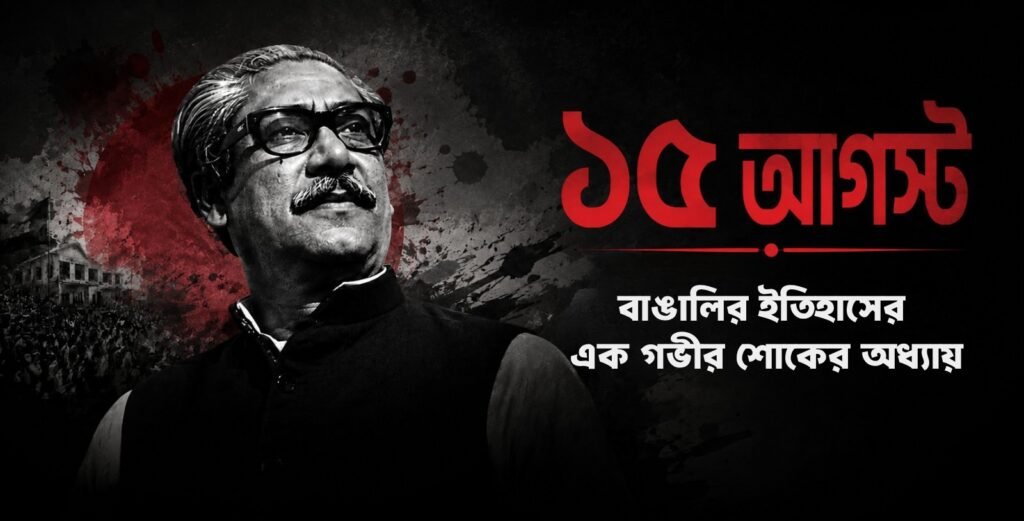
15 August remains one of the most painful and consequential dates in Bangladesh’s modern history. On this day in 1975, Sheikh Mujibur Rahman, the country’s founding leader, was assassinated at his residence in Dhanmondi, Dhaka, along with most members of his immediate family. The killings, which took place only a few years after Bangladesh emerged as an independent state, marked a dramatic rupture in the country’s political development and left a legacy that has continued to influence national politics, public memory and debates over Bangladesh’s identity.
Sheikh Mujibur Rahman’s political career was closely associated with the struggle for Bengali political, cultural and economic rights. His role in the Language Movement, the demand for greater autonomy, the Six-Point Movement and the mass uprising of 1969 helped establish him as a central figure in the nationalist movement. His leadership became particularly decisive during the political crisis of 1970–71, culminating in Bangladesh’s Liberation War and independence in 1971.
After independence, Sheikh Mujibur Rahman faced the formidable task of rebuilding a country devastated by war. Infrastructure and communications had suffered extensive damage, productive capacity had been disrupted and millions of people had been displaced. The new government also had to establish functioning state institutions, restore economic activity, address food shortages and develop a constitutional framework for the newly independent nation.
The post-independence years were nevertheless marked by severe difficulties. Economic disruption, inflation, shortages, administrative weaknesses and political instability placed enormous pressure on the government and the wider population. The devastating famine of 1974 deepened the crisis and intensified public dissatisfaction. These circumstances formed part of the troubled political environment in which the events of August 1975 unfolded.
The assassination was not limited to Sheikh Mujibur Rahman. His wife, Begum Fazilatunnesa Mujib, his sons Sheikh Kamal and Sheikh Jamal, and his youngest son Sheikh Russell were among those killed. Several other relatives also lost their lives. The scale of the killings made the incident not simply a political assassination, but a national tragedy with profound consequences for the country’s political and social memory.
The death of Sheikh Russell, who was still a child, has remained particularly poignant. He had no political role and was nevertheless killed during the attack on his family. His death has come to represent the devastating consequences of political violence for people who themselves have no involvement in political conflict.
Sheikh Mujibur Rahman’s two daughters, Sheikh Hasina and Sheikh Rehana, survived because they were abroad at the time. They were consequently spared the killings but lost their parents and several close relatives in a single night. Their subsequent lives were profoundly shaped by the events of 15 August.
Sheikh Hasina later became a major figure in Bangladeshi politics and led the Awami League for decades. She served as prime minister for several terms, during which Bangladesh experienced significant economic, infrastructural and technological development. Major infrastructure projects, expanded electricity generation, improved transport networks, digital services and broader social protection initiatives were among the developments associated with the country’s long period of economic growth.
Bangladesh’s transformation, however, has resulted from a much wider set of factors. The ready-made garment industry became a major source of exports and employment, while overseas workers’ remittances, agricultural improvements, private-sector investment and the contribution of millions of workers also played important roles. Over the decades, Bangladesh progressed from a war-ravaged economy towards lower-middle-income status and reached the United Nations’ criteria for graduation from the least developed country category.
The political interpretation of 15 August has remained deeply contested. The country has experienced repeated periods of intense political confrontation, with competing parties and movements offering sharply different interpretations of Bangladesh’s history and political legacy. Following the fall of Sheikh Hasina’s government on 5 August 2024, several sites associated with Sheikh Mujibur Rahman and the Awami League came under attack. The historic residence at Dhanmondi 32, which had been closely associated with the events of 15 August 1975, was attacked and set on fire. Statues and memorials connected with the former leader were also damaged in different locations.
Those developments renewed questions about how Bangladesh should preserve and examine its complex historical past. Political transitions can change the public interpretation of history, but historical evidence itself extends beyond the fortunes of individual governments or political organisations. The Language Movement, the struggle for autonomy, the Liberation War, independence and the subsequent political transformation of the country form interconnected chapters of Bangladesh’s national story.
The significance of 15 August therefore extends beyond a single day of mourning. It raises enduring questions about political violence, democratic institutions, historical evidence and the preservation of national memory. Bangladesh’s political history contains competing narratives and profound disagreements, but such disagreements need not be settled through violence or the destruction of historically significant places.
The political consequences of the 1975 assassination were far-reaching. Bangladesh subsequently experienced major changes in its political direction and system of governance. The killings continued to influence political debate and competition for decades, while the legal process surrounding the assassination eventually became another significant chapter in the country’s judicial and political history.
Fifty-one years after the killings, the legacy of 15 August remains deeply embedded in Bangladesh’s history. Sheikh Mujibur Rahman and the family members who died with him continue to occupy an important place in the country’s historical narrative, while the circumstances surrounding the tragedy remain a subject of political debate.
Remembering such an event is not simply a matter of holding ceremonies. Historical memory depends on reliable evidence, documentary records, education, public discussion and the preservation of significant sites. A mature society must be able to examine painful chapters of its past without allowing political disagreement to descend into violence.
The events of 15 August demonstrate how profoundly political violence can alter the direction of a nation. The assassination removed Bangladesh’s founding political leader and most of his immediate family, while its consequences continued to shape political discourse and national identity across generations.
For Bangladesh, the lasting lesson of 15 August lies in the human and political cost of intolerance. Political differences can be deep and difficult, but a stable society requires those differences to be addressed through democratic institutions, lawful processes, dialogue and peaceful political participation. Preserving historical evidence and allowing future generations to understand the consequences of political violence remain essential to building a more peaceful and democratic Bangladesh.