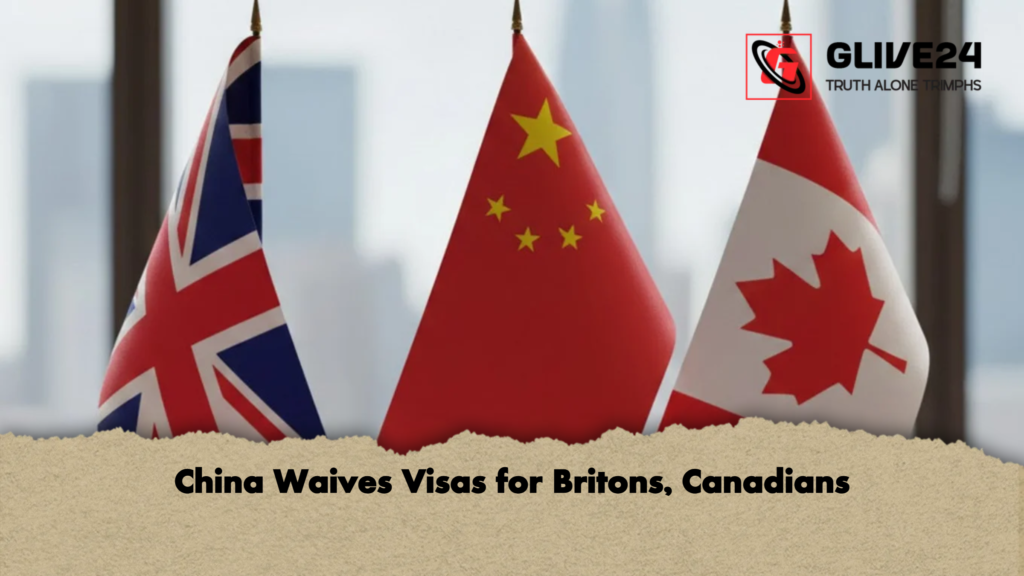
China has announced that citizens of the United Kingdom and Canada will be permitted to enter the country without a visa from Tuesday, in a move widely interpreted as a significant diplomatic gesture aimed at strengthening bilateral ties. The decision follows recent high-level visits to Beijing by British Prime Minister Keir Starmer and Canadian Prime Minister Mark Carney earlier this year.
The announcement was confirmed by China’s Ministry of Foreign Affairs in Beijing, which stated that the new visa-free arrangement would remain in force until 31 December. Under the policy, holders of ordinary British and Canadian passports will be able to enter China for up to 30 days without applying for a visa in advance.
The development comes after January meetings in Beijing between the two Western leaders and senior Chinese officials, including President Xi Jinping. Following those talks, both Mr Starmer and Mr Carney spoke positively about the progress made in discussions covering trade, cultural cooperation and broader geopolitical alignment.
Scope of the Visa-Free Policy
According to the official statement, the visa waiver applies to travel for business, tourism, family visits, cultural exchanges and transit purposes. It does not extend to employment, long-term study or journalistic assignments, which will continue to require the appropriate visas.
The key features of the arrangement are summarised below:
| Category | Details |
|---|---|
| Eligible nationalities | United Kingdom, Canada |
| Effective date | Tuesday (as announced) |
| Expiry date | 31 December (current year) |
| Maximum stay | 30 days |
| Permitted purposes | Tourism, business, family visits, cultural exchange, transit |
| Excluded purposes | Employment, long-term study, media work |
Chinese officials emphasised that the measure is designed to promote people-to-people exchanges and foster closer cultural and economic ties. In a statement, the Foreign Ministry noted that easing travel restrictions would “further facilitate exchanges between the Chinese people and those of other countries”.
Strategic and Economic Context
The decision reflects a broader recalibration in international relations. Both London and Ottawa have recently signalled a desire to diversify economic partnerships and reduce overreliance on any single global power amid evolving geopolitical tensions. Strengthening engagement with China—one of the world’s largest economies—forms part of that strategy.
For China, the move aligns with its ongoing efforts to revitalise inbound tourism and foreign business activity in the post-pandemic period. Over the past two years, Beijing has introduced similar visa exemptions and simplified entry procedures for several European and Asian nations, seeking to stimulate investment, trade and cultural exchange.
Business groups in both the UK and Canada have welcomed the announcement, arguing that reduced administrative barriers will make commercial travel more efficient and encourage new investment opportunities. Universities and cultural institutions have likewise expressed optimism that academic collaboration and artistic exchange will benefit from easier mobility.
Whether the visa-free arrangement will be extended beyond December may depend on the trajectory of diplomatic relations and the practical impact of the policy in the months ahead. For now, however, the measure represents a notable thaw in travel formalities and a tangible sign of improving engagement between Beijing, London and Ottawa.