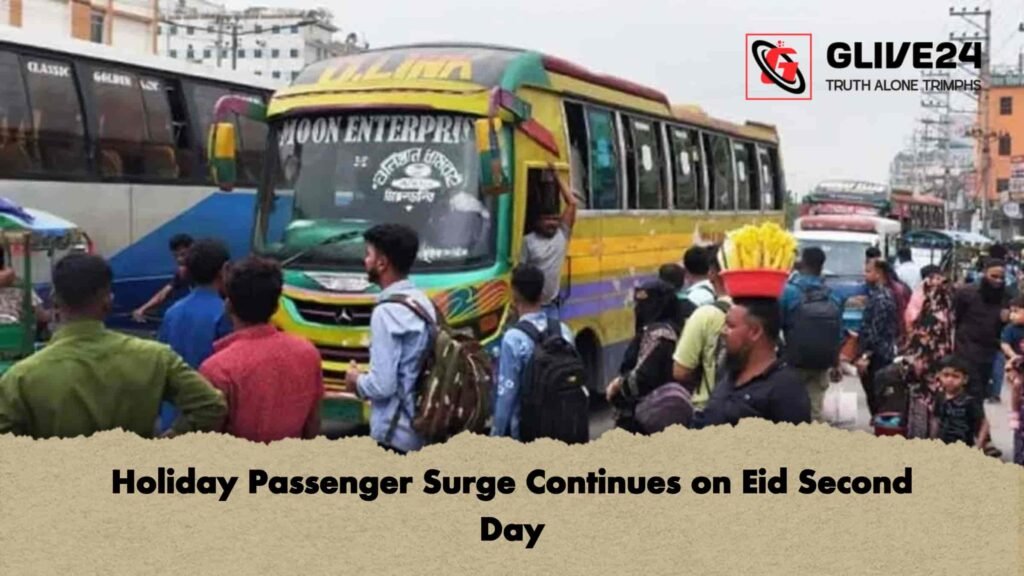
A substantial volume of outbound commuters continued to depart from the capital city of Dhaka on Friday, 29 May 2026, marking the second consecutive day of the nationwide Eid-ul-Adha holiday celebrations. Terminal data and field surveys conducted during the morning hours revealed significant passenger traffic across major inter-district bus terminals, corporate booking counters, and primary arterial transit points.
This post-Eid transport deployment is driven by two distinct groups of commuters. The first group comprises professionals, industrial labourers, and service-sector employees who were unable to secure leave or finalize their travels prior to the holiday because of strict workplace obligations or emergency operational duties. The second group consists of metropolitan families who chose to celebrate the first day of the festival within Dhaka and are now travelling to regional districts to visit extended family members.
Terminal Conditions and Highway Traffic Dynamics
In contrast to the severe logistical gridlock and extensive delays that characterized the pre-festival rush on Wednesday, transit operations on Friday morning were smooth. Commuters at multiple booking counters reported highly efficient processing times and minimal terminal waiting periods.
The primary operational factor ensuring this travel efficiency was a significant drop in vehicular density across the national highway network. Because commercial freight carriage, mass long-haul logistics, and corporate transport operations were suspended for the holiday period, the arterial routes connecting Dhaka to the northern, western, and southern districts remained clear. Commuters expressed high satisfaction with the low congestion levels, noting that travel times had decreased significantly compared to the pre-Eid transport metrics.
The localized passenger distribution, terminal operational status, and broader transit dynamics recorded across Dhaka’s primary transport points are outlined in the table below:
| Transport Hub Category | Location and Field Observations | Traffic and Velocity Status | Passenger Target Group |
| Inter-District Terminals | Gabtoli, Sayedabad, and Mohakhali central stations | Moderate-to-high passenger footfall; steady departures | Corporate staff, utility workers, and late holidaymakers |
| Arterial Intersections | Technical Crossing, Uttara House Building, Signboard | Informal boarding points active; high bus frequencies | Short-haul passengers travelling to adjacent sub-districts |
| National Highways | Dhaka–Tangail, Dhaka–Chittagong, Dhaka–Mawa | High-velocity, free-flowing traffic; zero structural congestion | All regional long-haul transport operators |
Administrative Deployment and Alternative Boarding Practices
To accommodate the steady flow of passengers, inter-district transport operators maintained high departure frequencies, utilizing spare vehicles from their corporate fleets. Due to the high demand at centralized booking offices, many passengers chose to bypass primary terminals completely, electing instead to board long-haul coaches at major suburban intersections. These roadside gatherings were observed at critical intersections, including Technical Crossing, Shyamoli, Kalyanpur, Uttara House Building, and the Signboard junction along the Dhaka–Chittagong highway.
Highway patrol units and metropolitan police detachments remained stationed at these intersections to oversee traffic management and enforce transport safety protocols. Terminal supervisors confirmed that ticket pricing structures remained largely aligned with government-regulated holiday guidelines, preventing the arbitrary fare increases often seen during peak travel periods. Transport authorities expect outbound passenger volumes to remain steady through Saturday morning, after which the transit network will transition to handle the subsequent influx of return commuters.