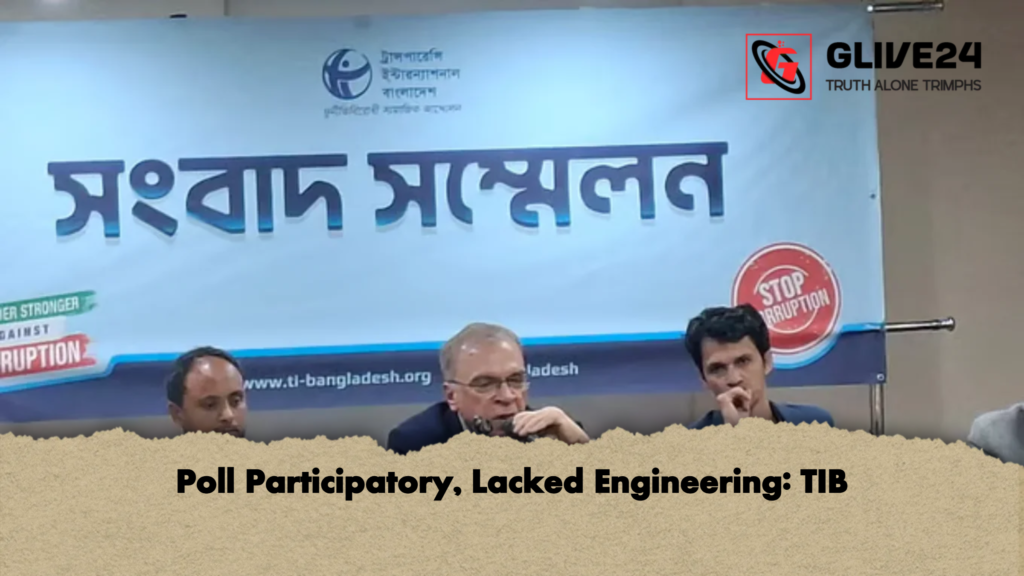
The 13th National Parliamentary Election was “participatory and inclusive to an acceptable degree” and did not exhibit signs of systematic “election engineering”, according to Transparency International Bangladesh (TIB).
Speaking at a press conference in Dhaka on Monday, the organisation’s Executive Director, Iftekharuzzaman, stated that, in TIB’s assessment, the overall process was “largely acceptable, reasonably fair, neutral and participatory”, despite notable irregularities and incidents of violence.
The remarks were made during the presentation of a report titled “Process and Affidavit-Based Observation of the 13th National Parliamentary Election” at TIB’s office in Dhanmondi. The report provides a structured evaluation of electoral procedures, candidate disclosures and post-election developments.
Table of Contents
Inclusiveness Without a Major Party
Responding to questions about whether the election could be deemed inclusive in the absence of the Awami League as an official contestant, Iftekharuzzaman argued that many of the party’s leaders and activists participated at the local level—either as independent candidates or under alternative political banners. He further observed that a significant proportion of voters were supporters of the Awami League, suggesting that participation extended beyond formal party nomination structures.
On that basis, TIB concluded that the election met a threshold of inclusiveness grounded in observable facts rather than partisan claims.
Methodology and Scope of Observation
TIB’s findings are based on a representative sampling model. Of the 300 parliamentary constituencies nationwide, 70 were selected through randomised sampling to ensure geographical and political diversity. Data were compiled through field observation, analysis of candidate affidavits, and monitoring of election-day conduct and post-election incidents.
| Indicator | Data |
|---|---|
| Total parliamentary seats | 300 |
| Constituencies observed (sample) | 70 |
| Code of conduct provisions | 58 |
| Candidates violating at least one provision | 99% |
Code of Conduct Violations
The report reveals that 99 per cent of contesting candidates breached at least one of the 58 provisions of the electoral code of conduct. Allegations and documented incidents on polling day included:
-
Physical assault on an independent female candidate
-
Intimidation of voters outside polling stations
-
Expulsion of polling agents representing independent candidates
-
Denial of entry to rival candidates’ agents at certain centres
-
Harassment of voters under questionable procedural pretexts
-
Proxy voting (one individual casting a ballot on behalf of another)
-
Distribution of money during voting hours
In addition, discrepancies between voter lists and identification photographs reportedly prevented some citizens from exercising their franchise, highlighting administrative shortcomings.
Post-Election Violence
The report also documents a series of violent incidents in the 70 observed constituencies:
| Type of Incident | Number Recorded |
|---|---|
| Clashes between political rivals | 45 |
| Intimidation of rival supporters | 34 |
| Attacks on homes or offices | 18 |
| Intra-party rebel clashes | 16 |
TIB noted that although early stages of the campaign suggested relatively healthy competition, entrenched patterns of confrontational and, at times, violent political behaviour gradually resurfaced. Inter-party conflict, factional disputes within parties, and aggressive competition for power intensified as polling approached and, in several areas, persisted after results were declared.
Overall Assessment
In its concluding observations, TIB emphasised that while the structural framework of the election did not reflect overt manipulation or orchestrated engineering, behavioural and cultural deficiencies within political practice remain a serious concern.
Thus, the election may be described as procedurally acceptable and participatory in broad terms, yet marred by widespread breaches of conduct and recurring violence—an outcome that underscores both incremental progress and enduring structural challenges within the country’s democratic landscape.