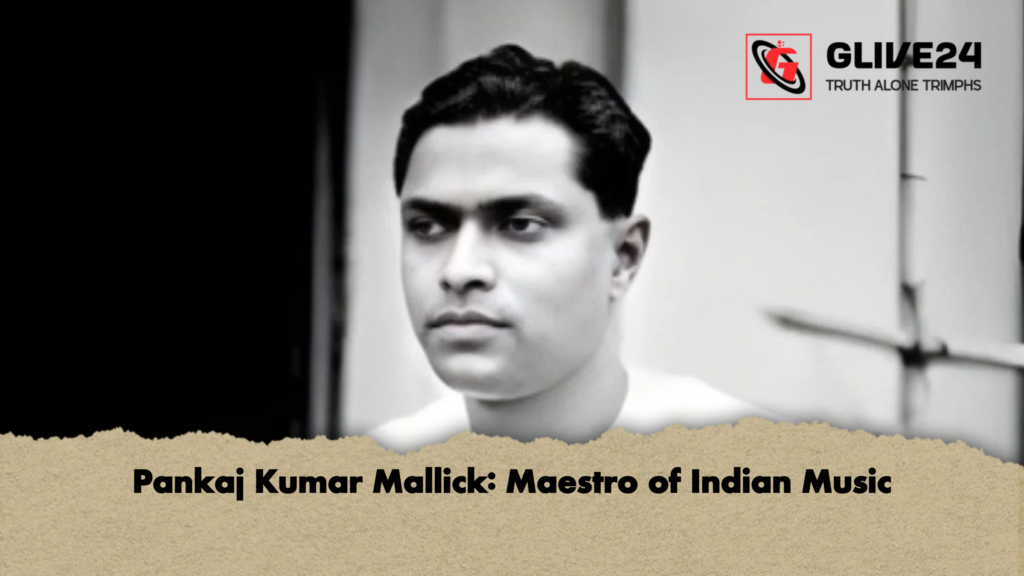
Pankaj Kumar Mallick (10 May 1905 – 19 February 1978) remains a singular name in the annals of Bengali and Indian music. A multifaceted talent, he was a vocalist, composer, music director, and actor. His pioneering role in introducing playback singing to Indian cinema and popularising Rabindra Sangeet in mainstream culture has secured him a permanent place in the history of Indian music.
Early Life and Education
Born in Kolkata to Manimohan Mallick and Manomohini Devi, Pankaj Kumar was immersed in a culturally rich environment from childhood. His father’s passion for music profoundly influenced him, shaping the trajectory of his artistic journey.
He received rigorous training in Indian classical music under the esteemed guru Durgadas Bandyopadhyay and later completed his higher education at Scottish Church College.
Advocate of Rabindra Sangeet
A pivotal chapter in Mallick’s life began with his association with Dinendranath Thakur, which brought him close to Rabindranath Tagore and fostered a lifelong devotion to Rabindra Sangeet. He quickly became one of its foremost interpreters, setting melodies to Tagore’s poetry, such as “Din-er Sheshe Ghumer Deshe” from the collection Kheya.
In September 1932, his first Rabindra Sangeet recording—“Praloynachan Nachle Jokhon, O Tomar Ashon Shunyo Aaji”—was released, marking the beginning of a prolific recording career.
Radio and Recording Career
At just eighteen, Mallick recorded the song “Nemeche Aaj Prothom Badal” in 1926. The following year, he joined the Indian Broadcasting Corporation in Kolkata, later known as Akashvani Kolkata, serving as a music director and performer for nearly five decades.
His musical direction for the radio programme Mahishasurmardini continues to resonate with Bengalis during Mahalaya, a testament to his enduring legacy.
Contributions to Cinema
From 1931 to 1969, Mallick worked for 38 years in Bengali, Hindi, Urdu, and Tamil films as a composer and performer. He was associated with New Theatres, India’s pioneering film studio, for nearly 25 years.
He played a pivotal role in introducing playback singing alongside legends like Raichand Boral and Nitin Bose and collaborated with iconic artists including:
-
Kundan Lal Saigal
-
Sachin Dev Barman
-
Hemanta Mukherjee
-
Geeta Dutt
-
Asha Bhosle
Mallick also appeared on screen, sharing frames with luminaries such as Pramathesh Barua and Kanan Devi.
Recognition and Legacy
In 2006, the Indian Postal Department issued a commemorative stamp to mark his centenary. He passed away on 19 February 1978, yet his music, voice, and compositions remain an indelible part of Indian musical heritage.
Key Milestones
| Year | Milestone | Contribution |
|---|---|---|
| 1905 | Birth | Kolkata, India |
| 1926 | First recording | “Nemeche Aaj Prothom Badal” |
| 1927 | Joined radio | Indian Broadcasting Corporation (later Akashvani Kolkata) |
| 1931 | Cinema debut | Bengali and Hindi films |
| 1932 | First Rabindra Sangeet record | “Praloynachan Nachle Jokhon…” |
| 1978 | Demise | Left a lasting legacy in music |
Pankaj Kumar Mallick was more than an artist; he was a bridge linking classical music, Rabindra Sangeet, and film music. His voice conveyed devotion, emotion, and classical sweetness in a blend that continues to reverberate in the hearts of music lovers.