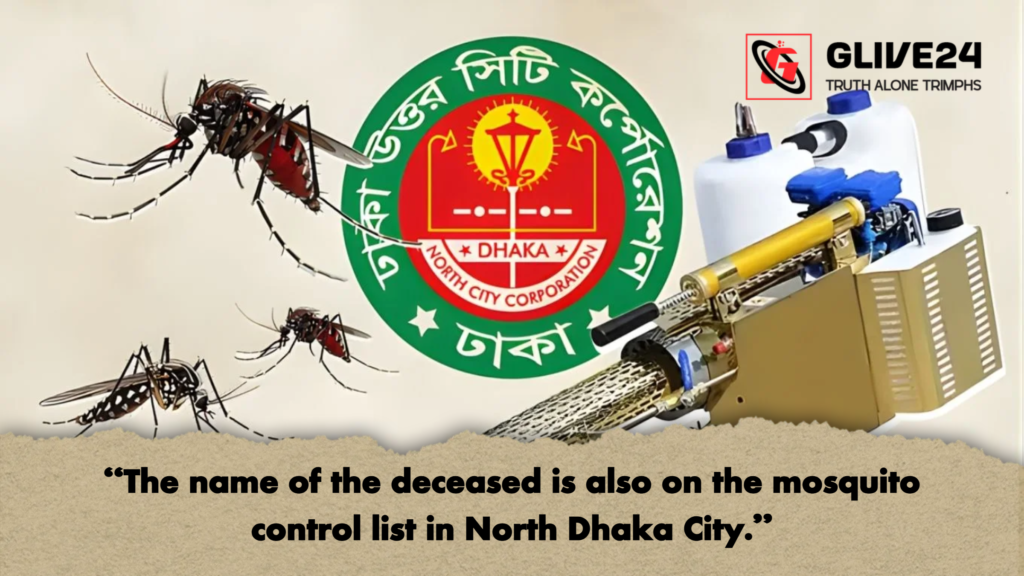
Residents of Dhaka North City have been left bewildered after discovering that a deceased person remains on the official roster of mosquito control workers. The schedule, published on the Dhaka North City Corporation (DNCC) website under the title “Mosquito Control Work Plan”, details which employees are assigned to specific areas on particular days of the week.
According to the list, the eighth entry for Ward 2 (Mirpur) names Offr Ali as responsible for mosquito control duties in Sagufta Residential Area (roads 1–5) and Beguntilla slum on Mondays and Thursdays, from 8:30 am to 11:30 am. However, a field visit by this correspondent on Thursday around 9 am revealed no presence of the assigned worker.
Attempts to contact Offr Ali via the mobile number listed on the DNCC website were unsuccessful; the phone was switched off repeatedly. Subsequently, the correspondent visited a nearby area, Shwapnagar Residential, where a worker was seen, though not actively spraying insecticide. Shortly thereafter, the worker departed with a companion on a motorcycle. Upon inquiry, the motorcycle driver identified himself as Rakibul Alam Khan, Ward 2 mosquito supervisor, while the accompanying worker was named Shah Alam.
When informed that Offr Ali was missing, Rakibul revealed that the worker had passed away approximately two and a half years ago, yet his name remains on the official list. Rakibul declined to comment further on why this outdated information persists.
DNCC sources admitted that the “Mosquito Control Work Plan” has multiple inconsistencies, and the Health Department, which oversees the mosquito eradication programme, has not updated the website for an extended period. Brigadier General Imrul Kayes Chowdhury, DNCC’s Chief Health Officer, confirmed this lapse, citing outdated records as the primary reason.
Local residents describe worsening mosquito infestations. Arafat Hossain of Shwapnagar said, “It is impossible to sit on the balcony at night; coils and sprays are ineffective.” Nearby Sagufta resident Zahid Hasan added, “The mosquitoes swarm from late afternoon onwards. After Maghrib, doors and windows must remain closed.”
Mosquito control work in the city occurs twice daily:
| Time Slot | Activity | Method |
|---|---|---|
| 8:30 am – 11:30 am | Larvicide application | Spraying stagnant water in breeding sites |
| 3:30 pm – 5:30 pm | Fogging | Dispersing insecticide smoke to kill flying mosquitoes |
Despite these efforts, residents question the effectiveness of the operations. Zakir Sarkar of Kaderrabad, Mohammadpur, observed that mosquitoes prevent children from studying at night and expressed concerns over the lack of supervision. In Uttara and other northern sectors, mosquito proliferation has intensified due to blocked drains and stagnant water, according to Nizamul Islam Bhuiya, Secretary of Uttara 3 Sector Welfare Association.
Chowdhury explained that the current surge is driven by Culex mosquitoes, whose breeding depends on poor drainage and waste management. While larvicide and fogging remain essential, comprehensive drainage clearing and proper waste management are critical to long-term control. DNCC has begun integrated operations involving the waste management department to address these challenges.
Experts, including Professor Kabirul Bashar of Jahangirnagar University, warn that administrative weaknesses and absence of local representatives exacerbate mosquito proliferation. They emphasise urgent larvicide campaigns and rapid clearance of stagnant water bodies as the only immediate solution.