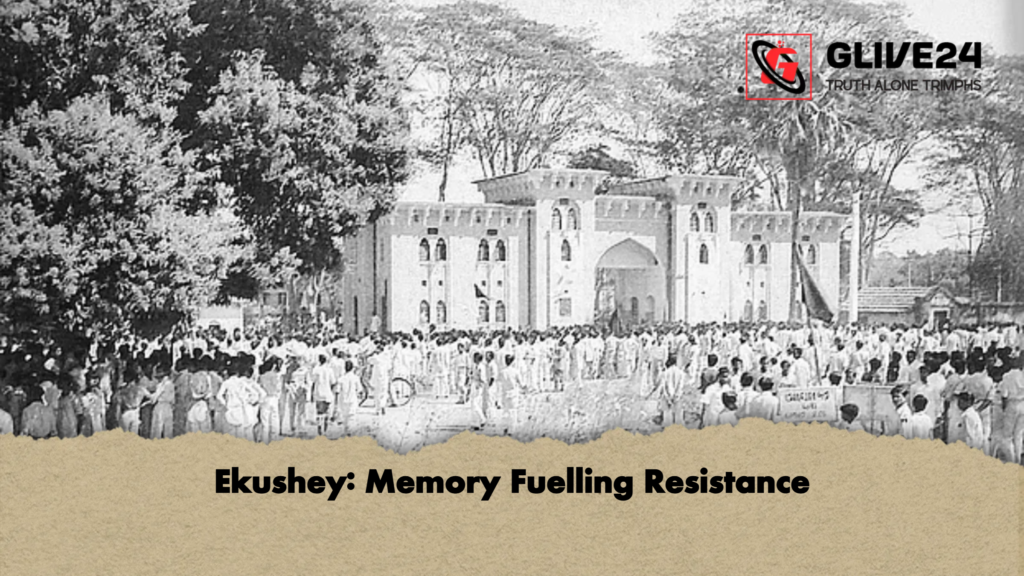
The enduring resonance of 21 February—Ekushey—within Bangladesh’s political and cultural consciousness is perhaps best captured in the closing lines of Arek Falgun by Zahir Raihan. Set against the observance of Language Movement Day in 1955, the novel culminates in a striking exchange: as prison authorities struggle to accommodate waves of detained protesters, a young activist declares defiantly, “Wait till next spring—we shall be twice as many.”
This literary moment has transcended fiction to become a recurring metaphor in Bangladesh’s history of protest. Each cycle of repression has seemingly produced a stronger, broader resistance. From novels to street murals, the idea of “doubling” has symbolised not merely numerical growth but the deepening of collective resolve.
Collective Memory and National Identity
National identity, far from being innate or immutable, is constructed through shared experiences and remembrance. In Bangladesh, the events of 21 February 1952—the Language Movement—form a cornerstone of that identity. The sacrifice of those who died defending the right to speak Bangla has become a unifying narrative, anchoring both historical memory and political imagination.
While some historians argue that Bangladesh’s story should be traced further back to avoid isolating Ekushey as a singular घटना, few dispute its profound influence. Indeed, attempts by successive regimes to reinterpret or appropriate the legacy of the Language Movement underscore its enduring political potency.
From Symbol to Strategy
Ekushey has functioned not only as a memorial but also as a strategic and symbolic resource in political mobilisation. As noted by Abul Mansur Ahmed, the formulation of the historic 21-point programme ahead of the 1954 United Front elections drew direct inspiration from the symbolic power of the number “21”. What began as a linguistic struggle thus evolved into a broader political framework, shaping demands for autonomy and rights.
Ekushey Across Political Movements
The influence of Ekushey across decades can be summarised as follows:
| Period | Movement | Role of Ekushey |
|---|---|---|
| 1952 | Language Movement | Foundation of linguistic and national identity |
| 1954 | United Front Election | Inspiration for 21-point manifesto |
| 1969 | Mass Uprising | Medium of protest through slogans and murals |
| 1971 | Prelude to Liberation War | Symbol of oath-taking and resistance |
| 1980s | Anti-autocracy movement | Rallying point for democratic demands |
| 2024 | Mass uprising | Revival of slogans and youth mobilisation |
Flames of Protest: 1969 to 1971
During the 1969 uprising against military rule, Ekushey became a canvas for dissent. Walls near the Shaheed Minar were filled with powerful imagery and slogans condemning imperialism, capitalism, and authoritarianism. These expressions transformed public space into a site of political articulation.
By 1971, the symbolic weight of Ekushey had intensified further. On the cusp of the Liberation War, Sheikh Mujibur Rahman invoked the memory of the language martyrs in his call for self-determination, declaring a willingness to sacrifice blood for autonomy. The day became a moment of collective oath-taking, bridging linguistic rights with the struggle for independence.
Beyond Formal Commemoration
In independent Bangladesh, Ekushey has been observed annually with state ceremonies. Yet its true vitality lies beyond official rituals. It emerges most forcefully in moments of crisis—when citizens mobilise against injustice, repression, or democratic backsliding.
During the anti-autocracy movements of the 1980s under Hussain Muhammad Ershad, Ekushey served as a focal point for resistance. Political leaders and student groups alike invoked its legacy to demand democratic reforms.
Contemporary Echoes
Even in recent times, Ekushey continues to inspire. The 2024 mass uprising saw a revival of historic slogans, including the iconic promise of “doubling” in the coming spring. Protest songs and graffiti drew direct parallels between 1952 and the present, demonstrating how deeply embedded Ekushey remains in the nation’s protest culture.
The Shaheed Minar, in particular, persists as a symbolic epicentre—hosting rallies, declarations, and collective acts of remembrance that blur the line between past and present संघर्ष.
A Living Legacy
Over seven decades, Ekushey has evolved from a day of mourning into a dynamic instrument of resistance. It provides language to the voiceless, courage to the oppressed, and continuity to movements seeking justice.
As Bangladesh stands at another Important political moment, the spirit of Ekushey offers both guidance and warning. It calls for a commitment to democratic values, human rights, and accountability. And should State repression re-emerge, history suggests that Ekushey will once again ignite resistance.
The song that asks, “Can I ever forget the twenty-first of February, stained with my brothers’ blood?” remains not just a lament, but a pledge—one that continues to reverberate through every the movement for justice and dignity.