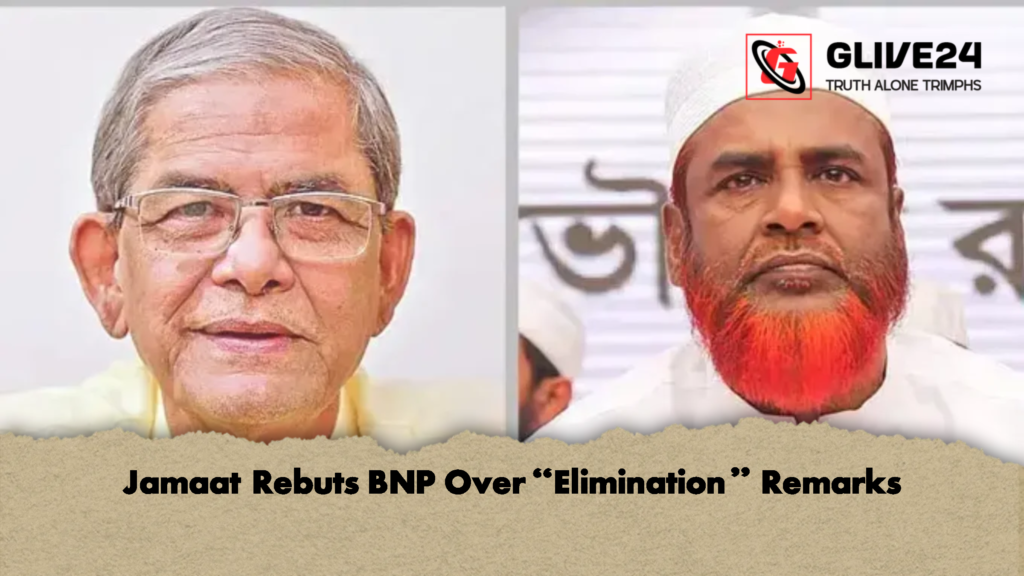
In a definitive response to recent political commentary, the Secretary General of Bangladesh Jamaat-e-Islami, Mia Golam Porwar, has asserted that his organisation cannot be suppressed through intimidation or threats of eradication. In a formal statement issued on Saturday, 25 April 2026, Mr Porwar addressed the rhetoric of the Secretary General of the Bangladesh Nationalist Party (BNP) and Minister for Local Government, Mirza Fakhrul Islam Alamgir, describing it as both undemocratic and inflammatory.
The dispute arose following a public address by Mr Alamgir, in which he reportedly stated that Jamaat-e-Islami must be “completely eliminated politically.” This exchange signals a widening division within the nation’s political landscape, specifically as Bangladesh manages the transition period following the mass uprising of 2024.
Critique of Rhetoric and Democratic Conduct
Mr Porwar characterised Mirza Fakhrul’s remarks as “unconstitutional, unwanted, and indecent.” He contended that the concept of “political elimination” is antithetical to democratic principles and argued that such language mirrors the phrasing employed by the previous administration.
In his communiqué, the Jamaat Secretary General stated:
“The Secretary General of the BNP has utilised the language of the fallen Awami fascists, which is wholly inappropriate and deeply regrettable. The citizens of this country do not expect such remarks, which lack basic political etiquette, from a leader of his standing. This statement appears to signal an attempt to steer the nation toward violence and provocative anarchy, reminiscent of past eras.”
The Jamaat leader further suggested that at a time when the public is seeking to establish the rule of law and a society based on justice following a “bloody revolution,” calls to eliminate a parliamentary opposition force suggest an underlying conspiracy. According to Mr Porwar, such rhetoric implies a preference for authoritarianism over healthy, multi-party competition.
Allegations of Ideological Failure
Mr Porwar posited that threats of political elimination are often a symptom of ideological bankruptcy. He argued that when a political entity fails to challenge an opponent through logic, morality, or sound policy, it resorts to provocative language that risks inciting violence.
“The conscious people of this country believe that only when a party is unable to face its political opponent with ideals and arguments do they display such bankruptcy through inflammatory rhetoric,” the statement read. He highlighted the resilience of Jamaat-e-Islami, noting that the party remained operational despite seventeen and a half years of “undemocratic and terrorist rampages” by the previous regime intended to dismantle its structure.
Appeals for Political Restraint and Stability
Concluding his statement, Mr Porwar urged the BNP Secretary General to refrain from “short-sighted” comments that could destabilise the country’s current democratic environment. He warned that any individual or party conspiring against the existence of Jamaat-e-Islami would eventually face rejection by the electorate, echoing the fate of previous administrations.
The statement emphasized several key points:
-
Structural Resilience: Despite the historical execution of its senior leadership and the closure of its offices under the former regime, the party maintains its organisational integrity.
-
Adherence to Constitutional Language: Mr Porwar called on Mr Alamgir to adopt systematic and constitutional discourse rather than language that threatens to dismantle the democratic system.
-
National Security: The communiqué stressed that provocative rhetoric serves only to undermine the fragile stability achieved after the 2024 transition.
As of Saturday evening, the BNP has not issued an official response to Mr Porwar’s rebuttal. Political analysts have expressed concern that such public friction between groups that historically opposed autocratic rule may complicate the country’s progress toward future electoral processes.