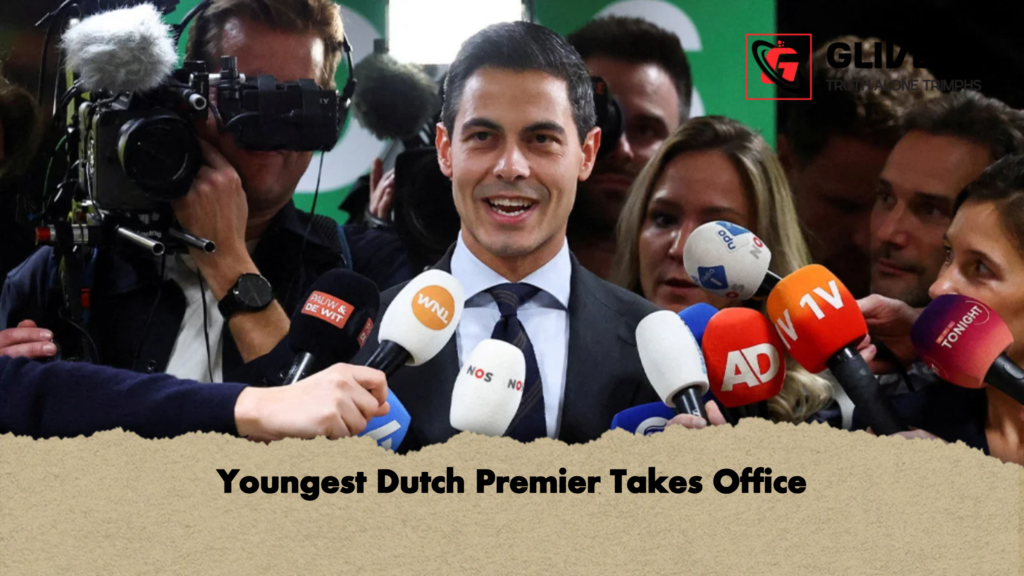
The Netherlands has inaugurated a new government, ushering in a historic premiership under 38-year-old centrist politician Rob Jetten. Sworn in on Monday, Jetten becomes both the youngest prime minister in Dutch history and the first openly gay leader to hold the office—an appointment widely viewed as emblematic of the country’s liberal social traditions and evolving political landscape.
Jetten secured a narrow yet decisive victory in October’s general election, defeating the anti-Islam, hard-right Party for Freedom (PVV) led by the outspoken populist Geert Wilders. The snap poll was triggered after the PVV withdrew from the previous coalition, precipitating the collapse of what had been described as the most right-leaning administration in recent Dutch history. That government endured for only 11 months before internal divisions rendered it untenable.
Following protracted negotiations, Jetten’s party, Democrats 66 (D66), formed a coalition with the centre-right Christian Democratic Appeal (CDA) and the liberal-conservative People’s Party for Freedom and Democracy (VVD). Together, the three parties command 66 seats in the 150-member House of Representatives—nine short of the 75 required for an outright majority. As a result, the government will need ad hoc support from opposition parties to pass legislation, raising the prospect of pragmatic deal-making in parliament.
A summary of the new government’s parliamentary standing is set out below:
| Category | Details |
|---|---|
| Prime Minister | Rob Jetten |
| Age at inauguration | 38 |
| Party | Democrats 66 (D66) |
| Coalition partners | CDA, VVD |
| Combined seats | 66 |
| Majority threshold | 75 |
| Time to form coalition | 117 days |
| Previous formation period | 223 days |
Notably, coalition talks concluded in 117 days—considerably faster than the 223 days required to assemble the previous government, reflecting both urgency and political calculation among the parties involved.
In his post-election address, Jetten argued that populist movements could be overcome by offering a positive and constructive vision for the country. Throughout his campaign, he emphasised the Netherlands’ place within Europe, stating that he sought to return the nation “to the heart of Europe”, underscoring his belief that European cooperation remains indispensable to Dutch prosperity and security.
The coalition’s January manifesto reaffirmed full support for Ukraine and pledged to meet NATO defence spending commitments. At the same time, fiscal policy is expected to be cautious. According to Professor Sara de Lange of Leiden University, while the new administration is less overtly hard-right than its predecessor, it nevertheless bears a “right-wing signature”. She notes that the coalition has opted for budgetary restraint rather than expanding deficits to finance public investment.
Immigration policy is likely to remain stringent. The coalition agreement outlines tougher rules on family reunification and promises intensified measures to curb irregular migration, signalling continuity with aspects of the previous government’s approach.
Taken together, Jetten’s premiership represents both continuity and change: socially progressive in symbolism, pro-European in orientation, yet fiscally conservative and firm on migration. His tenure will test whether a minority coalition can provide stable governance in an increasingly fragmented Dutch political arena.