
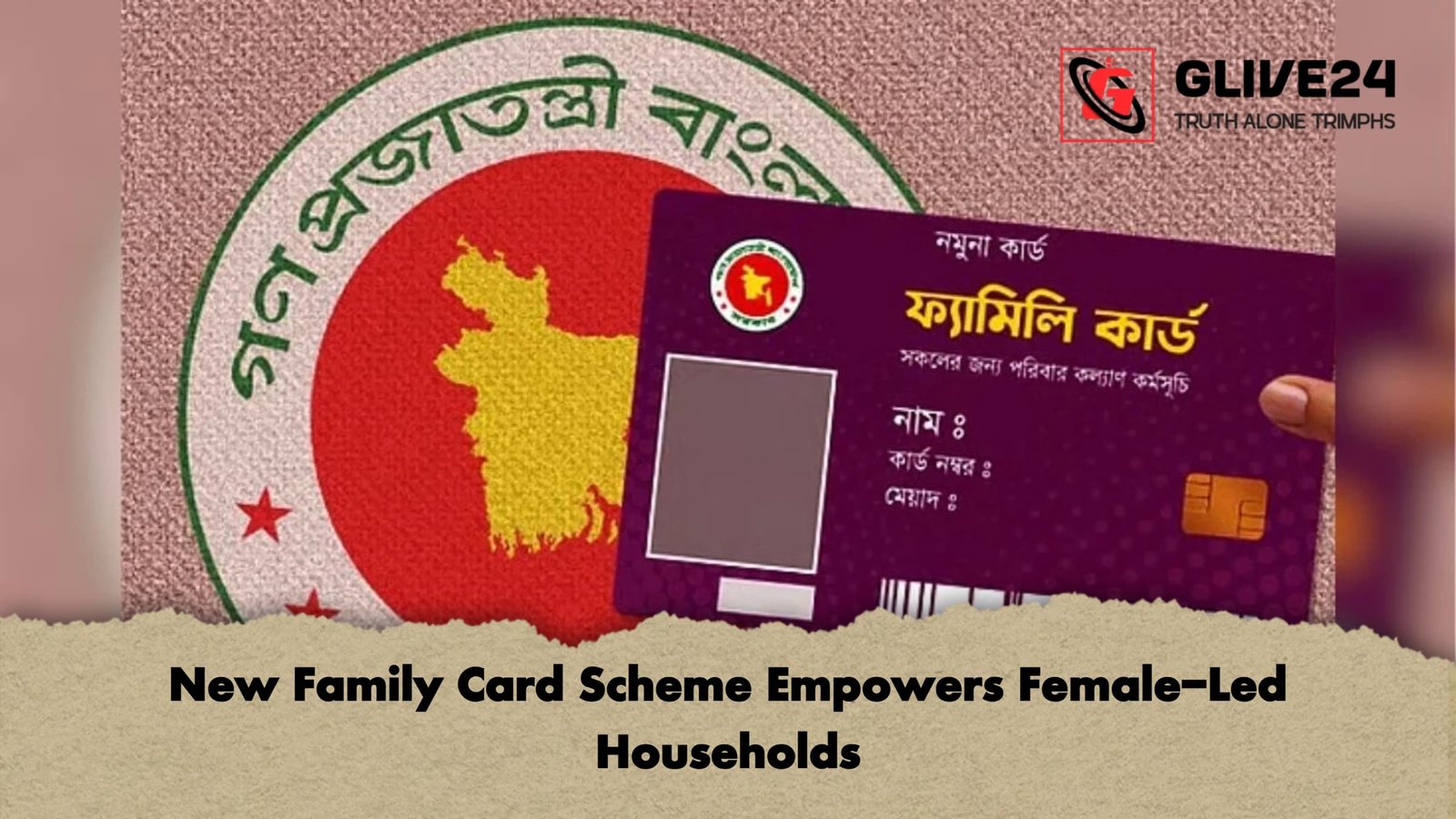
The Government is set to launch a landmark social safety net initiative tomorrow, introducing the “Family Card” on a pilot basis. Designed specifically to support female-headed households, the programme will provide a monthly stipend of 2,500 BDT. In a bid to enhance financial inclusion and transparency, beneficiaries will receive these funds directly through their preferred mobile wallets or bank accounts, ensuring they can access support from the comfort of their homes.
Prime Minister Tarique Rahman is scheduled to formally inaugurate the scheme at 10:00 am on Tuesday at the T&T Grounds adjacent to the Korail settlement in Banani, Dhaka.
Table of Contents
A Transparent Selection Process
At a joint press conference held on Monday at the Ministry of Finance, Finance and Planning Minister Amir Khosru Mahmud Chowdhury emphasised that the selection process remained strictly apolitical. “We have long advocated that the fruits of the Bangladeshi economy must reach every doorstep,” the Minister remarked. “Translating that vision into reality, while maintaining fiscal discipline, is no small feat.”
To ensure the integrity of the list, authorities categorised 67,854 female-led households using specialized software to determine poverty indices. This data-driven approach filtered families into five tiers: ultra-poor, poor, lower-middle-class, middle-class, and affluent.
Pilot Phase Statistics: Beneficiary Breakdown
The government has allocated 380.7 million BDT to cover the pilot phase through June. The final list was narrowed down after rigorous cross-referencing to prevent “double-dipping” (where individuals receive multiple government benefits) or inclusion of ineligible high-income earners.
| Phase of Selection | Number of Households |
| Initially Surveyed (Female-led) | 67,854 |
| Identified as Ultra-Poor/Poor/Lower-Middle | 51,805 |
| Verified as Accurate Data | 47,777 |
| Final Selected Beneficiaries | 37,567 |
Eligibility and Exclusions
The programme currently spans 13 wards across 13 districts, including City Corporations and Unions. Selection committees conducted door-to-door surveys, assessing socioeconomic factors such as household assets (TVs, refrigerators, computers), remittance inflows, and housing conditions.
Strict exclusion criteria apply to maintain focus on the needy:
Government Ties: Families with members receiving salaries, pensions, or grants from state-owned or autonomous bodies are ineligible.
Asset Wealth: Possession of luxury items such as cars or air conditioners, or owning savings certificates exceeding 500,000 BDT, disqualifies a household.
Commercial Interests: Families owning significant business entities or commercial licences are excluded.
Social Welfare Minister Abu Zafar Mohammad Zahid Hossain noted that while the card primarily covers five members per household, provisions exist to issue additional cards to large joint families on a proportional basis.
Future Expansion
Addressing concerns regarding political bias, Minister Chowdhury assured that supporters of all political affiliations—including the AL, Jamaat-e-Islami, and various leftist parties—would receive benefits if they met the poverty criteria. Furthermore, while the pilot currently focuses on women, the government plans to extend the scheme to ultra-poor male-headed households following the conclusion of the trial period in June.