
Khabor Wala Desk
Published: 11th March 2026, 11:23 AM
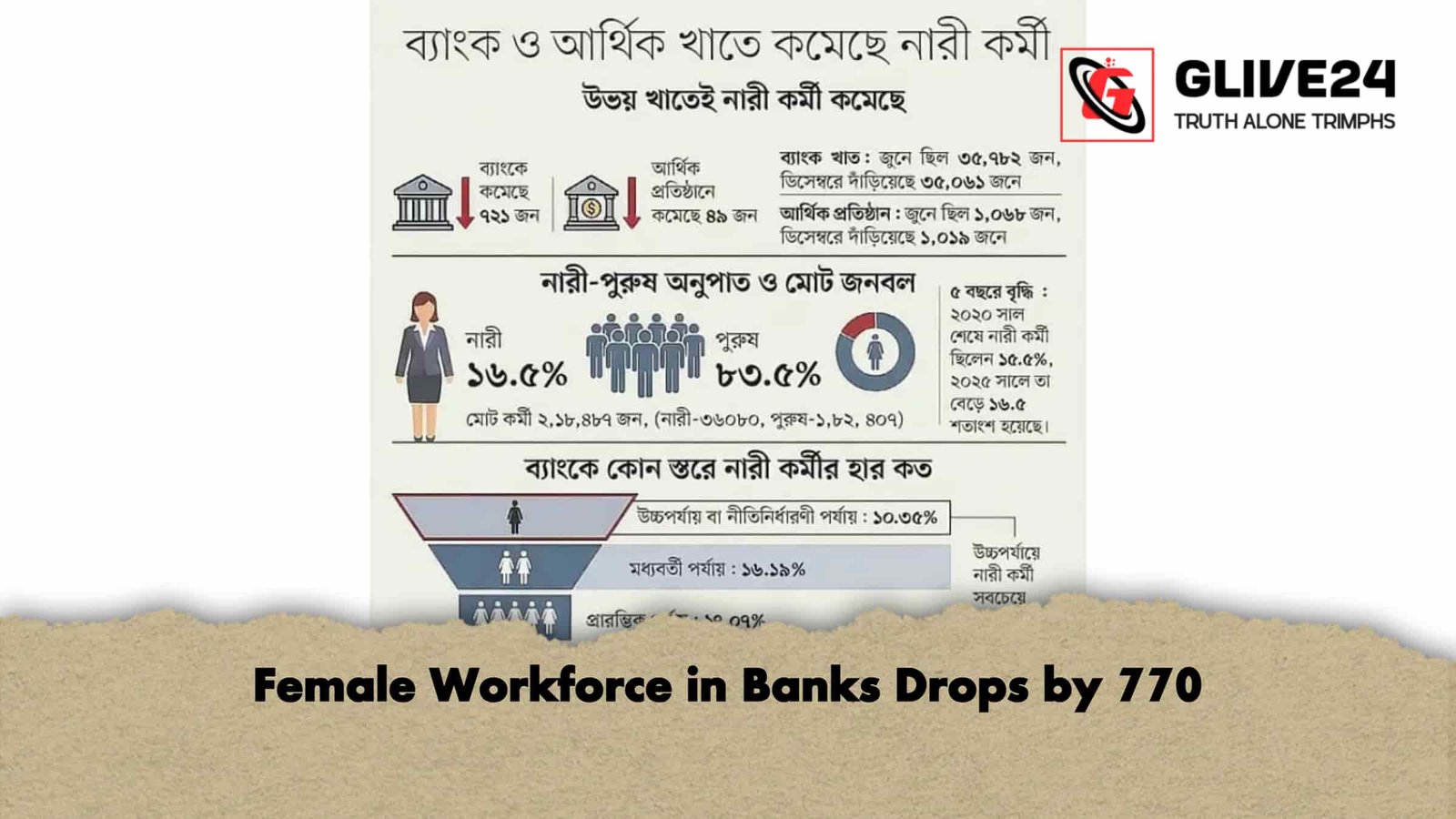
The number of female employees in Bangladesh’s banking and non-bank financial institutions has declined sharply over the last six months. According to the latest report on gender representation released by Bangladesh Bank, the banking sector saw a reduction of 721 female staff, while non-bank financial institutions recorded a decrease of 49, bringing the total decline in female employees to 770 during this period.
As per the central bank’s data, the number of female employees in the banking sector fell from 35,782 in June to 35,061 in December. Similarly, non-bank financial institutions witnessed a reduction from 1,068 female employees to 1,019 over the same six-month period. The report is based on data collected from 61 banks and 35 financial institutions nationwide.
In total, the workforce across banks and financial institutions stood at 218,487 at the end of December. Of these, 182,407 were men, and 36,080 were women. This means that women constitute only 16.5 per cent of the workforce, while men account for 83.5 per cent.
| Sector | June 2025 | December 2025 | Change | Female Percentage |
|---|---|---|---|---|
| Banks | 35,782 | 35,061 | -721 | 16.5% |
| Non-bank Financial Institutions | 1,068 | 1,019 | -49 | 16.5% |
| Total | 36,850 | 36,080 | -770 | 16.5% |
Industry experts attribute this decline to multiple factors. Following political transitions in 2024, several financially distressed banks and institutions underwent mergers or closures with government approval, resulting in many female employees losing their positions. In addition, family and societal pressures have led numerous women to voluntarily leave their roles.
Anita Gazi Rahman, Director at BRAC Bank and Senior Lawyer of the Supreme Court, remarked: “The decreasing presence of women is not limited to banking; it is observable across all workplaces. While women often excel academically, their career progression is hindered by societal expectations, family responsibilities, and institutional limitations. Many women are compelled to leave the workforce to care for children or household matters. Creating women-friendly workplaces, social reforms, and changes in policy and mindset are essential to reverse this trend.”
Among female bankers, the majority are employed in private commercial banks (22,983), followed by state-owned commercial banks (9,147). Specialized commercial banks employ 1,947 women, while foreign commercial banks have 984 female staff. Although private commercial banks have the largest number of women, foreign banks have the highest female representation proportionally at over 25 per cent, compared to 16 per cent in private banks.
Within the banking sector, women are concentrated in entry-level positions (over 17 per cent), with 16.19 per cent in mid-level roles and only 10.35 per cent in senior policymaking positions.
The data underscores that despite slight increases in female participation over the past five years, structural and social barriers continue to impede women’s long-term engagement in the financial sector.



Comments