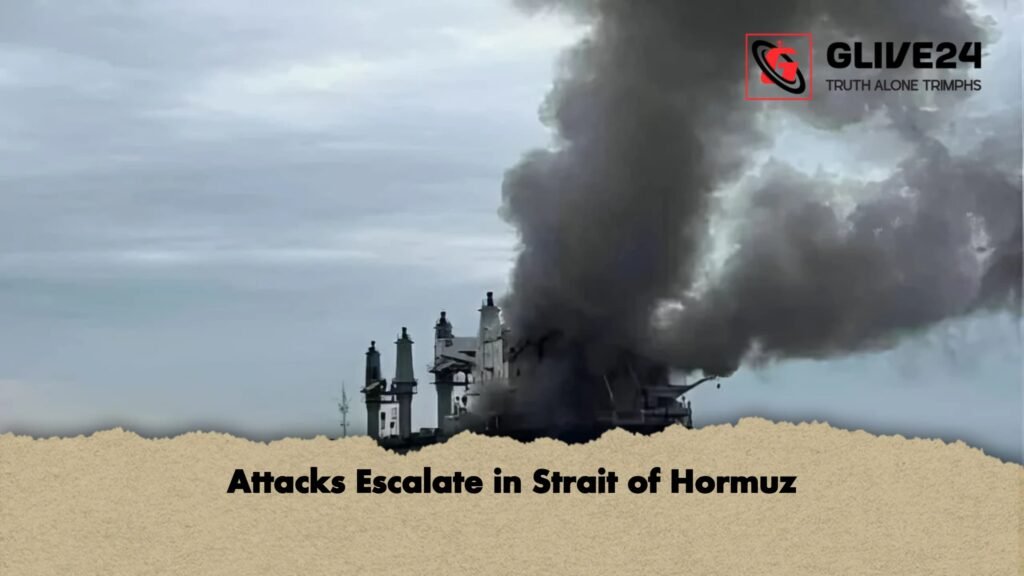
Tensions in the Persian Gulf have intensified sharply after six vessels were attacked in and around the strategically vital Strait of Hormuz, including a deadly assault on an oil tanker in Iraqi waters that left one crew member dead and two ships destroyed by fire.
According to Iraqi port authorities, maritime security agencies and international risk-analysis firms, the most serious incident occurred late on Wednesday, 11 March, when an explosives-laden boat believed to be operated by Iranian forces struck a tanker operating near Iraq’s southern coastline. The resulting explosion triggered a massive blaze that engulfed two nearby vessels, ultimately reducing both ships to charred wreckage.
Officials reported that the vessels were engaged in a ship-to-ship fuel transfer operation at the time of the attack. The explosion caused flames to spread rapidly across the transfer area, forcing surviving crew members to abandon the ships. Rescue operations were launched by Iraqi maritime authorities, but one crew member was confirmed killed in the incident.
The ships destroyed in the attack were identified as the Safe Sea Vishnu, sailing under the flag of the Marshall Islands, and the Zephyros, a Malta-flagged vessel. Both had been carrying energy products loaded from Iraqi terminals in the country’s southern oil export hub.
Iraq’s state oil marketing organisation (SOMO) confirmed that the Safe Sea Vishnu had been chartered by an Iraqi company under contract with SOMO, while the Zephyros was transporting fuel products for the Basra Gas Company.
Key Vessels Involved in the Incident
| Vessel Name | Flag State | Cargo / Role | Operator / Charterer | Reported Damage |
|---|---|---|---|---|
| Safe Sea Vishnu | Marshall Islands | Fuel products from Iraq | Iraqi firm under SOMO contract | Destroyed by fire |
| Zephyros | Malta | Energy cargo for Basra Gas Company | Basra Gas Company shipment | Severely burned |
| Four unnamed ships | Various flags | Commercial cargo vessels | International operators | Hit by projectiles |
Security analysts noted that the tanker incident followed projectile attacks on four other commercial vessels in the Persian Gulf earlier the same day. The sequence of attacks suggests a coordinated escalation in maritime hostilities linked to the ongoing conflict involving Iran.
Since the outbreak of hostilities in late February, at least 16 vessels operating in Middle Eastern waters have reportedly been attacked or damaged. Many of the targeted ships have commercial or logistical ties to the United States or European countries, raising fears that the conflict is spreading into critical international shipping routes.
The escalation comes in the wake of military strikes launched by the United States and Israel against targets inside Iran on 28 February. Since those strikes, maritime traffic through the Persian Gulf and the narrow Strait of Hormuz has slowed dramatically as shipping companies reassess security risks.
The Strait of Hormuz is one of the world’s most strategically important energy corridors. Roughly 20 per cent of global oil shipments pass through the narrow waterway linking the Persian Gulf with the Arabian Sea. Any sustained disruption to shipping in the area has immediate implications for global energy markets.
Indeed, oil prices have surged amid the growing instability, reaching their highest level since 2022 as traders react to the possibility of supply disruptions.
Iran’s Islamic Revolutionary Guard Corps has warned that if attacks on Iranian territory continue, Tehran could block oil exports destined for the United States, Israel and their allies. In a stark statement, Iranian officials declared that “not a single litre of oil” would be allowed to reach those countries from the Middle East.
Former US President Donald Trump responded with a sharp warning of his own, stating that Washington would launch further military strikes if Iran attempted to halt oil exports through the Strait of Hormuz. He also urged global oil companies and shipping firms to continue using the route, claiming that most of Iran’s naval capabilities had already been destroyed.
Maritime security experts warn that if attacks on commercial vessels continue, the conflict could trigger a wider disruption of global shipping and energy supplies, potentially drawing more countries into an already volatile regional crisis.