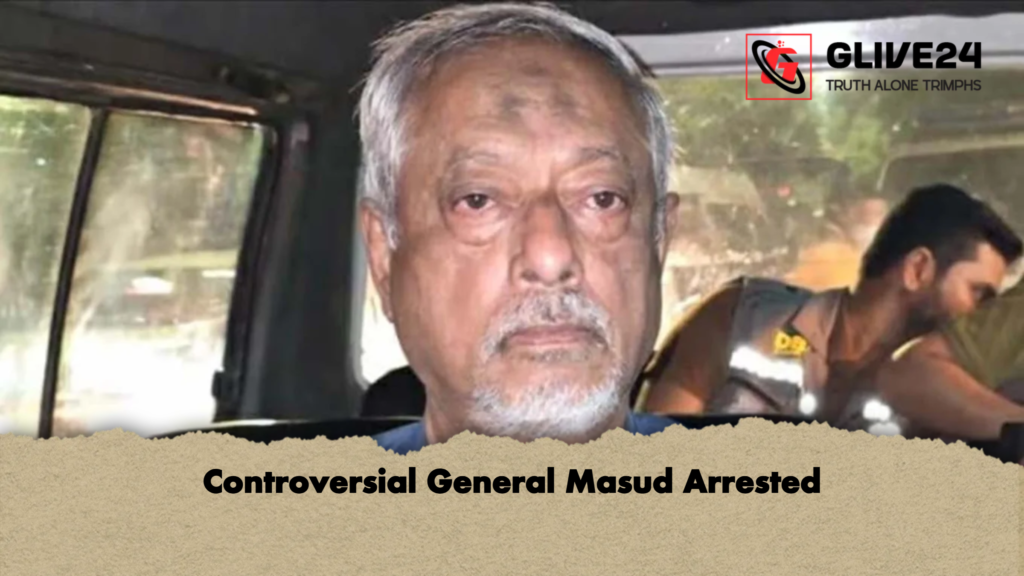
Retired Lieutenant General Masud Uddin Chowdhury, a former Member of Parliament representing the Feni-3 constituency, has been arrested by the Detective Branch (DB) of Dhaka Metropolitan Police in a late-night operation. The arrest took place on Monday (23 March) at his residence in the Baridhara DOHS area of the capital, marking a significant development given his prominence during Bangladesh’s 2007 political transition, commonly referred to as the “1/11” period.
The information was confirmed by Shafiqul Islam, Chief of the Dhaka Metropolitan Detective Police, who stated that a targeted campaign was conducted after a period of surveillance. According to police sources, Masud was apprehended from House No. 153, Road No. 2 in Baridhara DOHS. While authorities indicated that approximately five cases have been filed against him, detailed information regarding the nature of those complaint was not immediately disclosed.
Masud Uddin Chowdhury rose to national prominence during the During the military-backed caretaker government in 2007, a politically sensitive period in Bangladesh’s history marked by anti-corruption drives and institutional restructuring. At that time, he served as General Officer Commanding (GOC) of the Army’s 9th Infantry Division. Following the political change on 11 January 2007, he was appointed coordinator of the National Coordination Committee on Combating Serious Crimes, a body tasked with overseeing high-profile anti-corruption and law enforcement initiatives.
In recognition of his administrative and strategic capabilities, Masud was appointed Bangladesh’s High Commissioner to Australia in June 2008. Notably, even after a change in government in 2009, when the Awami League assumed power, he continued in this diplomatic role until June 2011, reflecting a degree of bipartisan confidence in his professional competence.
His transition into active politics occurred in 2018 when he joined the Jatiya Party. During the 11th Parliamentary Election, he was elected as a Member of Parliament from the Feni-3 constituency, which includes Sonagazi and Daganbhuiyan Upazilas. Interestingly, prior to joining the Jatiya Party, Masud had initially collected a nomination form from the Awami League for the same seat. Within five days, however, he shifted allegiance, purchasing a nomination form from the Jatiya Party and subsequently becoming a member of its presidium the following day.
Below is a summary of key information regarding his career and recent arrest:
| Category | Details |
|---|---|
| Full Name | Lt. Gen. (Retd.) Masud Uddin Chowdhury |
| Profession | Former Army Officer, Politician |
| Military Rank | Three-star General |
| Key Role (2007) | GOC, 9th Infantry Division |
| Special দায়িত্ব | Coordinator, National Coordination Committee |
| Diplomatic Role | High Commissioner to Australia (2008–2011) |
| Political Affiliation | Jatiya Party |
| Parliamentary Seat | Feni-3 |
| Arrest Date | 23 March (Late Night) |
| Allegations | Approximately five pending cases |
Analysts suggest that the arrest of such a high-profile figure—particularly one associated with a pivotal period in Bangladesh’s political history—may trigger renewed debate accountability and governance during the caretaker government era. As further details emerge regarding the allegations against him, the broader implications for both legal and political spheres are likely to become clearer.