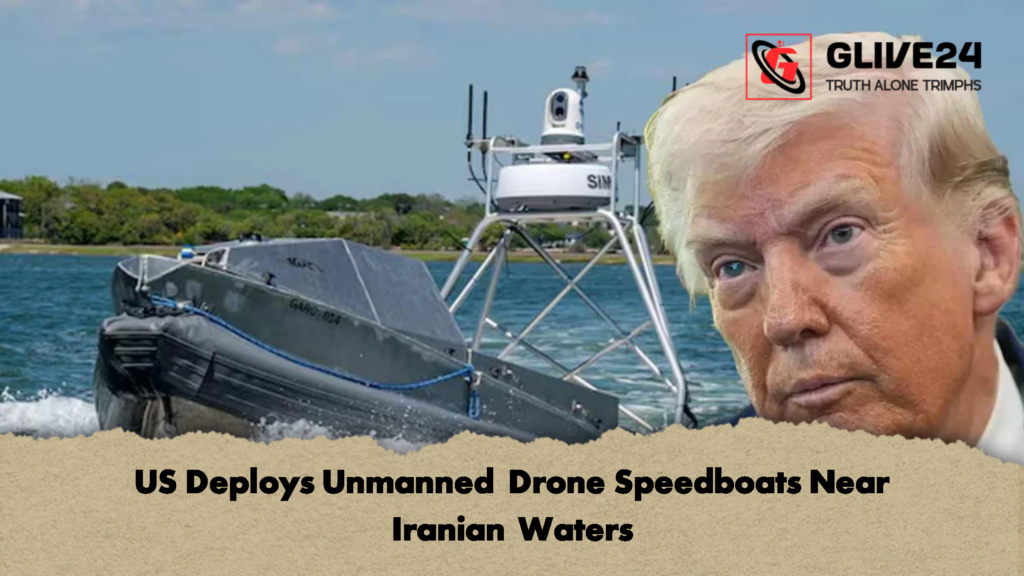
The United States has deployed unmanned “drone speedboats” for maritime patrol operations in waters connected to its broader campaign involving Iran, in what the Pentagon has confirmed as the first known operational use of such systems in an active theatre.
According to a Reuters report published on Friday (27 March), the unmanned surface vessels are capable of both intelligence-gathering missions and potential suicide-style attacks. However, US officials have not publicly confirmed any offensive use, stating only that the craft are currently being employed for patrol and surveillance duties. The deployment had not previously been disclosed.
Table of Contents
Shift towards autonomous naval warfare
The introduction of these autonomous surface vessels reflects a wider transformation in modern naval warfare, as militaries increasingly adopt unmanned systems for frontline operations. Designed to operate without onboard crews, such platforms are seen as cost-effective tools capable of long-duration missions in contested waters.
The US Navy has been developing autonomous and semi-autonomous vessels for several years, aiming to create a more flexible and less expensive alternative to traditional warships and submarines. The programme has also been driven by strategic competition, particularly the need to counter China’s expanding naval capabilities in the Indo-Pacific region.
However, the initiative has encountered repeated setbacks, including technical difficulties, high development costs, and challenges during live testing, which have delayed wider deployment.
Key details of deployed system
| Category | Details |
|---|---|
| System designation | GARC (Global Autonomous Reconnaissance Craft) |
| Developer | BlackSea Technologies (Maryland, United States) |
| Vessel type | Unmanned surface vessel (drone speedboat) |
| Operational command | US Fifth Fleet (Middle East operations) |
| Mission profile | Maritime patrol under “Operation Epic Fury” |
| Endurance record | Over 450 operational hours |
| Operational range | Approximately 2,200 nautical miles |
US Central Command confirmation
US Central Command (CENTCOM) spokesperson Commander Tim Hawkins confirmed that the vessels, produced by Maryland-based defence contractor BlackSea Technologies, are currently deployed as part of “Operation Epic Fury”, a wider maritime security mission focused on monitoring Iranian activity in the region.
He stated that the Global Autonomous Reconnaissance Craft (GARC) systems have completed more than 450 hours of operational deployment at sea and have travelled over 2,200 nautical miles during missions conducted under the Fifth Fleet’s area of responsibility.
However, he declined to disclose details regarding other unmanned systems currently operating in the region. The manufacturer also declined to comment when approached.
Expanding role of unmanned naval systems
Unmanned maritime technology has gained significant momentum in recent years, particularly following Ukraine’s extensive use of explosive-laden drone boats against Russia’s Black Sea Fleet, which inflicted considerable damage and demonstrated the effectiveness of low-cost autonomous naval warfare.
In parallel, tensions in the Middle East have accelerated interest in similar systems. Reports indicate that Iranian forces have previously deployed sea drones at least twice in attacks on commercial oil tankers in the Gulf amid heightened regional hostilities linked to US and Israeli military operations.
Despite this, there has been no official confirmation that the United States has previously used unmanned vessels in offensive strike roles, making the current deployment particularly significant in terms of operational precedent.
Development challenges and technical setbacks
The US Navy’s broader autonomous surface vessel programme has faced persistent difficulties. Earlier reporting by Reuters highlighted that prototype GARC vessels—approximately five metres in length and designed with angular, speedboat-style hulls—encountered multiple issues during testing phases.
These included performance instability and safety incidents, including a high-speed collision with another vessel during a military trial. According to sources familiar with the programme, another GARC unit reportedly became inoperable during a separate test conducted in the Middle East.
Officials have not publicly addressed these incidents in detail.
Strategic implications
Despite these challenges, the Pentagon continues to view the GARC programme as an important emerging capability designed to enhance maritime domain awareness and extend the operational reach of the US Fifth Fleet across strategically sensitive waterways.
Military analysts suggest that deploying autonomous patrol boats near Iranian-controlled maritime corridors signals a shift towards sustained unmanned surveillance, rapid response capability, and reduced risk to personnel in high-tension environments.
As geopolitical tensions remain elevated, the expansion of unmanned surface vessels is likely to continue, potentially reshaping naval doctrine and redefining the balance between human-operated and autonomous systems in modern maritime conflict.