Bangladesh cricket has once again come under sharp scrutiny following a fresh wave of administrative upheaval at the country’s governing body, the Bangladesh Cricket Board (BCB). Former national opener Aftab Ahmed has launched a scathing critique of the ongoing instability, describing the current state of affairs as nothing short of a “circus” and questioning the repeated leadership changes that have unsettled the sport since last year’s political transition.
Since the political shift on 5 August 2024, Bangladesh cricket has witnessed extraordinary turbulence. The long-standing tenure of former BCB president Nazmul Hassan Papon came to an end after more than a decade in office, triggering a rapid succession of leadership changes within a short span of time.
In the past 20 months alone, the board has seen three different figures assume top leadership roles—Faruk Ahmed, Aminul Islam Bulbul, and most recently former captain Tamim Iqbal—reflecting an unusually unstable administrative period for the country’s cricket structure.
The latest development saw the National Sports Council (NSC) dissolve Bulbul’s committee following allegations of irregularities in the BCB election process. In response, an 11-member ad hoc committee led by Tamim Iqbal has now taken charge of the board’s operations.
Table of Contents
Rapid Leadership Changes in Bangladesh Cricket
| Period | Leadership Figure | Role |
|---|---|---|
| Over a decade (pre-2024) | Nazmul Hassan Papon | BCB President |
| Post–August 2024 transition | Faruk Ahmed | Interim leadership phase |
| Subsequent phase | Aminul Islam Bulbul | Committee head |
| Current | Tamim Iqbal | Head of 11-member ad hoc committee |
Aftab Ahmed’s Strong Criticism
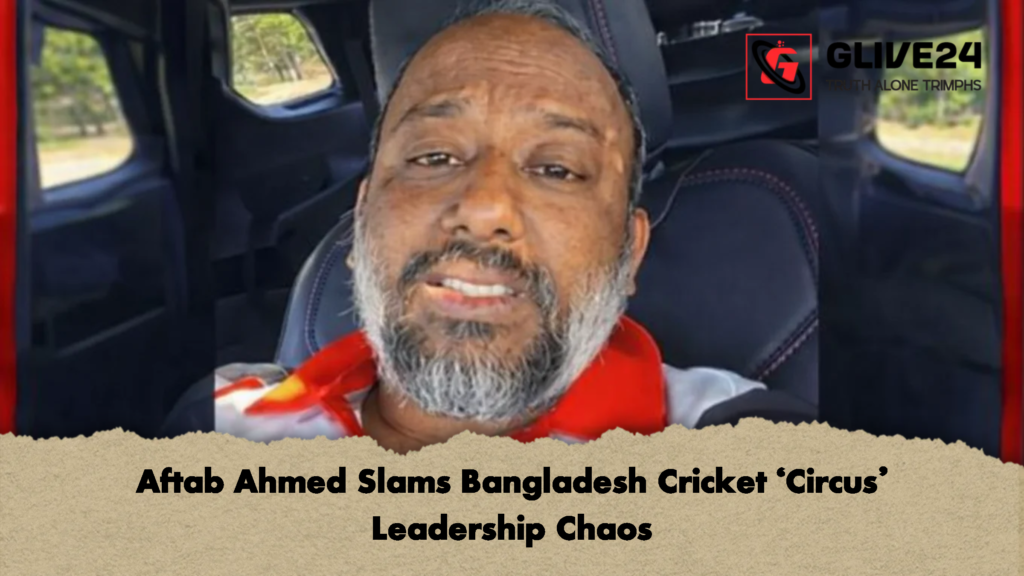
Amid this backdrop, former Bangladesh opener Aftab Ahmed—once regarded as the country’s first major “hard-hitting” batter—expressed deep frustration in a video message shared on social media.
Now based in the United States, Aftab compared the current state of Bangladesh cricket administration to a public spectacle. He remarked that even paying for a ticket would not be wasted, as the ongoing developments themselves resemble a “performance” rather than professional governance.
He stated that the frequent changes and controversies have turned Bangladesh cricket into what he described as the “biggest circus” in the country at present.
Comparison with United States Cricket Structure
Drawing on his experience in the United States, Aftab contrasted Bangladesh’s highly visible cricket administration with what he described as the near-invisibility of cricket governance in America.
He noted that despite living and working in the United States for three years, he remains largely unaware of the structure or even the members of the American cricket board. However, he emphasised that this lack of visibility does not hinder his ability to work in cricket development activities on a daily basis.
According to him, while ignorance of administrative structures in the US might be seen as personal limitation, in Bangladesh the situation is reversed—where governance issues are highly visible to the public due to extensive media coverage and political attention.
“No One Can Claim Ignorance in Bangladesh”
Aftab further argued that in Bangladesh, no stakeholder can plausibly claim ignorance of cricket administration, as developments are constantly amplified by media coverage. He suggested that even those who do not actively follow cricket governance are inevitably exposed to it due to its prominence in public discourse.
He criticised the repetitive cycle of instability, questioning how long the current situation would continue.
Growing Concerns Over Governance Stability
The remarks highlight broader concerns regarding administrative continuity in Bangladesh cricket, particularly at a time when structural reforms and election controversies continue to dominate headlines. The dissolution of elected bodies, formation of ad hoc committees, and frequent leadership turnover have raised questions about long-term planning and institutional stability within the BCB.
As Bangladesh cricket enters yet another transitional phase under Tamim Iqbal’s interim leadership, calls for governance stability and transparent administrative processes appear to be growing louder—both within and outside the cricketing community.