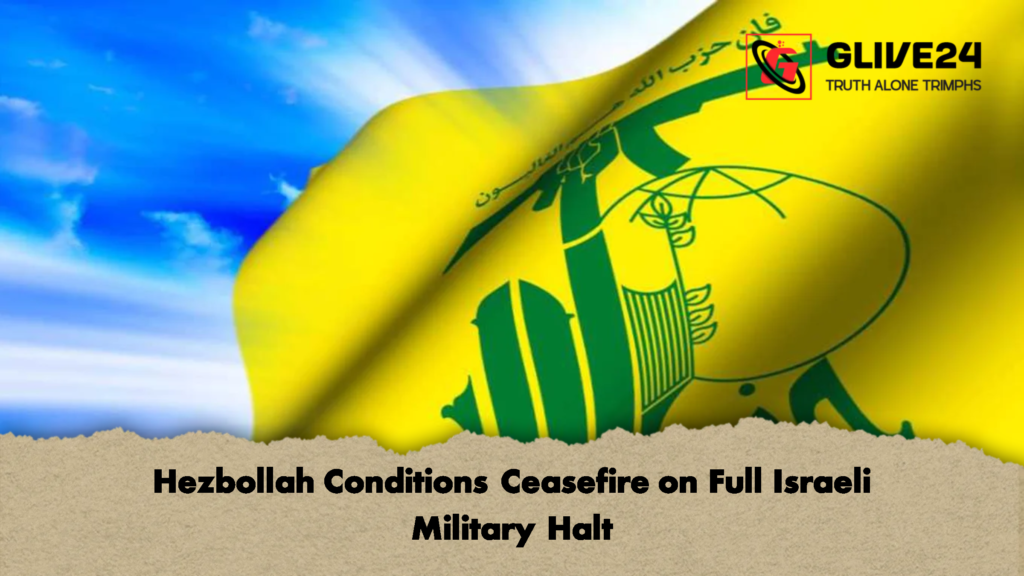
Lebanon-based armed group Hezbollah has stated that any prospective ceasefire in the ongoing conflict is entirely dependent on Israel halting all forms of military operations, underscoring the deep mistrust that continues to define efforts to secure even a temporary pause in hostilities.
According to reporting cited by Al Jazeera and attributed to Reuters, senior Hezbollah legislator Hassan Fadlallah insisted that the group would not abide by any ceasefire arrangement unless what he described as Israeli “hostile activities” were brought to a complete and verifiable end.
“If Israel does not stop all forms of aggression, then there is no question of adhering to any ceasefire,” Fadlallah was quoted as saying, reinforcing Hezbollah’s position that partial or conditional arrangements would be unacceptable.
He further indicated that Hezbollah had been informed by Iran’s ambassador in Beirut of a possible short-term ceasefire proposal that could begin as early as Thursday night. While details remain unclear, the remark suggests that regional diplomatic channels remain active, with Iran continuing to play a behind-the-scenes role in communication between key actors.
Fadlallah’s comments came shortly before a series of wider international statements regarding a separate ceasefire framework, highlighting competing narratives over both the timing and legitimacy of any proposed agreement.
Table of Contents
Trump announces proposed 10-day ceasefire
In a parallel and politically significant development, former United States President Donald Trump announced what he described as a 10-day ceasefire agreement between Lebanon and Israel, claiming both sides had agreed to temporarily suspend hostilities.
Posting on his Truth Social platform, Trump said he had held “significant discussions” with Lebanese President Joseph Aoun and Israeli Prime Minister Benjamin Netanyahu, which he claimed resulted in an agreement to initiate a short-term truce intended to open the door to broader peace negotiations.
He presented the initiative as part of a wider diplomatic effort to stabilise the region, framing it as a structured pause in fighting that could potentially evolve into a longer-term settlement if progress is made.
Diplomatic engagement and US involvement
Trump also stated that representatives from Lebanon and Israel had already met earlier in Washington, describing the meeting as an initial step towards formalised dialogue between the two sides. He further noted the involvement of US Secretary of State Marco Rubio in the discussions, signalling direct American engagement in the emerging process.
According to his account, senior US officials have been assigned specific roles in supporting the implementation and potential extension of the ceasefire. These include Vice President JD Vance, Secretary Rubio, and the Chairman of the Joint Chiefs of Staff, General Dan “Razin” Caine, who are said to be working alongside both parties to help transition the temporary truce into a more durable peace framework.
Overview of reported ceasefire framework
| Element | Detail |
|---|---|
| Proposed duration | 10 days |
| Parties involved | Israel and Lebanon |
| Mediators (claimed) | United States officials |
| Key US figures mentioned | Donald Trump, Marco Rubio, JD Vance, Gen. Dan Caine |
| Objective | Temporary cessation of hostilities and pathway to peace talks |
| Status | Not independently verified by all parties |
Competing narratives over ceasefire terms
The sharply contrasting statements from Hezbollah and US political figures highlight the fragility and contested nature of the proposed arrangement.
While Washington and its allies have presented the initiative as a structured diplomatic breakthrough with clear operational backing, Hezbollah continues to maintain that any agreement must be conditional upon a complete halt to Israeli military activity. From its perspective, anything short of a total cessation of operations would render a ceasefire meaningless or unenforceable.
Fadlallah’s remarks therefore underscore a fundamental divergence: whether a ceasefire should function as a temporary operational pause within ongoing hostilities, or as a reciprocal and fully verified suspension of all military action.
Wider geopolitical implications
The situation also reflects the increasingly complex diplomatic environment surrounding the conflict. Iran’s reported involvement in relaying ceasefire proposals through its ambassador in Beirut points to a multi-layered negotiation process in which formal announcements and back-channel communications run in parallel.
At the same time, the emergence of competing ceasefire claims illustrates how fragmented the diplomatic landscape has become, with different actors presenting overlapping or conflicting versions of developments.
Analysts suggest that such divergence complicates efforts to establish trust between parties, particularly in a context where verification mechanisms remain unclear and mutual suspicion is high.
Uncertain outlook
Despite the announcement of a proposed 10-day truce, the practical implementation and durability of any ceasefire remain uncertain. The key unresolved issue remains whether both sides can agree not only on the cessation of hostilities, but also on enforcement, monitoring, and reciprocal guarantees.
For now, the gap between political declarations and battlefield realities remains significant. As a result, the prospects for even a temporary and stable pause in fighting continue to hinge on whether minimum conditions of trust and compliance can be established between the parties involved.