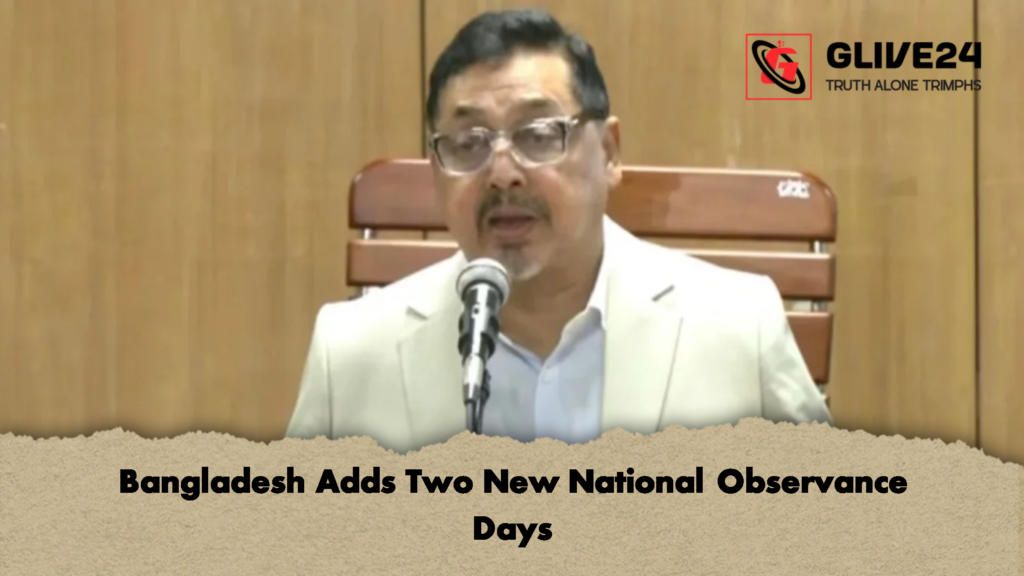
The Government has formally declared two new national observance days—“7 November Revolution and Solidarity Day” and “6 July Rural Development Day”—in a move aimed at institutionalising key political milestones and development priorities within the country’s official calendar. One of the newly designated days will be observed as a public holiday, while the other will remain a working-day commemoration.
The decision was confirmed on Thursday (16 April) following a Cabinet meeting held at the Secretariat. Cabinet Secretary Nasimul Ghani briefed journalists after the meeting, outlining the key outcomes of the deliberations.
Table of Contents
Cabinet approves new national calendar additions
According to the Cabinet Secretary, the government has approved 7 November as “Revolution and Solidarity Day”, which will be observed nationwide as a public holiday. The designation is intended to mark the date as one of historical and political significance in the national calendar.
He further announced that 6 July will be observed as “Rural Development Day”, focusing on agricultural progress, rural infrastructure, and broader socio-economic development. However, unlike 7 November, this day will not be a public holiday, and all public and private sector activities will continue as normal.
Officials said the inclusion of these days will be reflected in the official national observance schedule, with ministries and government institutions expected to organise programmes, seminars, and awareness activities accordingly.
Newly declared national observances
| Date | Name of observance | Category | Public holiday status |
|---|---|---|---|
| 7 November | Revolution and Solidarity Day | Historical-political observance | Yes |
| 6 July | Rural Development Day | Development-focused observance | No |
Senior participation in Cabinet meeting
The Cabinet meeting, held earlier in the evening at the Secretariat, was chaired by the head of government and attended by senior members of the Council of Ministers.
Among those present were the Minister for Local Government, Rural Development and Cooperatives Mirza Fakhrul Islam Alamgir, Liberation War Affairs Minister Ahmed Azam Khan, Land Minister Md Mizanur Rahman Mintu, Information Minister Zahir Uddin Swapon, Expatriates’ Welfare and Overseas Employment Minister Md Ariful Haque Chowdhury, and Civil Aviation and Tourism Minister Afroza Khanom, alongside other cabinet members.
Policy intent behind the decision
Officials described the decision as part of a broader initiative to strengthen national identity through structured remembrance of historically significant events, while also highlighting ongoing development priorities, particularly in rural areas.
The declaration of 7 November as a public holiday reflects its perceived importance within the country’s political and historical narrative, whereas the introduction of Rural Development Day signals continued emphasis on agriculture-led growth, rural infrastructure expansion, and decentralised economic planning.
Implementation and institutional rollout
Government sources indicated that detailed implementation guidelines will be issued to all ministries and relevant agencies in the coming weeks. These will include instructions for arranging official programmes, public awareness campaigns, and institutional observances aligned with each theme.
Educational institutions, local government bodies, and public agencies are also expected to participate through seminars, discussions, and outreach activities designed to promote civic engagement and policy awareness.
With these additions, Bangladesh’s national calendar is set to expand further, reflecting an evolving balance between historical commemoration and development-focused governance priorities.