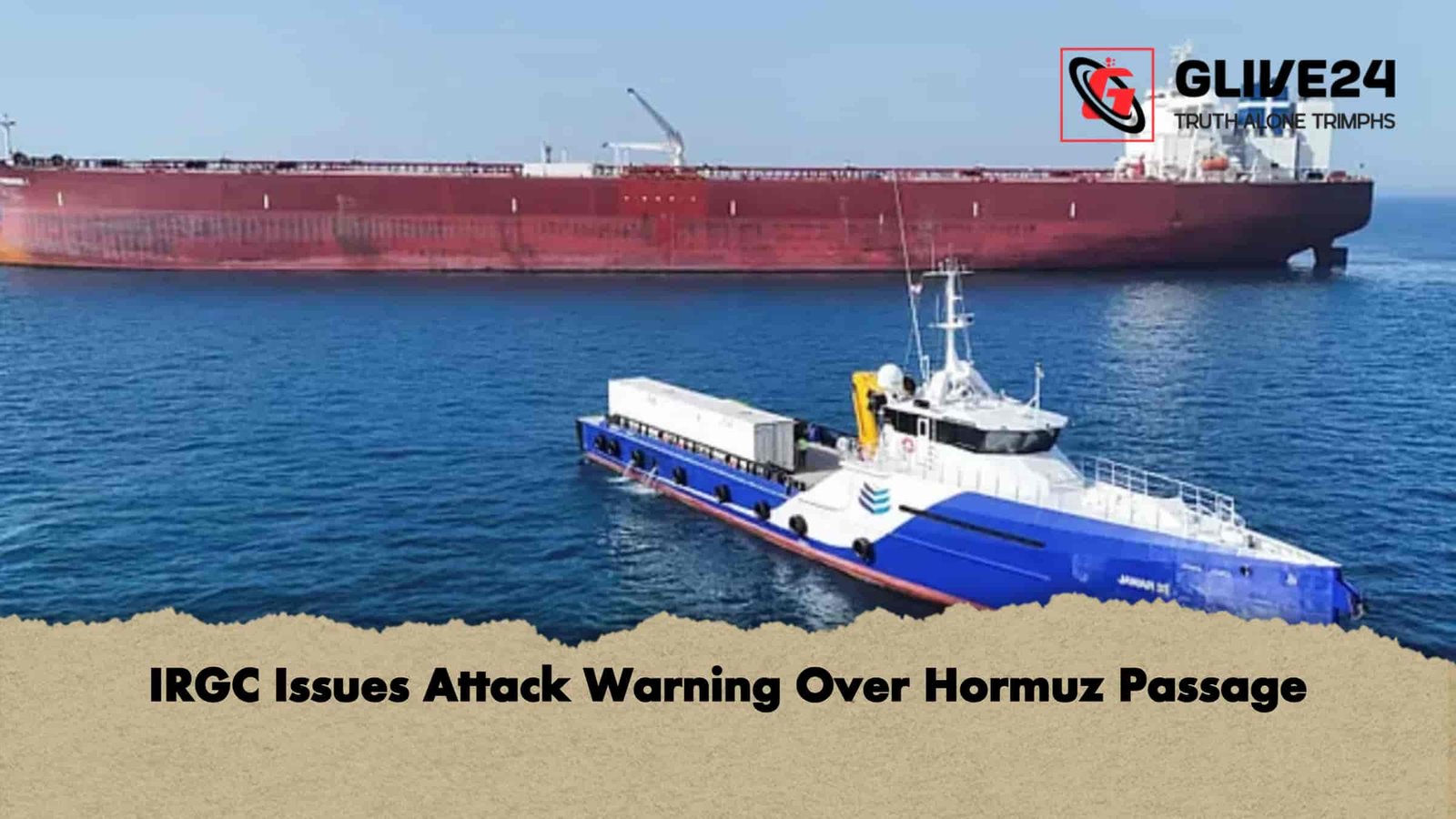
Iran’s Islamic Revolutionary Guard Corps (IRGC) naval forces have announced the closure of the Strait of Hormuz and warned that any vessel attempting to transit the passage will be targeted. The announcement represents a sharp policy reversal, coming less than 24 hours after Iranian authorities had indicated that the strategic shipping route had been reopened.
In a statement published on Saturday by Iran’s Student News Agency, the IRGC Navy said the closure would remain in place until the United States lifted what it described as a naval blockade on Iranian ships and ports. The statement further alleged that the restrictions amounted to a violation of an ongoing ceasefire linked to hostilities involving the United States and Israel.
The IRGC statement issued a direct warning to maritime traffic in the region. It instructed vessels anchored in the Persian Gulf and the Sea of Oman to remain stationary and not attempt to move towards the Strait of Hormuz. It added that any movement in that direction would be treated as hostile activity and could result in military action against the vessel concerned.
Iran’s parliamentary speaker and senior negotiator in ceasefire-related discussions, Mohammad Bagher Ghalibaf, also commented on the situation in a televised interview. He stated that the Strait of Hormuz remained under Iranian control and criticised United States policy statements on the issue, describing them as lacking competence and understanding.
The latest escalation follows a brief period in which the strait had appeared to be reopened. Earlier, in line with a 10-day ceasefire agreement between Israel and Lebanon, Iranian authorities had allowed commercial shipping through the waterway. Iran’s Foreign Minister Abbas Araghchi announced on Friday that the Strait of Hormuz was “fully open to all commercial vessels”, a development that was followed by a decline in global oil prices.
However, the reopening lasted only a few hours. Iranian authorities subsequently reasserted control over the waterway, effectively reversing the decision. During this brief interval, reports indicated that more than a dozen commercial vessels successfully passed through the strait.
Maritime monitoring organisation United Kingdom Maritime Trade Operations (UKMTO) reported that Iranian fast attack craft fired upon two commercial ships during the period of heightened tension. Both vessels were identified as Indian-flagged. India’s Ministry of External Affairs later confirmed that gunfire incidents involving the two ships had occurred in the region.
| Aspect | Detail |
|---|---|
| Status of Strait | Declared closed again by IRGC |
| Condition for reopening | Lifting of US naval restrictions demanded |
| Transit activity | Over a dozen vessels passed during brief reopening |
| Reported incident | UKMTO recorded firing on two Indian-flagged ships |
| Official warning | Ships instructed to remain stationary in regional waters |
Commercial vessels operating in the area also reported receiving radio communications from IRGC naval units instructing them that transit through the Strait of Hormuz was not permitted.
Former United States President Donald Trump responded by stating that Iran could not use the Strait of Hormuz as a means of applying pressure on Washington. He warned that if no agreement was reached before the expiry of a ceasefire deadline, military action could resume, and reiterated that maritime restrictions imposed on Iran would remain in force.
Separately, senior Iranian political figure Mojtaba Khamenei stated that Iran’s naval forces were prepared to impose further setbacks on opposing states, underscoring the continued strategic sensitivity of the Strait of Hormuz amid rising regional tensions.
> Cristiano Ronaldo Makes History Scoring in Six World Cup Tournaments
> Allegations of Substandard Road Works Spark Local Protest
> Court Hands Death Penalty in Wife Murder Case
> Malaysian Stage Echoes Bangla Song Diplomacy
> Habib Wahid Honoured as Track Features in Diplomatic Video
> Bangladesh foreign exchange rates show steady fluctuations
> Beximco Pharma Reports Strong Annual Profit Growth
> Chinese Man Reports Missing Wife, Cash Incident
> Iran launches new strikes against Kurdish groups in Iraq
> Sanjoy Joins World Cup Album
> Anupam Roy Live Concert Announced Dhaka
> Armed Drug Dealer Apprehended in Banani Police Raid
> Oxford Authorities Contradict Claims by Hasnat, Sadik
> Club Goal Rankings in World Cup History
> Two Arrested With Tapentadol
> The Psychology and Philosophy of Unwarranted Defamation

সম্পাদক ও প্রকাশক: এ বি এম জাকিরুল হক টিটন
যোগাযোগের ঠিকানাঃ পশ্চিম কাফরুল, বেগম রোকেয়া সরণি, ঢাকা
© Copyright 2026 Khaborwala। All Rights Reserved

Comments