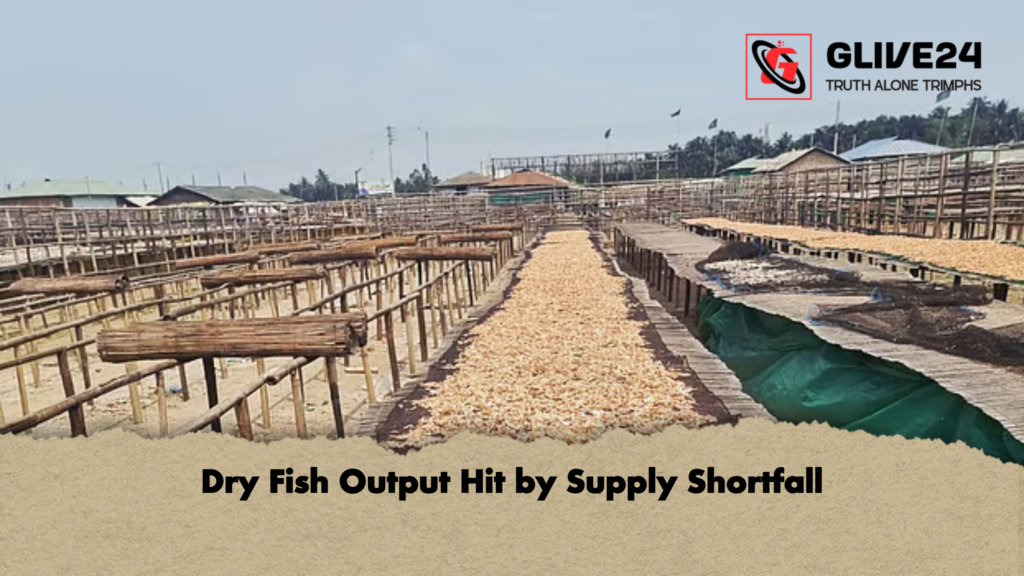
Despite the sweltering heat traditionally ideal for the dehydration process, the renowned dried fish industry in Cox’s Bazar has reached a standstill. While the intense summer sun remains conducive to salt production, it has failed to benefit the dried fish sector, known locally as Shutki, as a critical shortage of raw fish has forced the closure of over 600 processing yards (mahals).
Table of Contents
The Impact of the Fishing Ban
The primary catalyst for this industrial paralysis is the 58-day government ban on sea fishing, which commenced on 15 April. Under normal circumstances, yard owners stockpile sufficient quantities of fish prior to such prohibitions; however, systemic supply issues this year prevented such reserves. Consequently, of the approximately 700 processing yards located in the Nazirartek area of Cox’s Bazar Municipality’s Ward No. 1, at least 650 have ceased operations.
Currently, only 50 to 60 yards remain active, relying exclusively on expensive imported fish to maintain minimal production levels. According to Akhtar Kamal, a former municipal councillor, the industry is facing a dire situation where the “peak season” weather is being wasted due to an empty supply chain.
Economic Strain and Labour Displacement
The closure of these yards has triggered a humanitarian and economic crisis for the local workforce. It is estimated that over 20,000 labourers—approximately one-third of whom are women—face total unemployment once the current limited stocks of imported fish are exhausted.
A significant majority (95%) of these workers are climate refugees who settled in Nazirartek following the devastating cyclone of 29 April 1991. For individuals like Mayesha Begum and Samshunnahar, who earn roughly 500 BDT for a 12-hour workday, the cessation of work threatens their basic survival.
Statistical Overview of Production and Market Prices
Data from the District Fisheries Department indicates a noticeable decline in production efficiency compared to the previous fiscal year.
Dried Fish Production and Market Trends
| Category | FY 2023-2024 (First 8 Months) | FY 2022-2023 (Annual) |
| Total Production | 31,000+ Metric Tons | 48,285 Metric Tons |
| Monthly Average | 3,875 Metric Tons | 4,023 Metric Tons |
| Active Yards | ~60 Units | ~700 Units |
| Workforce Impact | 20,000 at risk of unemployment | Full employment during peak |
The scarcity has also impacted retail prices on Sugandha Road, where over 40 shops operate. Due to the halt in local production, many vendors are selling imported dried fish from India, Pakistan, and Myanmar, often marketing them as local produce to unsuspecting tourists.
Current Market Prices (Per Kilogram)
-
Churi (Ribbon Fish): 900 – 2,500 BDT
-
Loitta (Bombay Duck): 900 – 1,900 BDT
-
Lakhyua (Indian Salmon): 2,000 – 3,800 BDT
-
Koral (Sea Bass): 2,200 – 3,500 BDT
-
Poa (Croaker): 550 – 1,700 BDT
Environmental and Regulatory Concerns
Md. Nazmul Huda, the District Fisheries Officer, noted that climate change and other environmental factors have contributed to a dwindling catch in the Bay of Bengal. Investigations are currently underway to determine the precise causes behind the diminishing fish populations. Meanwhile, Md. Jaynal Abedin, President of the Cox’s Bazar Dried Fish Processing Business Co-operative Society, suggested that the government should reconsider the timing of the fishing ban to better align with the natural availability of fish and the peak drying season.