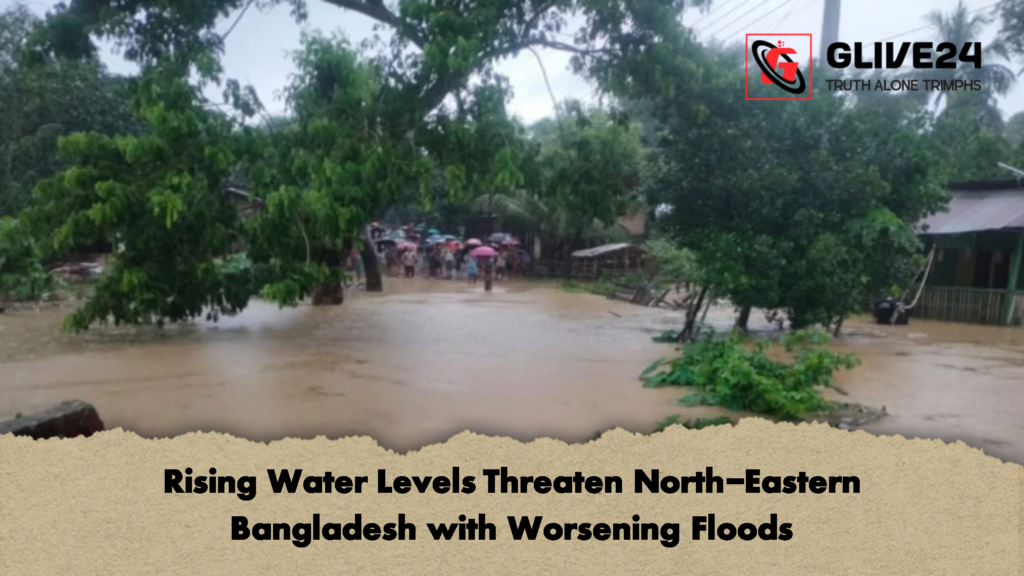
The Flood Forecasting and Warning Centre (FFWC), operating under the Bangladesh Water Development Board (BWDB), has issued a comprehensive advisory regarding the imminent deterioration of flood conditions in the north-eastern region of Bangladesh. Persistent pre-monsoonal rainfall, both within the country and in upstream catchment areas, has led to a steady escalation of water levels in several major river systems.
According to Mostafa Kamal Jihan, an Assistant Engineer at the BWDB, multiple rivers have already breached their designated pre-monsoon danger levels. Current hydrological observations highlight several critical points of concern:
-
Sunamganj District: The Naljur River is currently flowing above the danger threshold at the Jagannathpur station.
-
Netrokona District: Significant breaches have been recorded in the Bhugai-Kangsha River at Jariajanjail, the Someswari River at Kalmakanda, and the Magra River at both the Netrokona and Atpara monitoring points.
-
Habiganj District: The Sutang River has exceeded its pre-monsoon danger limit at the Sutang Railway Bridge location.
Analysis of Recent Hydrological Activity
In the last 24 hours, the primary river systems in the north-eastern haor (wetland) basins have exhibited fluctuating water levels. While the Surma and Kushiyara rivers remained relatively stable, and the Bhugai-Kangsha saw a marginal decline, the Dhanu-Baulai river system has continued to rise.
Meteorological reports indicate that the region has experienced heavy to very heavy rainfall internally, complemented by moderate to heavy precipitation in the upstream regions. This combination of local rainfall and transboundary water inflow is the primary driver behind the current hydrological volatility, placing low-lying areas at high risk.
Meteorological Projections for the Next 72 Hours
Utilising data from the Bangladesh Meteorological Department (BMD) and international weather agencies, the FFWC has forecast continued moderate to very heavy rainfall across the north-eastern region over the coming three days. The anticipated impacts are detailed below:
1. Sylhet and Sunamganj Districts Water levels in the Surma and Kushiyara rivers are expected to rise consistently over the next three days. By the 72-hour mark, the Kushiyara River is predicted to cross the pre-monsoon danger level at various points. This is expected to trigger flood conditions in the low-lying areas adjacent to the haors in both Sylhet and Sunamganj.
2. Netrokona and Kishoreganj Districts In Netrokona, the Baulai River is forecast to exceed its danger level at the Khaliajuri point within the next 48 hours. Furthermore, while the Bhugai-Kangsha and Someswari rivers are expected to remain stable, the existing flooding in the Bhugai-Kangsha basin is likely to persist. In Kishoreganj, the Dhanu-Baulai river system is projected to see rising water levels throughout the forecast period.
3. Habiganj and Moulvibazar Districts The Khowai, Sutang, Manu, and Juri rivers are all expected to witness significant rises. Notably, the Khowai and Juri rivers are forecast to rise rapidly within the next 24 hours, likely surpassing their pre-monsoon danger levels. The Manu River is expected to reach its warning limit, which will likely result in new flooding in the low-lying areas of Moulvibazar and a deterioration of the situation in Habiganj.
Socio-Economic Impact and Safety Measures
The current hydrological surge occurs at a particularly sensitive time for the north-eastern haor regions, which are presently in the peak of the Boro paddy harvesting season. The threat of sudden inundation poses a grave risk to standing crops, which could lead to significant economic losses for the local farming community.
The BWDB and local authorities have advised all stakeholders to remain vigilant. The rapid nature of water level increases in rivers such as the Khowai can lead to flash floods with minimal warning. Local administrations are currently working to disseminate flood warnings to residents in high-risk zones, ensuring that mitigation strategies are in place to protect lives, livestock, and agricultural produce.