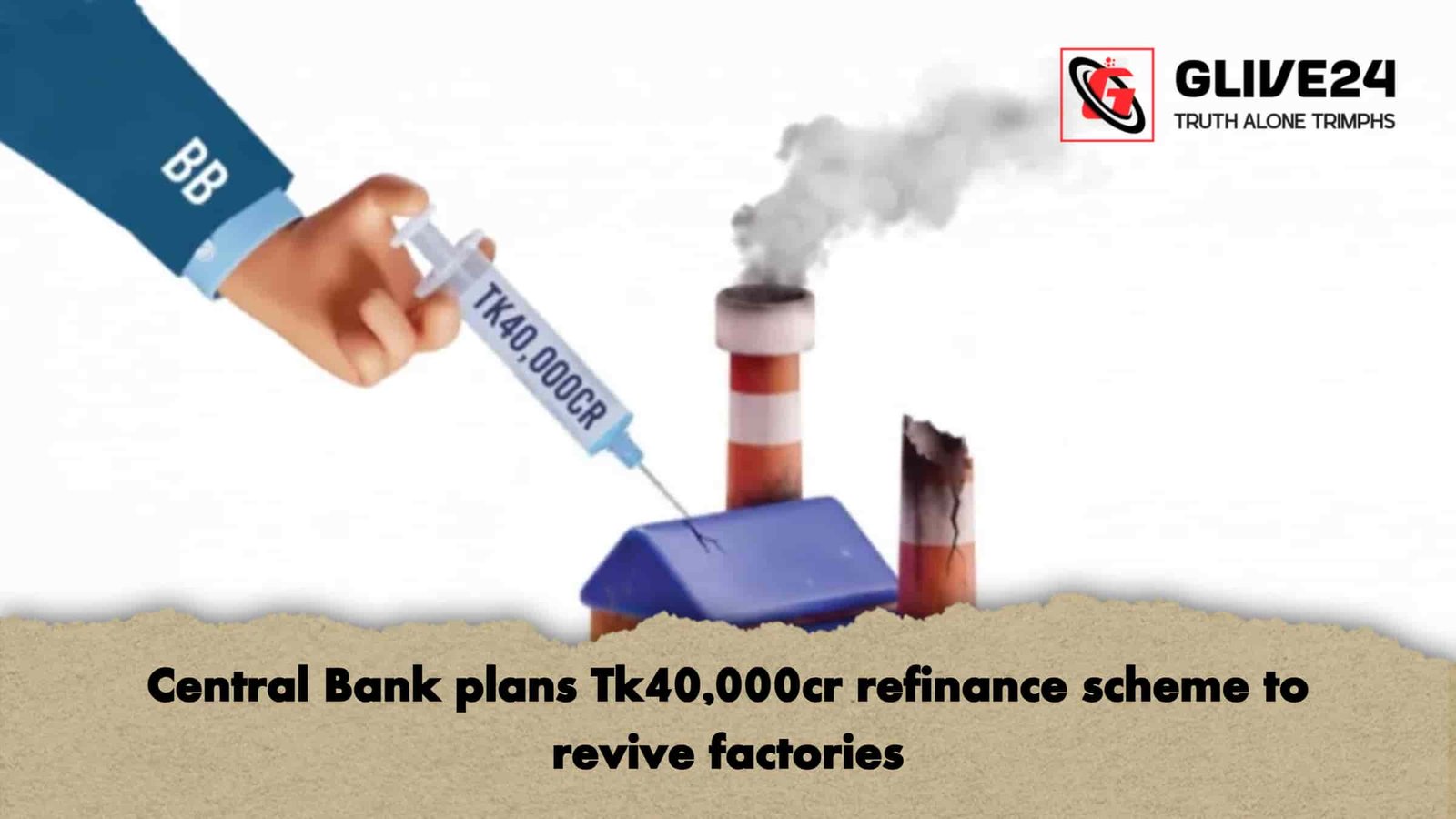
The Bangladesh Bank is preparing to introduce a Tk40,000-crore refinance programme designed to revive closed and inactive industrial units across Bangladesh. The initiative aims to restore production activity, protect employment, and strengthen export capacity at a time of continued macroeconomic strain.
Officials involved in the process said a policy framework is being drafted this week for submission to the Prime Minister for approval. Once approved, the central bank will issue a formal circular to implement the scheme.
The proposed financing package is structured to cover three broad sectors, with allocations reflecting industrial scale and economic priorities:
| Sector | Allocation (Tk crore) | Intended use |
|---|---|---|
| Large industries | 20,000 | Restarting major industrial units |
| CMSMEs | 10,000 | Revival of cottage, micro, small and medium enterprises |
| Agriculture | 10,000 | Supporting production-linked rural activities |
Under the plan, funds will be provided as short-term working capital loans with repayment periods ranging from one year to 18 months. The financing is intended to enable previously operational but now distressed factories to resume production, restart machinery, and re-enter supply chains.
A senior official of Bangladesh Bank said the facility will be limited to enterprises that were once active but became financially stressed due to post-Covid disruptions, global economic shocks including the Russia–Ukraine war, and instability in the foreign exchange market. Priority will be given to firms with confirmed orders and demonstrable market demand to ensure effective utilisation of funds.
More than 1,200 closed or partially operating factories have been identified through data collected from commercial banks and industry associations. These units have been categorised based on outstanding loan size, including those above Tk100 crore and those below it. The central bank has also held consultations with bank managing directors to assess financing requirements and determine viable candidates.
In some cases, borrowers classified as defaulters may be allowed to reschedule existing loans under relaxed terms before accessing the new refinance facility.
A key policy discussion is ongoing regarding the funding source. While direct financing by the central bank remains under consideration, officials acknowledge that such an approach could increase liquidity in the banking system and intensify inflationary pressure. Lending to banks is expected to take place at interest rates of around 5–6 percent, with final borrower rates set above inflation but below the policy rate.
The initiative follows policy directions from Prime Minister Tarique Rahman, who has emphasised reopening closed factories and protecting industrial employment. Earlier support measures included Tk525 crore provided to the Beximco Group to clear wage arrears for around 27,000 workers across 14 closed factories, and policy facilitation for the Nassa Group to restore trade financing operations affecting up to 27,000 workers.
Economists have expressed cautious support. The Centre for Policy Dialogue, through executive director Fahmida Khatun, has noted that while the scheme could help restore production and employment, its inflationary impact will depend heavily on the financing structure. Distinguished fellow Mustafizur Rahman has stressed the importance of distinguishing viable factories from non-viable ones, arguing that support should be directed only to enterprises with sustainable business prospects.
Officials also cautioned that large-scale monetary financing could amplify liquidity through the money multiplier effect, potentially complicating inflation control. Lessons from pandemic-era stimulus programmes, which included Tk128,303 crore across 23 packages in 2020 and later saw parts of the lending turn non-performing, have reinforced calls for strict monitoring and safeguards to prevent misuse and financial irregularities.
> MP Questions Bangladesh’s Alcohol Licensing Rules
> Fatal Fall Claims Former Student Leader in Mymensingh
> 172 Bangladeshis Return Home From Libya Detention Centre
> Holy Ashura Observed Across Bangladesh With Solemnity
> DIG Suspended After Eight-Month Unauthorised Absence
> Venezuela Earthquake Death Toll Climbs to 164
> Messi Defies Age With Intense Training Regime
> Footballer’s Family Missing After Venezuela Quake
> Iran launches new strikes against Kurdish groups in Iraq
> Anupam Roy Live Concert Announced Dhaka
> Oxford Authorities Contradict Claims by Hasnat, Sadik
> Club Goal Rankings in World Cup History
> Sanjoy Joins World Cup Album
> Two Arrested With Tapentadol
> Armed Drug Dealer Apprehended in Banani Police Raid
> Simrin Lubaba Begins New Life After Marriage Shift

সম্পাদক ও প্রকাশক: এ বি এম জাকিরুল হক টিটন
যোগাযোগের ঠিকানাঃ পশ্চিম কাফরুল, বেগম রোকেয়া সরণি, ঢাকা
© Copyright 2026 Khaborwala। All Rights Reserved


Comments