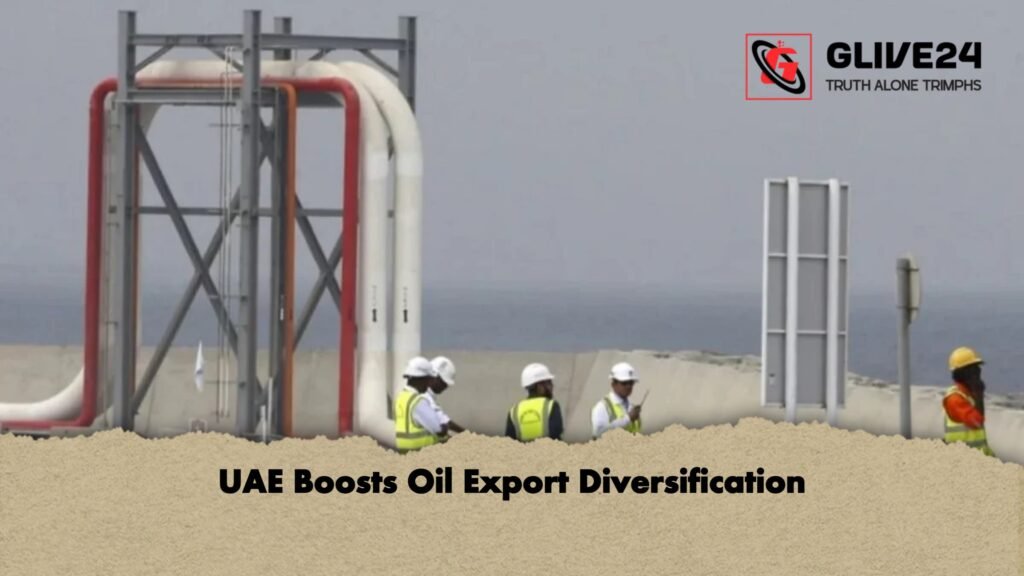
The United Arab Emirates has announced plans to complete a major new pipeline by 2027, aimed at bypassing the strategic Strait of Hormuz and significantly enhancing its crude oil export capacity. The development is expected to double the country’s ability to transport oil independently of the vulnerable maritime chokepoint, reinforcing its long-term energy security strategy.
According to the state-owned Abu Dhabi National Oil Company, construction of the pipeline heading towards the Fujairah terminal on the Gulf of Oman is already underway and progressing at a rapid pace. The project was formally unveiled during a high-level meeting attended by Sheikh Khaled bin Mohamed bin Zayed Al Nahyan, Crown Prince of Abu Dhabi.
The UAE currently relies on the Habshan–Fujairah pipeline, which has a daily capacity of approximately 1.8 million barrels. Once the new infrastructure is operational, the country will be able to significantly expand its export capacity without passing through the Strait of Hormuz, a critical maritime route that handles a substantial share of global oil shipments but is often exposed to geopolitical tensions.
Before recent regional escalations involving Iran and allied tensions with Western powers, the UAE’s total crude oil exports stood at around 3.4 million barrels per day. However, disruptions and heightened risks in the Strait of Hormuz reportedly led to a reduction of nearly 60 per cent in export flows, underlining the strategic vulnerability of relying on a single maritime corridor.
Officials have stated that the new pipeline system will restore much of the country’s pre-crisis export capability while reducing dependence on the strait. The UAE has also set an ambitious target of reaching approximately 5 million barrels per day in exports by 2027, supported by expanded infrastructure and production efficiency.
Recently, the UAE also signalled its departure from OPEC, the Saudi-led oil producers’ alliance, arguing that the move would grant it greater autonomy in shaping its production and export policies in line with market conditions and national priorities.
Despite these developments, analysts caution that the region remains geopolitically fragile. The proximity to Iran continues to pose risks to critical energy infrastructure, with past incidents reported at facilities such as the Habshan gas complex and the port of Fujairah during periods of heightened tension.
Saudi Arabia has also been developing alternative export routes. Its East–West pipeline system currently allows crude exports of up to 5 million barrels per day via the Red Sea port of Yanbu, providing additional redundancy in global oil supply chains.
Comparative Oil Export Infrastructure
| Country | Key Pipeline Route | Estimated Capacity (barrels/day) | Strategic Advantage |
|---|---|---|---|
| United Arab Emirates | Habshan–Fujairah + new pipeline | ~1.8 million (existing) + expansion | Bypasses Strait of Hormuz |
| United Arab Emirates (future target) | Expanded integrated system | ~5 million | Reduced maritime dependency |
| Saudi Arabia | East–West pipeline to Yanbu | ~5 million | Access to Red Sea shipping lanes |