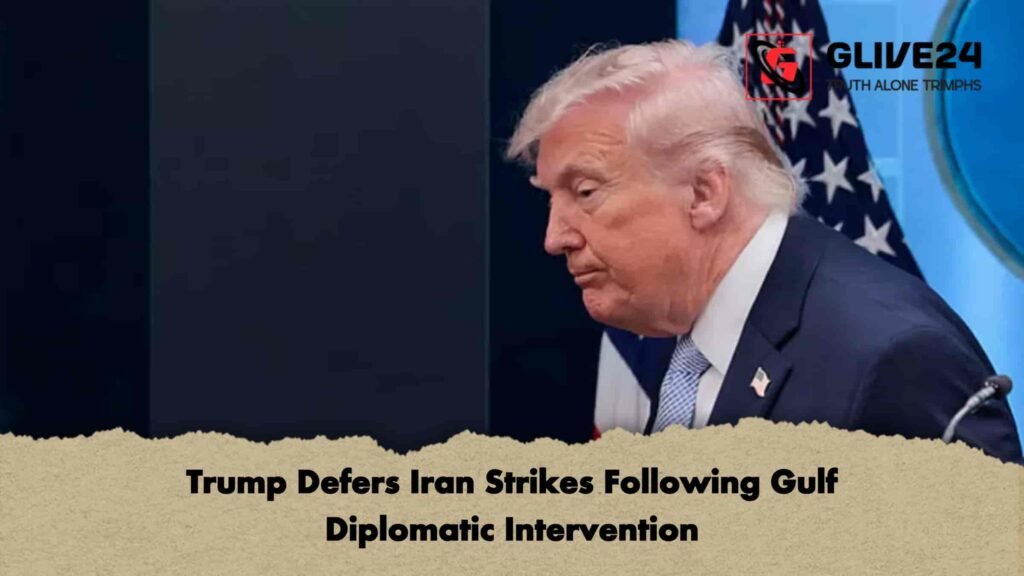
United States President Donald Trump announced on Monday the postponement of a newly authorised military offensive against Iran, reversing a decision made earlier the same day. The President had initially confirmed that a renewed wave of air strikes was scheduled to commence this week amid stalled negotiations with Tehran. However, he subsequently suspended the operation to allow a window for “important discussions”, citing diplomatic requests from three Gulf Arab leaders who sought additional time to broker an agreement regarding Iran’s nuclear programme.
Table of Contents
Strategic Inconsistencies and Campaign Status
The abrupt policy reversal follows a pattern of recurrent military threats followed by last-minute deferrals by the US administration. Speaking to reporters on Monday, President Trump stated:
“We were preparing a major attack for tomorrow [Tuesday], but I have halted it for a period. This could be permanent or temporary, because we have had very substantial discussions regarding Iran. Now, we shall see what the outcome will be.”
This latest developments occur as the military campaign approach its three-month mark. When the joint US-Israeli military operations commenced on 28 February 2026, President Trump asserted that the hostilities would conclude within four to five weeks. The protraction of the conflict has left the administration facing a choice between forcing an Iranian capitulation through sustained pressure or terminating operations to declare a military victory.
The administration’s public pronouncements have exhibited notable rhetorical inconsistencies. President Trump has alternately claimed that the war is “over” while subsequently asserting that the United States must “finish the job”. This followed a previous warning issued in April 2026, in which he threatened that “an entire civilisation will be destroyed tonight, never to be restored”—a deadline that passed without the threatened escalation.
Pentagon Casualty and Structural Damage Assessments
Despite the diplomatic pause, previous military operations have inflicted severe structural and institutional damage upon Iran. According to official statistical indicators compiled by the Pentagon, coalition forces have achieved substantial tactical objectives against Iranian state infrastructure:
| Tactical Parameter | Verified Operational Status and Impact |
| Target Infrastructure | Approximately 13,000 separate designated targets destroyed. |
| Naval Capabilities | The Iranian Navy has been reported as largely decimated. |
| Leadership Losses | Substantial casualties among senior military and intelligence officials. |
| State Leadership | Ayatollah Ali Khamenei, Iran’s Supreme Leader for 37 years, is confirmed deceased. |
| Nuclear Stockpiles | Remained structurally unaffected by the bombardment. |
Domestic Public Disapproval and Military Realities
The continuation of the military campaign faces significant domestic opposition within the United States. A public opinion poll conducted jointly by The New York Times and Siena College revealed that 64 per cent of registered voters view the decision to engage in military conflict with Iran as erroneous, with a majority expressing explicit dissatisfaction regarding the escalating economic expenditures of the war.
Furthermore, military stockpiles of US munitions have faced significant depletion since the outbreak of hostilities. Concurrently, negotiations concerning Iran’s nuclear infrastructure and the regularisation of maritime transit through the Strait of Hormuz remain entirely gridlocked. The US President has rejected multiple diplomatic proposals submitted by Tehran, demanding deeper concessions regarding their nuclear research capabilities.
Gulf Mediation and Defensive Adjustments
President Trump disclosed that the leaders of Qatar, Saudi Arabia, and the United Arab Emirates (UAE) formally requested the deferral of the scheduled strikes. These regional leaders maintain that they can negotiate a diplomatic settlement that satisfies Washington’s security criteria. President Trump noted:
“These three nations, along with several others, have contacted me. They are currently engaged in direct talks with our representatives and Iran. It appears they may reach a resolution. If this can be accomplished without dropping bombs, I would be very pleased.”
A primary statutory condition maintained by the US is the absolute prevention of Iranian nuclear weapons development, a position that remains the fundamental obstacle to a bilateral accord. While specific targets intended for Tuesday’s aborted strikes were not publicised, defense officials confirmed that contingency plans included strikes against Iranian ballistic missile installations.
Several US officials, speaking on the condition of anonymity, suggested that the public announcement of a deferral could be a deceptive tactical manoeuvre, noting that the initial February offensive was launched within days of both nations preparing for fresh negotiations.
Military intelligence sources report that during a recent one-month ceasefire, Iranian forces successfully excavated numerous ballistic missile bases previously obstructed by prior bombardments. The Iranian military has also redistributed mobile missile launchers and modified its defensive doctrines to counter potential air strikes.
A US military official confirmed that a significant portion of Iran’s ballistic missile arsenal remains secured within deep subterranean caverns and granite mountain installations that are highly resistant to aerial bombardment. US forces have primarily targeted the ingress points of these facilities to induce structural collapses, though the interior storage sectors remain functional, enabling Iran to reactivate multiple bases.
The official added that Iranian air defense units, reportedly utilizing Russian technical assistance, have successfully analysed US aerial attack vectors. The downing of an F-15E Strike Eagle and the damaging of an F-35 Lightning II aircraft last month indicate that Iranian forces have anticipated US tactical maneuvers, allowing for effective structural resistance. Despite the loss of senior command personnel during five weeks of continuous bombardment, the military official concluded that Iran has adapted into a more resilient adversary, successfully relocating its remaining strategic assets while maintaining the capability to disrupt regional energy infrastructure and challenge coalition air superiority.