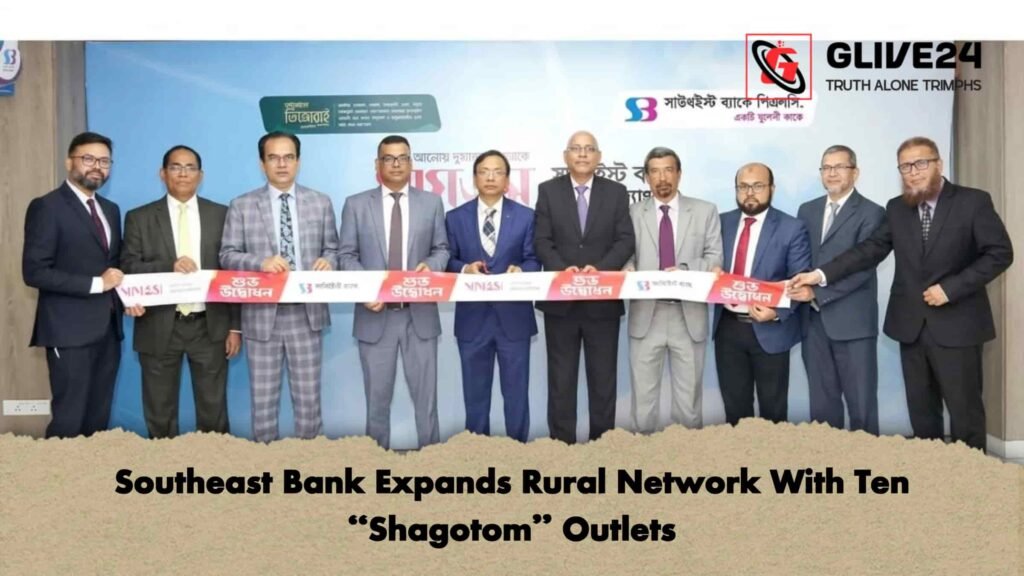
Southeast Bank PLC has formally extended its financial services footprint into the unbanked and underserved segments of Bangladesh through the concurrent inauguration of 10 new agent banking outlets. Operating under the corporate brand name “Shagotom”, these newly commissioned outlets have been strategically deployed across rural and semi-urban territories within seven distinct districts: Tangail, Manikganj, Narsingdi, Dhaka, Moulvibazar, Cumilla, and Feni. An official corporate press release noted that the operational expansion aligns with national financial inclusion strategies, aimed at embedding modern banking infrastructure across remote geographical zones.
Centralised Virtual Inauguration
The commercial operations of the 10 agent banking outlets were commenced via a centralised digital launch ceremony. Abidur Rahman Chowdhury, the Additional Managing Director of Southeast Bank PLC, presided over the event and executed the formal virtual openings.
The digital proceeding brought together senior executives from the bank’s corporate head office, the respective heads of its regional commercial branches, and the independent proprietors and agents selected to manage the 10 new local outlets. This remote corporate configuration illustrates the institution’s strategy of utilizing digital communication networks to coordinate extensive peripheral branch expansions without necessitating localized physical deployments during the launch phase.
Functional Capabilities and Service Suite
The “Shagotom” agent banking model delivers a comprehensive suite of technology-driven financial products, structured to accommodate both conventional retail banking customers and those seeking Sharia-compliant financial solutions via the bank’s specialized “Tijarah”-Islamic Banking framework.
The range of financial transactions and administrative services made available to local consumers at these newly established outlets comprises the following:
-
Account Management: Provision for the initial registration and opening of both current and savings accounts, alongside the processing and issuance of commercial chequebooks, debit cards, and credit cards.
-
Transaction Architecture: Inbound and outbound cash deposits and withdrawals, domestic peer-to-peer fund transfers, and real-time electronic clearing via the Bangladesh Electronic Funds Transfer Network (BEFTN) and Real-Time Gross Settlement (RTGS) systems across all commercial banks.
-
Remittance and Investment Access: Processing and distribution of inbound foreign remittances, coupled with the administrative opening of Beneficiary Owner (BO) accounts and stock market share transaction capabilities.
-
Credit Operations: Facilitation of micro-credit, medium enterprise loans, agricultural (Krishi) loans, and retail lending facilities integrated with consumer insurance protection, alongside the automated collection of standard loan instalments.
-
Public and Utility Services: Automated collection of utility bills, distribution of government social security allowances, and user integration into the bank’s primary internet banking infrastructure.
Core Infrastructure Specifications
To ensure uninterrupted consumer access beyond standard daytime operating hours, Southeast Bank PLC has integrated automated self-service terminals into these regional nodes. A structured breakdown of the operational parameters governing this rollout is detailed below:
| Operational Parameter | Institutional Specification |
| Banking Entity | Southeast Bank PLC |
| Agent Banking Brand | “Shagotom” |
| Newly Commissioned Outlets | 10 (Ten) distinct units |
| Geographic Distribution | Tangail, Manikganj, Narsingdi, Dhaka, Moulvibazar, Cumilla, and Feni districts |
| Inaugurating Official | Abidur Rahman Chowdhury (Additional Managing Director) |
| Operational Frameworks | Conventional Banking & “Tijarah”-Islamic Banking |
| Continuous Availability | 24/7 client access via integrated automated Cash Recycler ATMs |
By outfitting these agent locations with automated Cash Recycler ATMs, the bank enables local populations to deposit and withdraw currency continuously, reducing the historical reliance of rural communities on long-distance travel to traditional brick-and-mortar bank branches.