The 1950 FIFA World Cup marked the resurgence of international football following a twelve-year hiatus caused by the Second World War. As Europe laboured to recover from the devastation of conflict, Brazil was selected as the host nation, providing a stage for a tournament that would become a cornerstone of sporting history.
Context and Global Participation
The previous two editions of the tournament, scheduled for 1942 and 1946, were cancelled due to the war. To ensure the safety of the trophy, FIFA Vice-President Ottorino Barassi famously hid the Jules Rimet Trophy in a shoe box under his bed to prevent it from being seized by occupying forces.
By 1950, several prominent nations were absent. Scotland and Turkey withdrew despite qualifying, while Argentina declined to participate due to a dispute with the Brazilian Football Confederation. Furthermore, Germany and Japan remained banned from FIFA, and the Soviet Union declined to enter. Consequently, only 13 teams competed in the finals.
The Construction of the Maracanã
To host the event, Brazil commissioned the construction of the Estádio do Maracanã in Rio de Janeiro. At the time of the tournament, it was the largest stadium in the world, with an official capacity exceeding 180,000, though attendance figures often surpassed 200,000. Despite the tournament beginning while the stadium was still partially unfinished—complete with scaffolding and unpaved areas—it served as the primary venue for the final round.
Tournament Format and Notable Upsets
The 1950 tournament was unique as it did not conclude with a traditional knockout final. Instead, the winners of the four opening groups entered a final round-robin group. The team with the most points at the end of this phase would be crowned champions.
One of the greatest upsets in football history occurred during the group stages when the United States defeated England 1-0. England, making their World Cup debut and considered heavy favourites with stars like Billy Wright and Tom Finney, were humbled by a goal from Joe Gaetjens.
Final Round Performance
Brazil entered the final round as the dominant force, defeating Sweden 7-1 and Spain 6-1. Their attacking trio of Ademir, Zizinho, and Jair was deemed unstoppable. In contrast, Uruguay had struggled to a 2-2 draw against Spain and a narrow 3-2 win over Sweden.
Final Group Standings Prior to the Deciding Match:
| Team | Played | Won | Drawn | Lost | Points | Goal Diff |
| Brazil | 2 | 2 | 0 | 0 | 4 | +11 |
| Uruguay | 2 | 1 | 1 | 0 | 3 | +1 |
| Spain | 2 | 0 | 1 | 1 | 1 | -5 |
| Sweden | 2 | 0 | 0 | 2 | 0 | -7 |
The “Maracanazo”
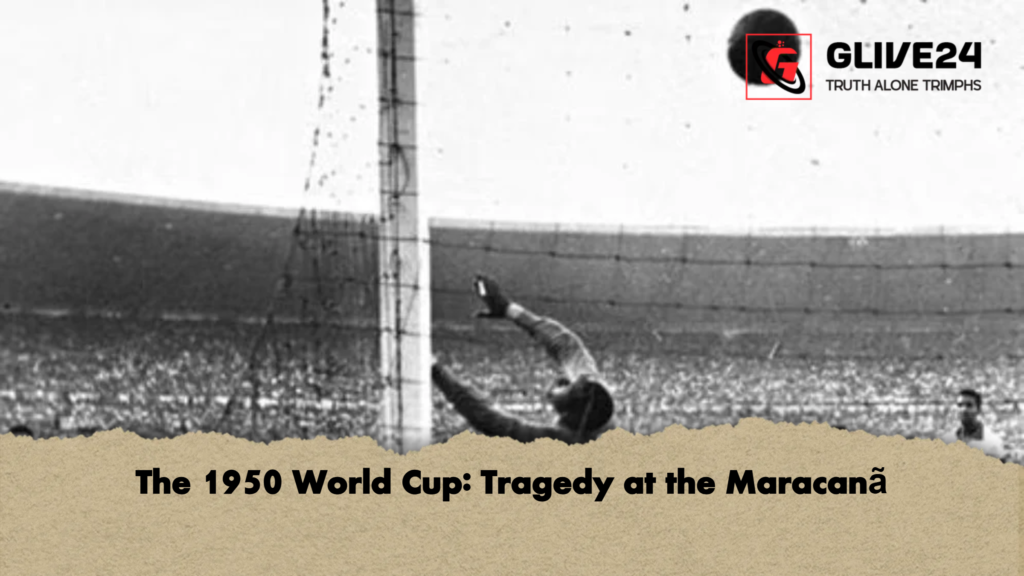
On 16 July 1950, Brazil met Uruguay in the final match. Brazil required only a draw to secure the title. Friaça scored for Brazil in the 47th minute, seemingly securing the victory. However, Juan Alberto Schiaffino equalised for Uruguay in the 66th minute. In the 79th minute, Alcides Ghiggia scored the winning goal, beating Brazilian goalkeeper Moacir Barbosa at the near post.
The match ended 2-1 to Uruguay. The result, known as the Maracanazo, remains one of the most significant moments in sporting history, leading to national mourning in Brazil while confirming Uruguay as two-time world champions. Captain Obdulio Varela famously noted that while they were considered the underdogs, they fought until the very end.