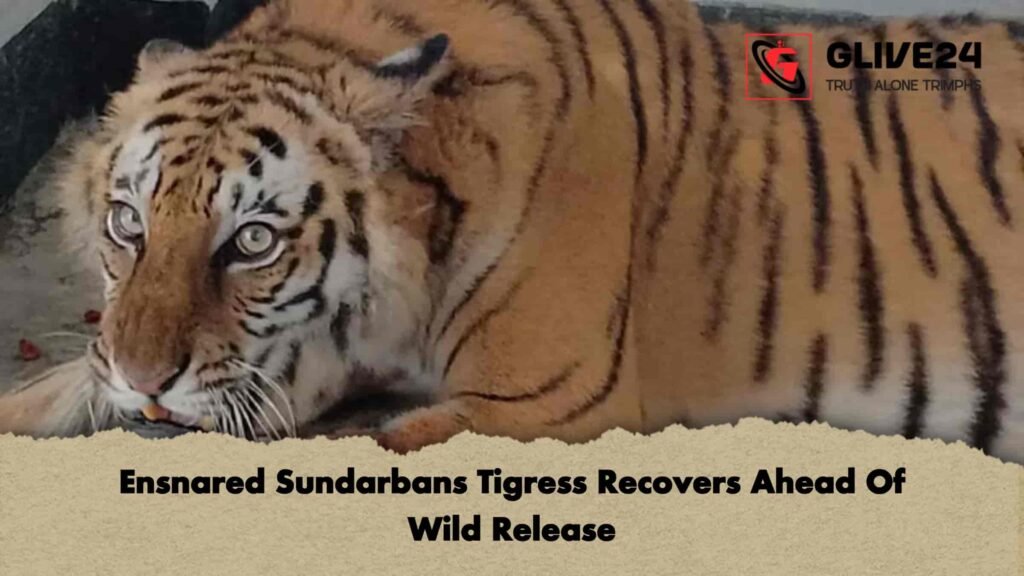
A female Bengal tigress aged between 10 and 11 years has successfully recovered at a specialised rehabilitation facility after being rescued from an illegal poacher’s snare in the Sundarbans. Following five months of intensive veterinary treatment, the Bangladesh Forest Department is finalizing logistics to release the predator back into her native habitat, with the translocation operation scheduled to take place in June 2026.
The animal was initially discovered on 3 January after becoming caught in a wire loop trap, locally termed a Mala Phand, which had been deployed by deer poachers near the Sharkir Khal waterway along the Mongla upazila boundary in Bagerhat. Alerted by field intelligence, a specialized rescue unit from the Forest Department extracted the trapped feline on 4 January.
The injured tigress was transferred to the Wildlife Rehabilitation Centre in Khulna, managed by the Wildlife Management and Nature Conservation Division, where a five-member medical board of veterinary experts was formed to oversee her clinical rehabilitation.
Veterinary Assessment and Physiological Recovery
Dr Hatem Sazzat Zulkarnain, a senior veterinary surgeon with the Forest Department who led the clinical team, noted that the initial rescue operation was conducted under highly challenging field conditions. Upon arrival at the medical centre, the tigress was diagnosed as severely emaciated, weak, and lethargic.
The constriction of the poacher’s wire snare around her front left leg had caused a deep three-inch laceration, severing skin, muscle tissue, and surface veins. Due to the animal’s frantic attempts to break free, the wound had developed severe necrosis.
The medical board implemented a rigorous treatment program consisting of targeted antibiotic cycles and daily wound debridement. By March, the infection was completely cleared and the laceration had healed. The damaged muscle tissue has since regenerated fully, and new fur has covered the scar site. The tigress has regained her standard speed, agility, and reflexes, with her body mass rising to a healthy 80 kilograms.
The historical, clinical, and law enforcement metrics compiled by the Forest Department during this rehabilitation cycle and the associated anti-poaching campaigns are detailed in the table below:
| Technical Metric Category | Documented Field and Clinical Data | Verifying Institutional Authority |
| Species & Sex | Female Bengal Tigress (Panthera tigris) | Wildlife Rehabilitation Centre |
| Estimated Age & Weight | 10–11 Years Old; Weight: ~80 kg | Veterinary Directorate |
| Capture Mechanism | Wire Loop Trap (Mala Phand) targeting deer | Sundarbans East Forest Division |
| Seized Gear (East Zone) | 61,010 ft Loop Traps; 380 Spring Traps; 2,000 Foot Traps | Saran Khola & Chandpai Range Logs |
| Seized Gear (West Zone) | 1,200 ft Loop Traps; 1,200 ft Snare Traps; 748 Foot Traps | Sundarbans West Forest Division |
| Legal Prosecutions (East) | 22 Wildlife Lawsuits; 69 Named Suspects; 62 Arrests | Forest Department Legal Cell |
| Legal Prosecutions (West) | 50 Wildlife Lawsuits; 130 Named Suspects; 19 Arrests | Judicial Magistrate Registry |
Expert Debate Surrounding Relocation Strategies
As the June release date approaches, senior forest administrators and academic wildlife biologists have engaged in a technical debate regarding the optimal long-term management strategy for the tigress, whose age is close to the maximum 15-year life expectancy of the species in the wild.
Sanaullah Patwary, Conservator of Forests for the Wildlife and Nature Conservation Region, expressed caution regarding a direct wilderness release, noting that her prolonged isolation from the wild had impacted her predatory efficiency. He recommended transferring her permanently to a state-managed safari park.
“The tigress has spent a considerable period away from her natural hunting grounds, which inevitably reduces her stalking capability,” Patwary noted. “Given her advanced age, her capacity to defend territory against younger, dominant wild tigers is low. Housing her in a protected safari park would eliminate these survival risks.”
This perspective was challenged during an inter-agency stakeholder conference on 21 May, where wildlife researchers strongly advocated for her return to the mangrove forest. Dr M.A. Aziz, a prominent wildlife researcher and Professor at the Department of Zoology, Jahangirnagar University, argued against permanent captivity.
“If this tigress survives in the wild for even a single day, it represents a significant victory for regional conservation efforts,” Dr Aziz stated. “She has an absolute right to live and die within her natural home range. Confining her to a safari park deprives her of her right to a natural death.”
Dr Aziz added that due to her advanced age and history of entrapment, there is an increased risk that she might migrate toward human settlements along the forest fringe. To prevent this, he advised fitting the animal with a GPS satellite tracking collar prior to release, noting that the Indian Forest Service has successfully monitored six tigers using satellite collars in their sector of the Sundarbans.
Strategic Release Parameters and Enforcement Operations
Imran Ahmed, Conservator of Forests for the Khulna Region, stated that camera-trap data from 2024 had recorded the tigress three times across a 40-kilometre home range. Based on this historical movement data, the department plans to release her at the deepest point within that specific zone, as far as possible from human villages. Ahmed clarified that additional stakeholder meetings will be held to finalize the tracking protocols, with a definitive deployment plan expected by June.
The Forest Department noted that poachers primarily deploy four types of illegal traps within the mangrove ecosystem: loop traps (Mala Phand), spring traps (Chitka Phand), foot traps (Hata Phand), and neck snares (Gala Phand). Extensive anti-poaching operations conducted over the past several months have led to major seizures of this equipment and numerous arrests across both the Eastern and Western jurisdictions of the forest.