At the break of dawn in Chaghcharan, the provincial capital of Ghor, hundreds of men assemble in a dusty municipal square. Standing in exhaustion along the roadside, they wait in the hope of securing manual labour. For these men, securing a day’s work is the sole determinant of whether their families will receive a meal or face total starvation.
Employment, however, remains exceptionally scarce. Among those waiting is 45-year-old Zuma Khan, who has managed to secure only three days of manual work over the preceding six weeks. His daily compensation ranges from a mere 150 to 200 Afghanis, equivalent to approximately USD 2.50 to USD 3.00.
“My children have slept without food for three consecutive nights,” Khan stated. “My wife was weeping, and the children were crying as well. I sought a loan from a neighbour to purchase wheat flour. I live in constant terror that my children will succumb to starvation.”
Table of Contents
Macroeconomic Collapse and Systemic Aid Reductions
The crisis extending across Ghor Province reflects a broader national catastrophe recorded by international observers. According to data published by the United Nations, three out of every four individuals in Afghanistan are currently unable to meet their basic survival needs. The country faces historic levels of food insecurity, with approximately 4.7 million people—representing over 10% of the total population—perched on the brink of famine.
This systemic collapse follows severe reductions in international humanitarian assistance. The United States, formerly the largest donor nation to Afghanistan, systematically dismantled its primary aid pipelines over the course of last year. Other major sovereign contributors, including the United Kingdom, alongside global non-governmental organisations, implemented parallel budgetary cuts.
United Nations tracking systems indicate that the total volume of international humanitarian aid delivered to Afghanistan this year has suffered a 70% reduction compared to the aggregate funding metrics recorded in 2025. This fiscal shortfall is further exacerbated by a prolonged, multi-province drought that has severely degraded domestic agricultural yields.
The key demographic, financial, and institutional metrics defining the current humanitarian crisis in Afghanistan are structured in the table below:
| Socio-Economic Parameter | Documented Statistical Metrics | Primary Reporting Authority |
| National Famine Threshold | 4.7 million citizens bordering starvation (>10% of population) | UN Food & Agriculture Organisation |
| Basic Resource Deficit | 75% of total population unable to meet basic needs | United Nations Field Report |
| Aid Funding Contraction | 70% budgetary drop this year compared to 2025 metrics | UN Financial Tracking Service |
| Typical Daily Wage Range | 150 – 200 Afghanis (Approximately USD 2.50 – USD 3.00) | Chaghcharan Labour Exchange |
| Primary Climate Driver | Severe, multi-season drought across >50% of provinces | Ministry of Agriculture & NGOs |
| Target Marriage Value | 200,000 Afghanis (Bilateral familial transaction) | Ghor Provincial Case Study |
Field Realities of the Chaghcharan Labour Market
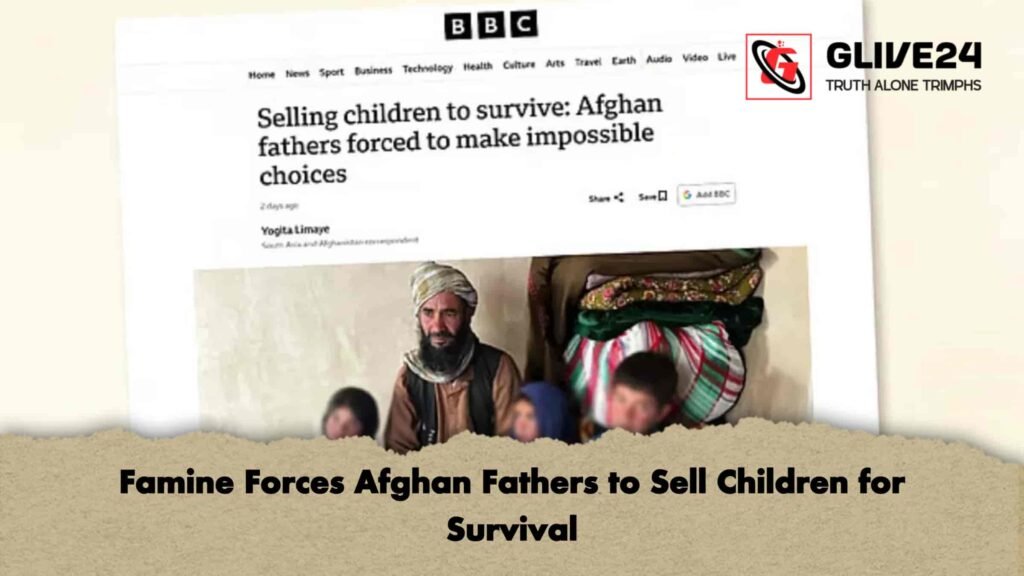
During a two-hour field assessment conducted at the Chaghcharan municipal square by BBC correspondent Yogita Limaye, the severity of the unemployment crisis was visible. Only three men out of the hundreds assembled succeeded in securing work. The desperation of the crowd was demonstrated when a local bakery distributed stale flatbreads from the previous day; the entire supply was exhausted within seconds as dozens fought to claim the food. Minutes later, the arrival of a single motorist seeking a lone labourer to transport bricks triggered a chaotic surge as dozens of desperate men swarmed the vehicle.
For those returning empty-handed to the barren, arid terrain of the Siyah Koh mountain range, the options for survival are shrinking. Another resident, Rabbani, described the psychological toll of the crisis, stating that he received a telephone call informing him that his children had been without food for 48 hours. “My immediate impulse was to end my own life,” Rabbani confessed. “But I reasoned, how would my death benefit my family? Thus, I returned to this square to search for employment.”
Similarly, Khaja Ahmad, an elderly resident whose adult sons have died, wept as he explained that his advanced age prevents employers from hiring him, leaving his surviving dependents completely destitute.
The Financial Exigencies Behind the Transaction of Children
This absolute lack of income has forced several fathers to consider or execute the transaction of their children to ensure the survival of their remaining dependents. Within Afghan society, female children are disproportionately selected for sale over male children. This pattern stems from entrenched social structures that view male children as long-term financial providers—a dynamic that has intensified following the Talibani administration’s severe restrictions on female education and employment.
Abdul Rashid Azimi presented his seven-year-old twin daughters, Rokiye and Rohila, explaining that his mounting debts and lack of employment left him no other choice.
“I am prepared to sell my daughters,” Azimi stated. “I return home from the square hungry, thirsty, and entirely disoriented, only for my children to beg for bread. If I successfully negotiate the sale of one daughter, I can secure enough food to sustain my remaining children for at least four years.”
The twins’ mother, Kayhan, noted that the household subsists entirely on dry bread and hot water, unable to afford even basic tea leaves. To assist, the family’s two adolescent sons work as shoe-shiners in the town centre, while a third son scavenges combustible municipal waste to fuel their cooking fire.
In another part of the province, resident Sayed Ahmad confirmed that he had already finalized a legal transaction involving his five-year-old daughter, Shaika. The child had been diagnosed with appendicitis alongside a hepatic cyst on her liver, and Ahmad lacked the capital required to fund her urgent surgical intervention.
[Structured Familial Debt & Marriage Dowry Framework]
Bilateral Agreement: 200,000 Afghanis Total Value ──► Immediate Advance for Surgery ──► 5-Year Installment Matrix ──► Custody Transfer at Age 10
To secure the medical fees, Ahmad entered into a contract with a relative, selling Shaika for a total sum of 200,000 Afghanis. Under the specific terms of the agreement, the buyer advanced only the immediate funds required to cover the operation, with the remaining balance to be paid in instalments over the next five years. Shaika will remain in her biological father’s home until she reaches the age of ten, at which point she will be transferred to the relative’s custody to marry one of his sons.
“If I possessed financial resources, I would never have entertained such a course of action,” Ahmad stated. “But I had to choose between this agreement and letting her die from her medical condition. Marrying a child off at such a young age is deeply concerning and causes severe complications, but this decision ensured she survived.”
Rising Infant Mortality Across Local Settlements
While the current Taliban government attributes the severe economic stagnation to the structural failures and systemic corruption of the pre-2021 US-backed administration of Ashraf Ghani, local communities continue to bear the immediate cost.
Mohammad Hashem detailed the loss of his 14-month-old daughter, who died from combined malnutrition and a total lack of accessible medicine. Local community elders in Ghor confirm that infant mortality rates have escalated dramatically over the last 24 months, driven primarily by severe wasting and malnutrition.
In the absence of official census registries, the scale of this child mortality crisis can only be verified through local burial grounds. Field counts conducted at rural cemeteries reveal that the physical number of infant and child graves is now nearly double that of adult plots, providing stark evidence of the vulnerability of Afghanistan’s youngest population.