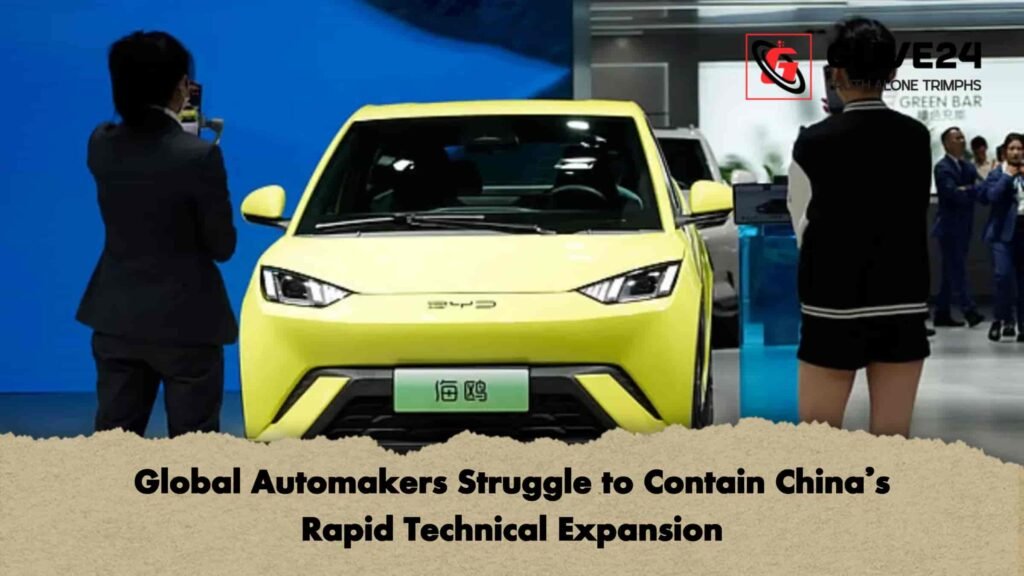
The global automotive manufacturing landscape is undergoing a structural realignment as long-established American, European, and Japanese automotive corporations lose domestic and international market share to Chinese competitors. This competitive shift extends significantly beyond the production volumes of electric vehicles (EVs). It encompasses vertical integration across advanced battery chemistries, proprietary software architectures, automated vehicular design, and high-efficiency factory engineering.
During a series of factory inspections conducted in Beijing and Hefei to coincide with the Auto China 2026 trade exposition, international observers documented a significant technological disparity. The pace of automation and software deployment across China’s domestic assembly plants consistently outpaced the development lifecycles maintained by traditional Western and Japanese legacy automakers.
Senior executives from several traditional automotive conglomerates have issued clear assessments regarding this shifting paradigm. Speaking to Japanese media after touring an advanced automated production facility in Shanghai, Toshihiro Mibe, Chief Executive Officer of Honda, acknowledged the scale of the challenge:
“Looking at their infrastructure, I felt that we simply do not stand a chance in this current trajectory,” Mibe observed.
Simultaneously, Jim Farley, Chief Executive of Ford Motor Company, warned that the global expansion of Chinese automotive enterprises has forced Western manufacturers into a complex struggle for structural survival.
The Evolution from Local Partnerships to Technology Dependency
For over three decades, international automotive brands entered the mainland Chinese consumer market by forming mandatory joint ventures with domestic state-owned enterprises. Under this arrangement, Western firms supplied advanced engineering blueprints and brand equity, while local partners provided manufacturing facilities and domestic regulatory access. This historic relationship has inverted; to remain commercially viable within the contemporary ecosystem, foreign brands are increasingly dependent on Chinese technological architectures.
Bill Russo, a prominent Shanghai-based automotive analyst and founder of consultancy Automobility, argued that the primary strategic miscalculation made by the developed world was viewing this industrial transformation solely as a transition toward electrification.
[Global Mobility Technology Paradigm Shift]
Traditional Strategy: Internal Combustion Engines ──► Foreign Engineering Dominance
Modern Strategy: Integrated Smart Mobility       ──► Chinese Hardware & Software Vertical Control
According to Russo, the real conflict centers on achieving systemic control over future “mobility technology.” Cars are increasingly transitioning into complex software-defined platforms, incorporating driver-assistance machine learning and integrated digital infotainment environments—a structural pivot that plays directly into the strengths of China’s established consumer technology ecosystem.
The statistical data illustrating China’s manufacturing expansion, price advantages, and the erosion of foreign market share are detailed in the table below:
| Industrial & Market Metric | Historical Baseline / Context | Current Verified Metric (2026) | Data Authority / Source |
| China’s Core Export Leadership | 163 distinct product categories (2016) | 315+ dominant export product lines | UN / General Customs Administration |
| EV Manufacturing Cost Differential | Developed economies baseline index | At least 30% lower production costs | International Energy Agency (IEA) |
| Foreign Brand Market Share (China) | 64% of domestic market share (2020) | Decreased to 32% of total market share | Automobility Consultancy |
| Xiaomi Assembly Line Velocity | Initial brand entry into EV sector (2024) | 1 completed vehicle every 76 seconds | Beijing Factory Operations Log |
| General Motors Sales Trajectory | Historical multi-billion dollar profit center | 21% contraction in sales (Q1 2026) | GM Quarter-One Financial Report |
| BYD Ultra-Fast Charging Output | Standard internal combustion refueling time | 400 km range replenishment in 5 minutes | BYD Technical Specifications |
Government Subsidies and the “Smartphone on Wheels” Concept
China’s manufacturing dominance is reinforced by its supply chain infrastructure. The nation is currently the world’s leading exporter of over 315 distinct industrial product categories, up from 163 in 2016. A high percentage of these components—including lithium-ion battery cells, raw cathode materials, precision sub-assemblies, and specialized factory robotics—are integrated into the electric vehicle supply chain.
According to data compiled by the International Energy Agency (IEA), the production cost for a compact electric Sport Utility Vehicle (SUV) manufactured within China is at least 30% lower than an identical vehicle assembled in a developed economy. This cost advantage is primarily driven by lower localized battery production expenses and a fully integrated regional supply network.
This infrastructure was developed through sustained state-directed financial planning. Independent audits by the Rhodium Group show that China channeled billions of dollars in state funding, tax incentives, and subsidized land grants into the domestic EV and battery manufacturing sectors over recent years. While the European Union (EU) and the United States have argued that these subsidies create global market distortions, the funding has allowed Chinese firms to scale production and lower unit costs rapidly.
Furthermore, intense domestic competition within mainland China has accelerated the pace of innovation. Major consumer electronics and internet conglomerates—such as Xiaomi, Huawei, and Alibaba—now actively design, fund, and manufacture intelligent vehicles. This integration has bridged the gap between consumer software and heavy automotive engineering.
Russo noted that Chinese firms are no longer benchmarking their progress against Western legacies, but are locked in intense internal competition to see who can innovate fastest. This environment has transformed the modern vehicle into what analysts describe as a “smartphone on wheels.”
Advanced Automation and Production Benchmarks
At the automated Xiaomi EV assembly plant outside Beijing, highly synchronized robotic lines complete a finished electric vehicle approximately every 76 seconds. Despite launching its inaugural electric vehicle in 2024, Xiaomi has quickly climbed into the upper tiers of domestic sales. The company’s core strategic roadmap focuses on linking vehicles, mobile smartphones, application software, and smart-home appliances into a single digital ecosystem.
Similarly, NIO’s primary manufacturing complex in Hefei operates with near-total automation across its chassis and stamping divisions. Concurrently, BYD has developed an ultra-fast charging battery architecture capable of adding 400 kilometers of operational range within a five-minute charging window—a timeframe that closely matches the refueling duration of a traditional internal combustion petrol tank.
Beyond standard road vehicles, local manufacturers are investing heavily in future mobility concepts. Speaking to the BBC, He Xiaopeng, the founder and Chief Executive Officer of XPENG, confirmed that his company is developing humanoid robotics and autonomous flying vehicles alongside its standard EV models.
“Over the course of the next decade, every successful automotive manufacturer must transition into a functional robotics enterprise,” Xiaopeng stated.
Financial Strain on Foreign Legacy Brands
As their technological lead narrows, international automakers have become increasingly dependent on Chinese manufacturing centers for their global supply networks. Tesla regularly exports its Shanghai-assembled Model 3 to European markets, while BMW utilizes Chinese factories to manufacture its electric Mini models for export.
However, within China’s domestic retail market, foreign brands are facing a steep decline. Data from Automobility shows that the collective market share held by foreign automotive brands in China dropped from 64% in 2020 to just 32% over the current fiscal year. This contraction has eroded the earnings of major European and American firms, including General Motors (GM), which historically viewed China as a reliable, highly profitable market.
This competitive pressure is visible in the luxury vehicle segment as well. Huawei’s premium Maextro S800 luxury sedan has surpassed the combined domestic sales volumes of the Porsche Panamera and the BMW 7 Series to become the top-selling vehicle priced above USD 100,000 in China.
To adapt, several Western automotive groups are forming new partnerships to license Chinese technical architecture:
-
Stellantis Group: The conglomerate recently finalized a €1 billion joint venture with state-owned Dongfeng Motor Corporation to manufacture Peugeot and Jeep models in China for both domestic and export markets. Stellantis is also importing Dongfeng’s premium electric brand, Voyah, into Europe and evaluating the feasibility of manufacturing Chinese-designed platforms directly in France.
-
Volkswagen Group: The German automaker has invested USD 700 million into XPENG to gain direct access to the Chinese firm’s proprietary software and autonomous driving systems, openly admitting that its internal software divisions could not develop comparable systems fast enough.
“We learn from each other, which builds mutual trust and facilitates deeper industrial collaboration,” XPENG CEO He Xiaopeng stated regarding the Volkswagen partnership. Other global manufacturers, including Toyota, Hyundai, Ford, and Nissan, are expanding their research hubs within China or assessing options to build Chinese-designed platforms in their overseas factories.
However, these strategic pivots have faced significant hurdles. Audi was forced to offer substantial retail discounts on its localized E5 electric model after initial sales fell short of projections. Concurrently, General Motors revised the asset valuations of its Chinese operations downward by several billion dollars after reporting a 21% decline in sales volumes during the first quarter of the year.
Japanese automakers, who were comparatively slow to transition their core lineups toward fully electric platforms, face similar challenges. They are coming under intense pressure across both China and Southeast Asia, where Chinese brands are expanding rapidly.
While Volkswagen temporarily regained its position as China’s top-selling automotive brand at the beginning of 2026, market analysts attributed this brief shift to a temporary suspension of domestic EV subsidies, which briefly slowed down local competitors rather than signaling a structural recovery for foreign brands.
Global Tariff Barriers and Industrial Relocation Risks
As domestic economic growth slows within mainland China due to localized overcapacity and aggressive price wars, Chinese automakers are accelerating their international expansion. Despite the European Union imposing defensive import tariffs of up to 45% on Chinese-manufactured vehicles, brands like BYD, Chery, and SAIC are steadily increasing their market footprint across Europe and emerging economies.
For example, Chery’s Jaecoo 7 model has become one of the fastest-selling new vehicle imports in the United Kingdom within 14 months of its market debut. In contrast, the United States market remains largely inaccessible to Chinese automotive brands due to the enforcement of defensive tariffs exceeding 100%.
International trade analysts warn that if the core centers of automotive engineering, battery development, and software design continue to consolidate within China, regional manufacturing hubs across Europe and Southeast Asia could face structural decline, potentially affecting local employment and industrial output.
Automotive consultant James Pearson noted that defensive trade barriers face limitations against agile supply chains:
“Even if you block their products from entering one specific market, they will simply redirect their capital to establish footholds in alternative regions,” Pearson observed.
Russo concluded that the global center of gravity for the automotive industry has permanently shifted toward China. He noted that while international companies open to genuine collaboration still have clear opportunities, those focused solely on trying to block China’s industrial ascent risk falling further behind.