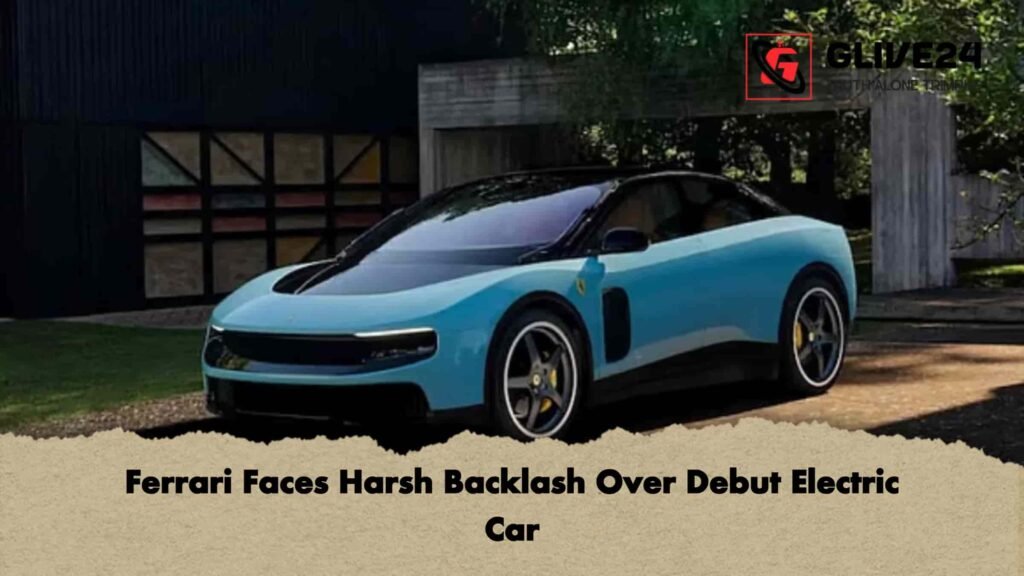
The iconic Italian supercar manufacturer Ferrari has initiated a radical new chapter in its corporate history with the unveiling of its first fully electric vehicle, the Luce. Named after the Italian word for “light,” the model signals a major tactical pivoting for a brand historically renowned for the acoustic roar of its internal combustion engines. However, the premium vehicle has sparked an intense, unprecedented storm of criticism regarding its non-traditional design.
Table of Contents
High-Profile Launch Coupled with Financial Decline
The international debut of the Luce was conducted with immense ceremony, attracting prominent dignitaries including the Italian President Sergio Mattarella and Pope Leo. Despite the substantial global anticipation generated ahead of the unveiling, the subsequent response from social media commentators, financial market investors, and sector politicians has been heavily critical.
On the day following the launch event, Ferrari’s share price fell sharply by 8 per cent on the stock exchange. Concurrently, the internet was flooded with a vast array of satirical memes and jokes targeting the vehicle, which commands a retail price of $640,000. Structurally, the vehicle represents another notable departure from tradition, being the first-ever five-seat model produced by Ferrari.
Minimalist Aesthetic Breaks with Maranello Heritage
The visual design of the Luce was overseen by the celebrated former Apple product designer, Sir Jony Ive. The final product lacks the sharp, aggressive contours characteristic of Ferrari’s historic petrol models, choosing instead a smooth, continuous exterior silhouette. Furthermore, the electric powertrain operates without the traditional engine note, replacing it with a quiet mechanical profile.
This dramatic shift from traditional design principles has polarised industry figures:
-
Luca Cordero di Montezemolo (Former Ferrari Chairman): Warned reporters that the Luce risks undermining the foundational identity of the legendary company, even suggesting the company should consider removing its historic prancing horse emblem from this specific model.
-
Matteo Salvini (Italy’s Deputy Prime Minister and Transport Minister): Publicly questioned whether the vehicle truly represented innovation, wondering how the company’s founder, Enzo Ferrari, would react and noting that it failed to resemble the traditional image of the brand.
-
Shaun Baker (Luxury Car Dealer and Collector): Expressed his disappointment to the BBC, mockingly rebranding the “Luce” as a “loser” and stating that the design damaged the aspirational reputation of the marque.
Conversely, a minority of automotive analysts have defended the vehicle, praising the aesthetic choices as a unique and brave example of modern automotive design.
Supercar Performance Amid Global Re-evaluations
Despite the controversy surrounding its external appearance, the mechanical specifications of the Luce adhere to high-performance supercar standards. The vehicle is capable of accelerating from 0 to 96 km/h (0 to 60 mph) in 2.5 seconds, with a verified maximum top speed exceeding 305 km/h.
Luce Technical Performance Profile
| Metric Parameter | Performance Data |
| Retail Market Price | $640,000 |
| Seating Configuration | 5 Seats (First for Brand) |
| Acceleration (0–96 km/h) | 2.5 Seconds |
| Maximum Top Speed | >305 km/h |
The Luce enters a global automotive market beset by complex structural challenges. While Ferrari advances its electrification timeline, several rival luxury brands are actively downsizing their electric programmes. Lamborghini recently cancelled its pure electric car project to concentrate on hybrid systems due to soft market demand, a decision its Chief Executive, Stephan Winkelmann, called the correct path. Major legacy firms including Porsche, Honda, and Ford have similarly restricted their electric vehicle initiatives.
Furthermore, Western manufacturers face intense pressure from Chinese firms. Data from the International Energy Agency reveals that Chinese production costs are at least 30 per cent lower than other global regions, driven by an integrated parts supply network and domestic state subsidies. This allows Chinese companies to lower prices while advancing technological innovation, forcing brands like Tesla and Volkswagen to implement price cuts. Chinese brands are also entering the premium supercar tier, exemplified by the fully electric BYD Yangwang U9, which retails for roughly $250,000 and matches the Luce with a 0-96 km/h time of 2.3 seconds.
Identity Crises Across the Luxury Segment
Ferrari is not the isolated target of heritage-related criticism. In 2024, Jaguar declared its intention to transition into an ultra-luxury electric-only brand, revealing the “Type 00” concept vehicle. That model, characterised by an elongated bonnet and oversized wheels, was widely condemned by purists as a break from legacy. At the time, Jaguar Chief Executive Rawdon Glover defended the choice, stating that being bold and disruptive was essential to establish market presence.
Today, Ferrari faces identical allegations of compromising its historic identity. Singaporean automotive analyst James Wong praised the internal craftsmanship of the Luce but noted that it remains difficult to identify the car as a Ferrari from its exterior. Sustainable industry specialist Jessica Cheam added that the vehicle’s high price tag raises serious questions, especially given the availability of cheaper, highly advanced electric alternatives.
In response, Ferrari Chief Executive Benedetto Vigna has dismissed comparisons to low-cost Chinese EVs, arguing that the high pricing is justified by the scale of innovation. He also maintained that early purchase enquiries from prospective customers have been highly encouraging.
Sector experts suggest that the Luce may be an intentional attempt to pivot towards a younger, technology-focused demographic. While traditional enthusiasts remain sceptical, analysts note that the unique design might successfully attract an entirely new segment of affluent buyers who had not previously engaged with the Ferrari brand.