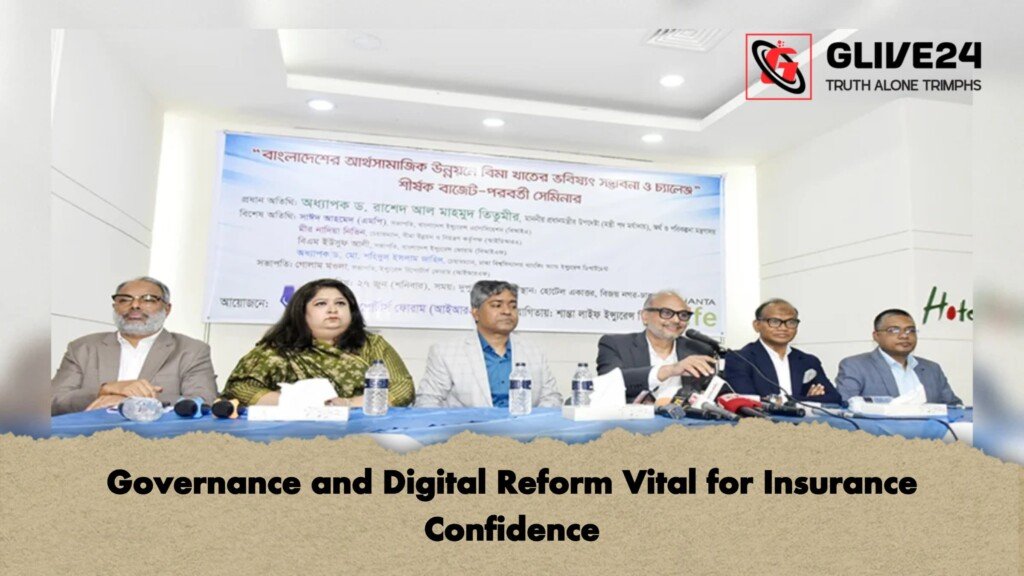
Strengthening governance, accelerating digital transformation and restoring public confidence emerged as the central themes of a post-budget seminar examining the future prospects and challenges of Bangladesh’s insurance sector.
The seminar, organised by the Insurance Reporters Forum (IRF), was held on Saturday at Hotel Ekattor in Bijoynagar, Dhaka. It brought together policymakers, regulators, industry leaders and academics to discuss how the insurance industry can play a more effective role in Bangladesh’s socio-economic development.
The event was chaired by IRF President Golam Mawla. The chief guest was Professor Dr Rashed Al Mahmud Titumir, Adviser to the Prime Minister on the Ministry of Finance and Planning. Special guests included Mir Nadia Nivin, Chairman of the Insurance Development and Regulatory Authority (IDRA), Bangladesh Insurance Association (BIA) President Said Ahmed, MP, and Bangladesh Insurance Forum (BIF) President BM Yusuf Ali.
Addressing the seminar, Professor Titumir said Bangladesh’s insurance industry has yet to achieve an adequate level of digital transformation, making it difficult to ensure efficient governance and high levels of customer satisfaction. He observed that shortcomings in regulatory oversight have contributed to a growing crisis of confidence among policyholders.
He also stressed that Bangladesh, being highly vulnerable to climate-related disasters, requires a stronger and more resilient insurance sector. According to him, the limited adoption of modern technology has prevented many insurers from operating efficiently. He called for sector-specific audit mechanisms alongside a more robust regulatory framework to improve transparency and accountability.
IDRA Chairman Mir Nadia Nivin identified three key priorities for reforming the insurance sector: restoring public trust, strengthening the regulatory and long-term investment framework, and improving institutional capacity.
She revealed that outstanding insurance claims currently stand at approximately Tk 70 billion. While some of the challenges are structural and affect the industry as a whole, she noted that others are linked to specific companies. Efforts are underway to address these issues through regulatory interventions.
She also pointed to complications surrounding the disposal of assets held by several insurance companies, saying these obstacles need to be resolved promptly. Introducing a risk-based supervisory system, she added, would help regulators identify weaknesses earlier and improve oversight across the industry.
Highlighting Bangladesh’s exposure to natural disasters, she said insurance has an increasingly important role to play in protecting individuals, businesses and livelihoods. She also emphasised the need to introduce microinsurance products and improve service delivery channels so that insurance coverage becomes more accessible to lower-income communities and underserved groups.
BIA President Said Ahmed said the insurance commission must remain completely independent of commercial interests and irregular practices. He also advocated expanding compulsory motor insurance and encouraged insurers to explore new sectors and products to widen insurance coverage across the country.
BIF President BM Yusuf Ali noted that several insurance companies in Bangladesh are capable of settling claims within just 24 hours. However, he argued that such positive examples rarely receive public attention. Instead, delayed or disputed claims dominate public discussion, overshadowing the industry’s better-performing institutions. He urged stakeholders to highlight successful practices alongside addressing legitimate concerns.
SM Nuruzzaman, Managing Director of Zenith Islami Life Insurance, said the life insurance segment faces more severe challenges than the non-life sector. He attributed part of the problem to complications in asset disposal and suggested that easier access to bank financing and improved asset management could help ease financial pressures on struggling companies.
Professor Dr Md Shahidul Islam Jahid of the University of Dhaka described insurance as an important pillar of the national economy that remains underdeveloped. He observed that insurance penetration in Bangladesh is still low and must increase significantly to strengthen financial resilience and broaden economic protection.
He added that weak regulation, a focus on short-term profits and the absence of long-term planning continue to hinder the sector’s development. He also highlighted the growing importance of insurance in addressing climate risks and supporting the agricultural sector, while warning that the industry cannot become stronger unless broader governance weaknesses and ethical risks within the financial system are addressed.
Speakers at the seminar reached a common conclusion that rebuilding public confidence, ensuring good governance, embracing digital technologies and strengthening regulatory oversight are essential for the sustainable growth of Bangladesh’s insurance industry. They said meaningful progress will require political commitment as well as coordinated efforts from regulators, insurers and all other stakeholders connected to the sector.