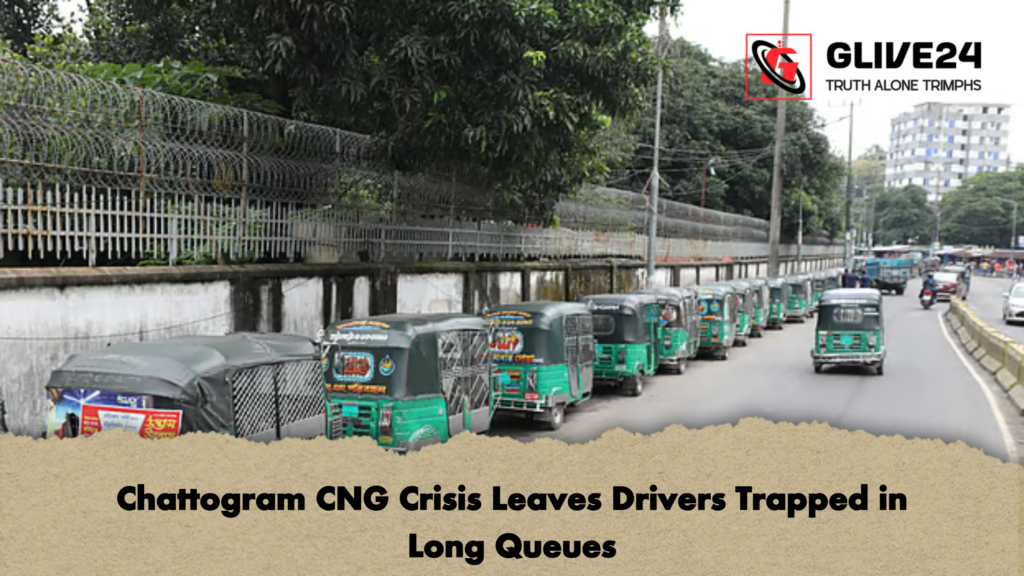
Drivers of CNG-powered auto-rickshaws, minibuses and microbuses in Chattogram are facing an increasingly difficult daily struggle as severe gas shortages force them to spend hours waiting at filling stations instead of carrying passengers.
For many drivers who begin work before dawn and depend on daily earnings to support their families, the disruption has become a serious financial setback. Long queues are reducing the number of hours they can spend on the road, cutting their income while leaving fixed expenses—including daily payments to vehicle owners, food, fuel-related costs and household bills—largely unchanged.
A typical CNG-powered vehicle driver may spend 10 to 12 hours working on the road each day. When five or six of those hours are consumed by waiting for gas, almost half of the working day can disappear without any income being generated. The impact is being felt beyond the drivers themselves. With fewer vehicles available during busy periods, passengers are facing longer waits and, in some cases, the possibility of higher fares as drivers attempt to recover mounting operating costs.
The situation was evident at around 10am on Tuesday outside the Paharika CNG filling station in the Akbar Shah area of the city. Auto-rickshaw driver Abu Tayeb said he had been waiting in the queue since 4am. More than five hours had passed, yet he had still not been able to refuel. He had spent the previous night inside his vehicle and had breakfast at a nearby hotel that morning. Even that modest expense, however, had become a source of concern because he was uncertain whether his earnings for the day would be enough to cover it.
Hundreds of other drivers are reportedly experiencing similar difficulties. Long queues resembling traffic congestion have been seen outside several CNG filling stations, including those in Paharika and Foysal areas of Sholashahar. Some drivers have been waiting for four hours, others for five or six. Even after finally obtaining gas, several drivers have complained that they are not receiving enough fuel to meet their normal requirements.
Mohammad Abul Kashem, who was waiting at the Paharika station, said he had spent nearly eight hours in the queue the previous day before getting gas. After driving for only about two hours, the fuel had run out. He returned to the station at 6am the following morning and once again found himself facing an uncertain wait.
Drivers at the Foysal filling station said that under normal circumstances they could refuel and return to the road within 20 to 30 minutes. The waiting time has now stretched to several hours. That reduction in productive driving time is directly affecting their earnings, with many unable to come close to their usual daily income.
The financial pressure is also being felt by drivers of larger passenger vehicles. Mohammad Nahid, who drives a minibus on the Chattogram-Fatehabad route, said his earnings had fallen sharply over the previous two days. On a normal day, he could earn between Tk1,500 and Tk2,000. The previous day, however, he returned home with only Tk600. He feared that another prolonged wait at a filling station would further reduce his earnings.
Drivers who operate vehicles under daily rental or deposit arrangements are particularly vulnerable. They must pay a fixed amount to the vehicle owner regardless of how much they earn during the day. At the same time, household expenses such as food, rent, children’s education and other essential costs continue. With income falling but expenditure remaining largely unchanged, some drivers are being forced to borrow money to manage their households, while others are trying to work longer hours whenever gas becomes available.
The disruption could also place additional pressure on passengers. If drivers attempt to compensate for lost income and higher operating costs by charging more, commuters may face increased transport expenses. A shortage of vehicles during peak hours could also lengthen journeys and waiting times, creating further difficulties for office workers, students and other regular passengers.
Transport-sector observers say the gas shortage is therefore not merely an issue affecting individual drivers. It is also disrupting the wider public transport network in Chattogram. Vehicles spending several hours at filling stations are unavailable during crucial periods of the day, reducing the number of buses and auto-rickshaws actively serving passengers. If the shortage persists, the pressure on the city’s already busy transport system could intensify.
The wider gas crisis in Chattogram has been linked to a fire at a floating LNG terminal in Maheshkhali. The terminal, operated by Excelerate Energy, caught fire on 21 July, after which gas supplies to the national grid fell significantly. The disruption subsequently affected gas distribution across the Chattogram region. Until the damaged terminal is fully restored, a rapid resolution to the supply shortage appears unlikely, according to officials familiar with the situation.
Data from Karnaphuli Gas Distribution Company Limited (KGDCL) show the scale of the shortfall. In the 24 hours up to 8am on Tuesday, the company received around 190 million cubic feet of gas, against daily demand of approximately 350 million cubic feet. That represents a deficit of about 160 million cubic feet. The company received a similar volume of gas during the preceding 24-hour period.
Under normal conditions, KGDCL’s gas supply is distributed among several major sectors, including power generation, industry, residential consumers and CNG stations. Daily demand is estimated at around 150 million cubic feet for power plants, 90 million cubic feet for industrial facilities, 60 million cubic feet for residential consumers and 50 million cubic feet for the CNG sector. With such a substantial supply gap, however, the company is unable to meet the full requirements of any sector.
A senior KGDCL official said the reduced supply from the national grid meant that gas had to be distributed among different sectors in line with allocations from Petrobangla. As a result, it was not possible to satisfy all sectors simultaneously. Repair work was under way at the affected LNG terminal, with a team of specialists working to restore the facility and improve the overall supply situation.
Officials hope that gas supplies could return to normal within the week. Until then, however, the uncertainty facing CNG-dependent transport workers is likely to continue.
For drivers living on daily earnings, every additional hour spent in a filling-station queue represents more than lost time. It is a lost opportunity to earn money. When that lost working time is multiplied across hundreds of drivers and several days, the consequences extend beyond individual households to the city’s transport network and its passengers. The immediate priority, therefore, is not only restoring adequate gas supplies but also reducing the disruption that has left drivers waiting for hours simply to get back to work.