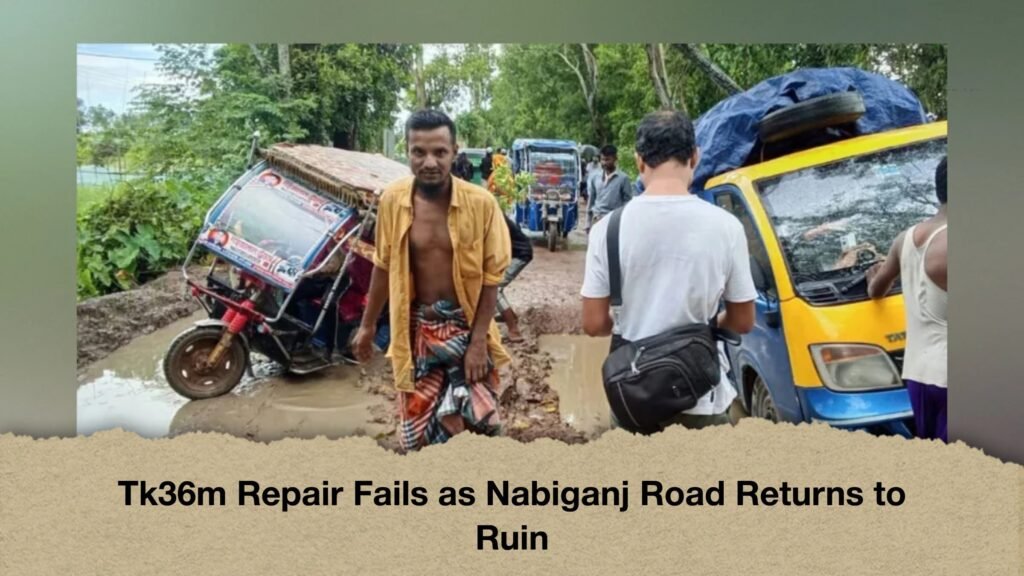
A Tk36 million repair project on a key road in Habiganj’s Nabiganj upazila has deteriorated badly, with the work reportedly failing within just three months of completion.
The 17-kilometre Kajiganj Bazar-Markuli road, which serves as a major route connecting the upazila’s haor and low-lying areas, is now riddled with potholes and uneven surfaces. The road was repaired about a year ago at a cost of Tk36 million, but local residents say the work largely involved filling existing potholes with broken brick and rubble. Much of that material has since washed away or been displaced by traffic, leaving the road in almost the same condition as before.
During the monsoon, the situation becomes particularly hazardous. Rainwater accumulates in the potholes, some of which are difficult to identify from the surface. Drivers are therefore forced to navigate the road without knowing the depth of the submerged holes, increasing the risk of accidents.
More than 30,000 people from at least two unions depend on the road for daily travel, according to local sources. Hundreds of vehicles, including CNG-powered auto-rickshaws, battery-powered easy-bikes, trucks, pick-up vans, motorcycles and ambulances, use the route regularly.
Residents say the poor condition of the road has disrupted both passenger and emergency transport. After rainfall, water-filled potholes can become so extensive that vehicles struggle to pass through some sections. In some cases, passengers reportedly have to pay substantially higher fares to secure transport, while vehicles may be unavailable altogether.
The difficulties are especially serious for patients requiring urgent medical attention. Taking a patient to a health facility in Nabiganj or to the district headquarters can become a lengthy and uncomfortable journey because vehicles have to move slowly through the damaged sections.
Residents of Purba Bara Bhakoi and Paschim Bara Bhakoi unions said travelling on the road has become a matter of considerable concern. They claimed that vehicles frequently break down and accidents occur at different points along the route.
Akhtar Hossain Chuba, chairman of Kajiganj Bazar Union Parishad, described the condition of the road as extremely poor. He said the large potholes make it appear as though parts of the road had been dug out for fish cultivation. According to him, the road was repaired with bricks about a year ago, but the improvement lasted no more than three months.
Former Nabiganj upazila chairman Mujibur Rahman Shefu also called for urgent action. He said water accumulates in the potholes during the monsoon, at times making sections of the road resemble a river. This causes serious difficulties for both people and vehicles. He also claimed that the poor communication system has created wider social problems for residents of the area, including difficulties surrounding marriage arrangements for young people.
The repeated deterioration has also raised questions among residents about the effectiveness and durability of short-term road repairs. Filling potholes can provide temporary relief, but such measures are unlikely to withstand heavy traffic and prolonged monsoon conditions if the underlying road structure remains damaged.
The road is particularly significant for communities that rely on it to travel for work, education, healthcare, trade and other essential activities. Its poor condition therefore affects more than transport alone, placing an additional burden on residents who have limited alternative routes.
Nabiganj Upazila Engineer Mir Sabbir Ahmed said a proposal had been sent to the relevant authorities seeking prompt repairs to the important road.
For residents, however, the immediate concern remains when a lasting solution will be implemented. After a Tk36 million repair effort failed within months, they are calling for a durable reconstruction of the damaged sections rather than another short-lived measure.