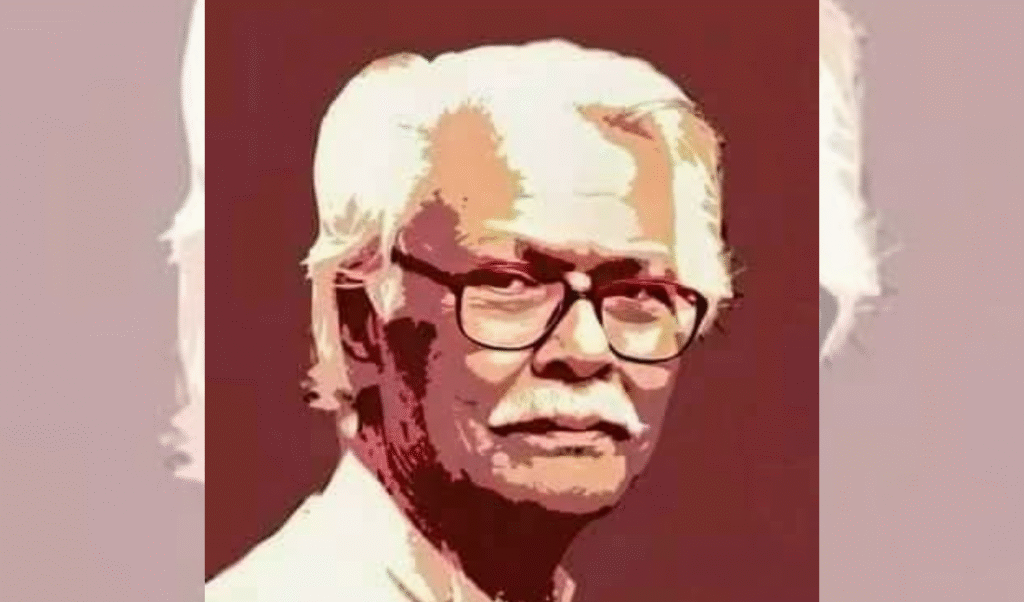
When the Pakistani rulers struck brutally at the Bengali language, threatening the very existence of the people, young art student Imdad Hossain realised that suppressing a language meant destroying a culture. From this profound understanding, his art, his intellect and his struggles gradually turned towards awakening the cultural consciousness of the masses.
He was born on 21 November 1926 in Chandpur, at his father’s workplace. His childhood, however, was spent in Rohitpur of Keraniganj, where lay his roots, family and early education. Later, he enrolled at Dhaka Art College—now the Faculty of Fine Arts at the University of Dhaka—as a student of its first batch. His contemporaries included legendary artists such as Hamidur Rahman and Khaled Chowdhury. This artistic environment shaped him into a progressive, aware and determined artist.
From the Language Movement to the Liberation War—an unbroken journey of struggle
During the turbulent days of the Language Movement, he not only took to the streets but also proposed adding a red sun behind the main columns of the Shaheed Minar design. This design, symbolising respect for the language martyrs and the spirit of Bengali identity, emerged from his thoughtful insight.
As a member of the All-Party State Language Action Committee in 1952, he was directly involved in organising the movement. During the communal riots of 1950, he formed a volunteer force and played a crucial role in Keraniganj. His active participation in the 1969 mass uprising and the formation of the Charushilpi Sangstha with patua Kamarul Hasan remain important milestones of his activist life.
During the Liberation War, his home in Keraniganj served as a shelter for freedom fighters. With his strong associations in left-oriented politics, his home also became a centre for secret meetings.
Architect of cultural revival
Imdad Hossain is one of the key figures responsible for popularising Bengali festive culture in urban life. His contributions to establishing Pohela Boishakh, Nabanna, Barshamangal and Basantotsab as major cultural events are especially noteworthy. He is credited with naming the “Mangal Shobhajatra” that originates from Dhaka University.
As a student, he became self-reliant by drawing book covers and working on various artistic projects. He later served as the chief designer of Pakistan Television’s Dhaka centre, a senior lecturer at the IER of the University of Dhaka, and after independence, joined Bangladesh Television in 1972. The current logo of BTV was designed by him.
Along with friends, he founded the publishing house “Muktadhara,” which played a significant role in promoting literature and culture.
Artist, activist, organiser—an unforgettable figure
Imdad Hossain embodied the combination of artist, designer, language activist, freedom fighter, cultural organiser and social thinker. His life represents a quiet yet tireless struggle—a luminous symbol of resistance against inequality and injustice.
He passed away on 13 November 2011. Yet his art, ideas and cultural journey continue to guide and inspire.
Imdad Hossain will be remembered forever as a beacon of Bengal’s cultural awakening.
SS