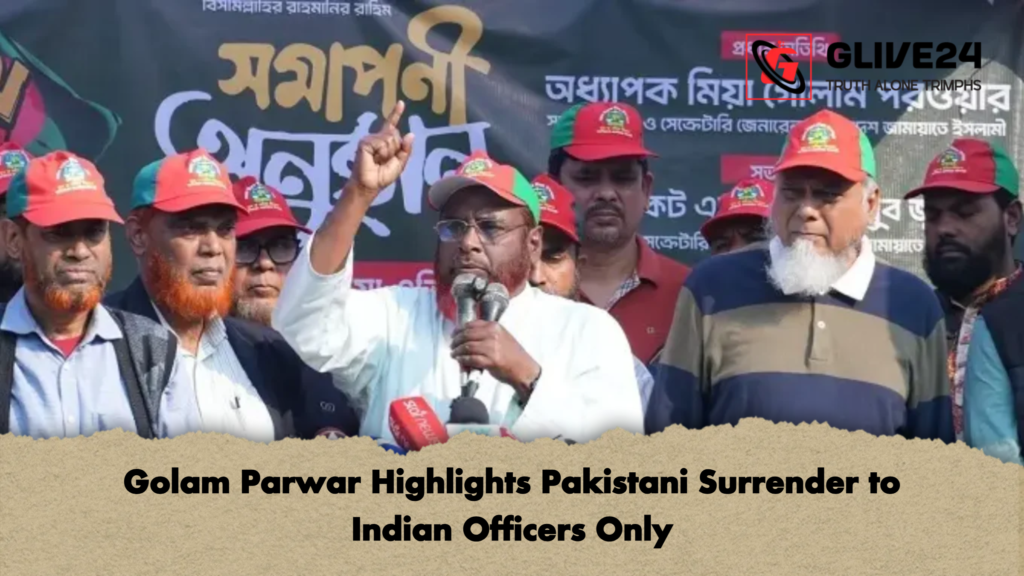
Professor Mia Golam Parwar, speaking at a Victory Day event on 16 December, claimed that India’s intervention in Bangladesh’s liberation war was motivated by revenge for the 1965 conflict with Pakistan rather than a genuine commitment to Bangladesh’s independence. He asserted that India’s support was strategically designed to strengthen its own influence in the region, with plans to utilise the Awami Baksal to consolidate political and economic control. This, he argued, was ultimately countered by the August Revolution, which restored Bangladesh’s independence and ended external interference.
Parwar emphasised the historical importance of 16 December, noting that the Pakistani military’s formal surrender occurred before Indian commanders rather than the Bangladeshi liberation forces. He criticised India for celebrating this date as its Victory Day, which, in his view, disrespects the contributions of Bangladesh’s freedom fighters. “The Suhrawardy Udyan, where the Pakistani forces surrendered, should have been a moment of national pride,” Parwar stated. “Instead, foreign intervention and local collaborators prevented Bangladesh from fully claiming the triumph of liberation.”
He further highlighted that General Osmani, supreme commander of the liberation forces, was absent from the surrender ceremony, a fact that remains unexplained. The surrender to Indian officer Jagjit Singh Arora, Parwar noted, symbolises the political complexities surrounding Bangladesh’s independence and underscores the challenges the nation faced in asserting full sovereignty.
Regarding the recent attack on Osman Hadi, Parwar condemned the act as part of a premeditated plot against freedom fighters and potential parliamentary candidates. Hadi, a revered figure in the national consciousness, was targeted just one day after the election schedule was announced, indicating a broader strategy to disrupt the electoral process. He stressed the urgent need for robust security measures for all political leaders, particularly those with a history of involvement in the liberation struggle.
The Victory Day gathering, held in front of the National Parliament, featured numerous senior Jamaat-e-Islami officials. Dr Fakhruddin Manik moderated the event, while central Majlis-e-Shura members, regional representatives, and parliamentary candidates addressed the assembly. The event combined commemorations of historical sacrifice with contemporary political warnings, highlighting ongoing security and sovereignty concerns.