Bangladesh’s banking sector is witnessing stark contrasts in the handling of non-performing loans (NPLs). According to the latest September data from Bangladesh Bank, 17 banks have impressively kept their NPL ratios below 10%, highlighting effective loan management amid sector-wide challenges.
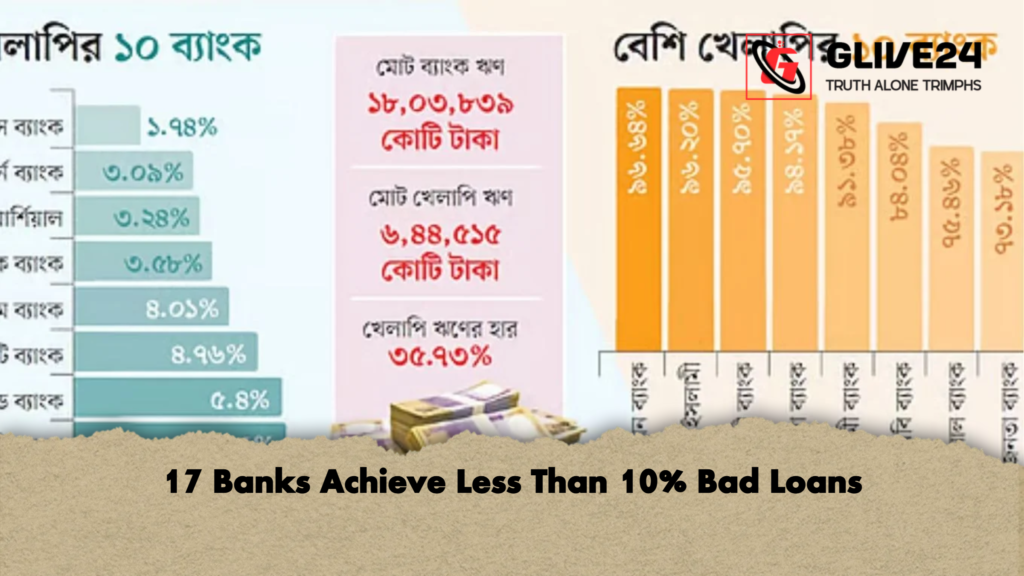
The sector had faced a surge in defaulted loans under the previous government, with NPLs exceeding 12% by June last year. Many loans had been artificially concealed through concessions and regulatory gaps. The subsequent change in government revealed the true scale of defaulted loans, causing an immediate spike in reported NPLs to over 36% of total loans by September.
Yet, a group of banks has maintained exemplary performance. Citizens Bank, a relatively new institution, tops the list with a mere 1.74% of loans in default. Eastern Bank and Bengal Commercial follow closely at 3.09% and 3.24% respectively. Brac Bank, Prime Bank, and City Bank also demonstrate strong credit control with NPLs under 5%.
Brac Bank Managing Director Tarek Refaat Ullah Khan said, “We operate with full professionalism. Our risk and loan management teams are robust, and we actively assist clients facing difficulties. This proactive approach ensures our NPLs remain minimal.” City Bank MD Masrur Arefin emphasised their decentralised loan approval process, with a 30% corporate loan portfolio and diverse retail lending, keeping bad loans under control.
Other banks performing well include Midland Bank (5.40%), Pubali Bank (5.50%), Meghna Bank (6.11%), Mutual Trust Bank (6.83%), Community Bank (7.07%), Shahjalal Islami Bank (7.67%), NCC Bank (8.31%), Dhaka Bank (8.44%), Uttara Bank (8.91%), Trust Bank (8.95%), and Jamuna Bank (9.06%). Prime Bank’s DMD Ziaur Rahman expects NPLs to fall below 3% by December with ongoing recovery and monitoring strategies.
Conversely, some banks continue to face massive default challenges, particularly Islamic banks that suffered heavily during the previous administration. Union Bank’s NPL stands at 96.64%, First Security Islami Bank at 96.20%, and Global Islami Bank at 95.70%. Several banks, including Exim and Social Islami, have been merged into Combined Islami Bank to stabilise the sector.
Bangladesh Bank Executive Director Arif Hossain Khan noted, “Accurate reporting has revealed the true scale of NPLs. While sector-wide defaults have risen, many banks are showing resilience, and ongoing initiatives are expected to gradually reduce the overall NPL ratio.”