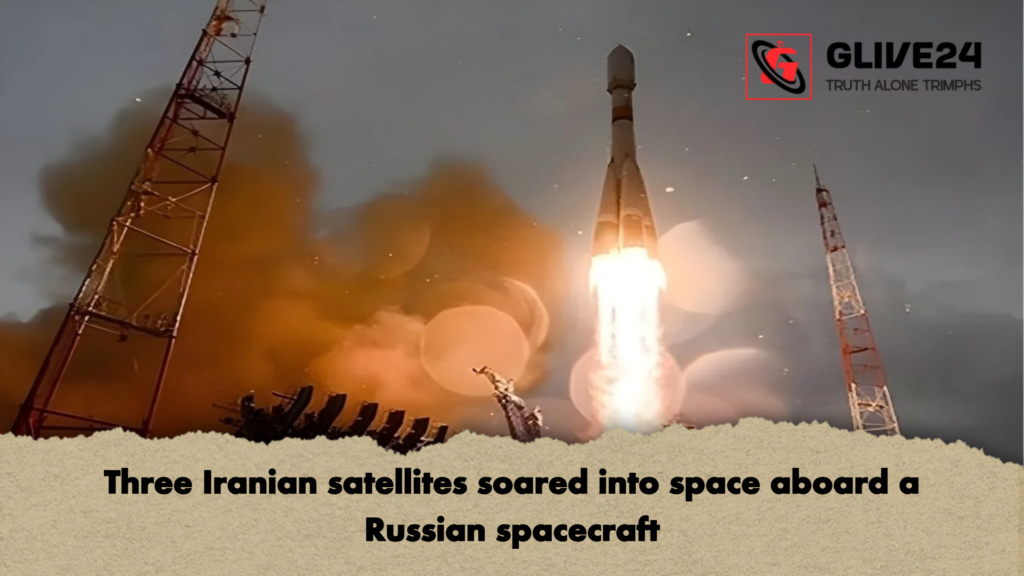
Iran has successfully placed three domestically developed remote-sensing satellites into orbit using a Russian launch vehicle. The Soyuz satellite-carrying rocket was launched on Sunday, 28 December, at 16:48 local time in Tehran.
The mission included multiple payloads, among which were Iran’s Jafar-2, Paya, and Kawsar satellites. Iranian officials confirmed that the satellites were launched from Russia’s Vostochny Cosmodrome as part of a multi-payload mission. This marks the seventh time Iran has utilised Russian rockets for its satellite launches.
Before the launch, Iran’s ambassador to Moscow, Kazem Jalali, described the mission as a significant advancement for Iran’s space programme. Posting on social media platform X, Jalali emphasised that the satellites were entirely designed and manufactured domestically, attributing the success to collaboration between government agencies, universities, and knowledge-based private companies.
He further clarified that while the design and construction of the satellites were completed in Iran, the launch was conducted in cooperation with Russia. Jalali also highlighted that two of the satellites belong to the government sector, while one represents the private sector, with active participation from knowledge-driven companies and academic institutions.
Satellite Details:
| Satellite Name | Developer/Institution | Purpose/Capabilities | Notable Features |
|---|---|---|---|
| Jafar-2 | Iran University of Science and Technology | Natural resource monitoring, environmental assessment, disaster management, mapping | Advanced imaging for comprehensive earth observation |
| Paya (Tolu-3) | Iranian Space Agency | Earth observation | Heaviest Iranian satellite to date (~150 kg) |
| Kawsar | Iranian Space Agency | Internet of Things (IoT) support, smart observation systems | Improved version of previous Kawsar and Hoduhood satellites, enables real-time data exchange |
Jafar-2 will provide vital data for natural resource monitoring, environmental condition assessment, disaster management, and cartography. Paya, developed by the Iranian Space Agency, is Iran’s heaviest Earth observation satellite to date, weighing approximately 150 kilograms. Kawsar is an enhanced version of the previous Kawsar and Hoduhood satellites and comes equipped with Internet of Things (IoT) capabilities, enabling real-time data transmission for smart observation systems.
Iran first entered the space arena in 2009 with the launch of the Omid (Hope) satellite. Despite ongoing Western sanctions, Tehran has steadily expanded its civilian space programme, demonstrating significant technological progress in satellite design and deployment.