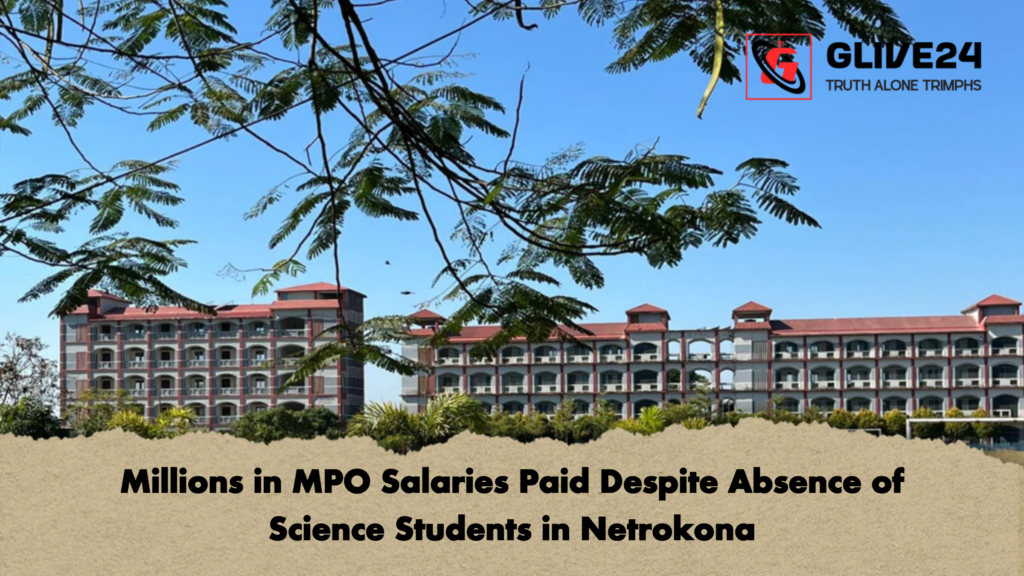
Netrokona’s education system is facing a critical crisis in the science stream, which now appears to exist largely on paper. While students continue to enrol in other subjects at the secondary level, the number pursuing science at higher secondary level has plummeted sharply. Classrooms remain empty, laboratories are locked, and equipment is rusting, yet MPO-funded teachers and staff continue to receive their full salaries, leading to the annual waste of millions of taka in government funds.
Investigation reveals that out of 45 colleges in the district, 11 are government-run, 19 are MPO-affiliated, and 15 are non-MPO. Among the MPO-affiliated institutions, seven colleges have no science department at all.
For the upcoming 2026 HSC examinations, government and MPO-affiliated colleges will have 6,801 regular candidates, but only 908 students are enrolled in the science stream—less than one-sixth of the total. Meanwhile, 136 science teachers are employed across 23 colleges, creating a stark imbalance. In 11 of these colleges, student numbers are fewer than 10, and one college currently has no students at all. This pattern has persisted over the past three years. Despite this, the annual expenditure on science departments in these colleges exceeds two crore taka.
Many students are shifting from science to humanities or commerce after secondary education. The reasons include fear of mathematics and physics, inadequate laboratories, extra costs, parental financial constraints, and a shortage of qualified teachers. Humanities and commerce streams are now considered a safer and more popular option.
A closer look at student-teacher distribution in selected colleges illustrates the severity:
| College Name | Science Students | Science Teachers |
|---|---|---|
| Mohanganj Shaheed Smriti College | 0 | 4 |
| Mohanganj Women’s College | 2 | 5 |
| Madan Government Aziz Khan College | 7 | 5 |
| Chandranath College | 5 | 5 |
| Hena Islam College | 5 | 4 |
| Atpara Degree College | 2 | 5 |
Remarkably, half of the district’s science students come from just two colleges: Netrokona Government College and Netrokona Government Women’s College, which together enrol 530 students.
Laboratory conditions in many colleges are dire: equipment is damaged, labs are locked, or there are no teachers available to conduct practical sessions. The Ministry of Education’s 2021 policy mandates a minimum of 20 students per science department, but enforcement has yet to be seen.
Experts stress that to reverse this decline, initiatives are needed including career counselling from secondary school, modern lab facilities, scholarships for disadvantaged students, teacher training, and redistribution of teachers from student-less colleges.
Several principals blame local political influence, which ensures MPO status for most colleges. Any attempt to reduce teaching staff, even where students are absent, is met with political pressure.
Shaila Parveen Shraboni, a student of Computer Science and Engineering at Netrokona University, warns that if science education continues to decline in rural areas, the country will face a shortage of qualified students for higher education, with consequences for technology-driven industries, healthcare, engineering, and research.
Netrokona Government College principal Md. Abu Taher Khan stated:
“Science enrolment at upazila-level colleges is almost zero. Departments with no students should be merged into other colleges to prevent government fund wastage.”
A.K.M. Alif Ullah Ahsan, Director of Moulvibazar MASHI (Moymon Singh region), added that while MPO teachers cannot yet be transferred, measures will be proposed to reduce wasteful spending and encourage proper student enrolment in these colleges.